Offshore wind projects face economic storm. Cancellations jeopardize Biden clean energy goals
Advertisement
Read this article for free:
or
Already have an account? Log in here »
To continue reading, please subscribe:

Digital Subscription
One year of digital access for only $205*
- Enjoy unlimited reading on winnipegfreepress.com
- Read the E-Edition, our digital replica newspaper
- Access News Break, our award-winning app
- Play interactive puzzles
*First annual payment billed as $205.00 + GST for one year. This annual subscription will automatically renew at $233.00 + GST every 52 weeks (10% off the regular annual price of $259.35). Offer available to new and qualified returning subscribers only. Cancel any time.
To continue reading, please subscribe:
Add Free Press access to your Brandon Sun subscription for only an additional
$1 for the first 4 weeks*
- Enjoy unlimited reading on winnipegfreepress.com
- Read the E-Edition, our digital replica newspaper
- Access News Break, our award-winning app
- Play interactive puzzles
*Your next Brandon Sun subscription payment will increase by $1.00 and you will be charged $17.95 plus GST for four weeks. After four weeks, your payment will increase to $24.95 plus GST every four weeks.
Read unlimited articles for free today:
or
Already have an account? Log in here »
Hey there, time traveller!
This article was published 04/11/2023 (1044 days ago), so information in it may no longer be current.
WASHINGTON (AP) — The cancellation of two large offshore wind projects in New Jersey is the latest in a series of setbacks for the nascent U.S. offshore wind industry, jeopardizing the Biden administration’s goals of powering 10 million homes from towering ocean-based turbines by 2030 and establishing a carbon-free electric grid five years later.
The Danish wind energy developer Ørsted said this week it’s scrapping its Ocean Wind I and II projects off southern New Jersey due to problems with supply chains, higher interest rates and a failure to obtain the amount of tax credits the company wanted. Together, the projects were supposed to deliver over 2.2 gigawatts of power.
The news comes after developers in New England canceled power contacts for three projects that would have provided another 3.2 gigawatts of wind power to Massachusetts and Connecticut. They said their projects were no longer financially feasible.
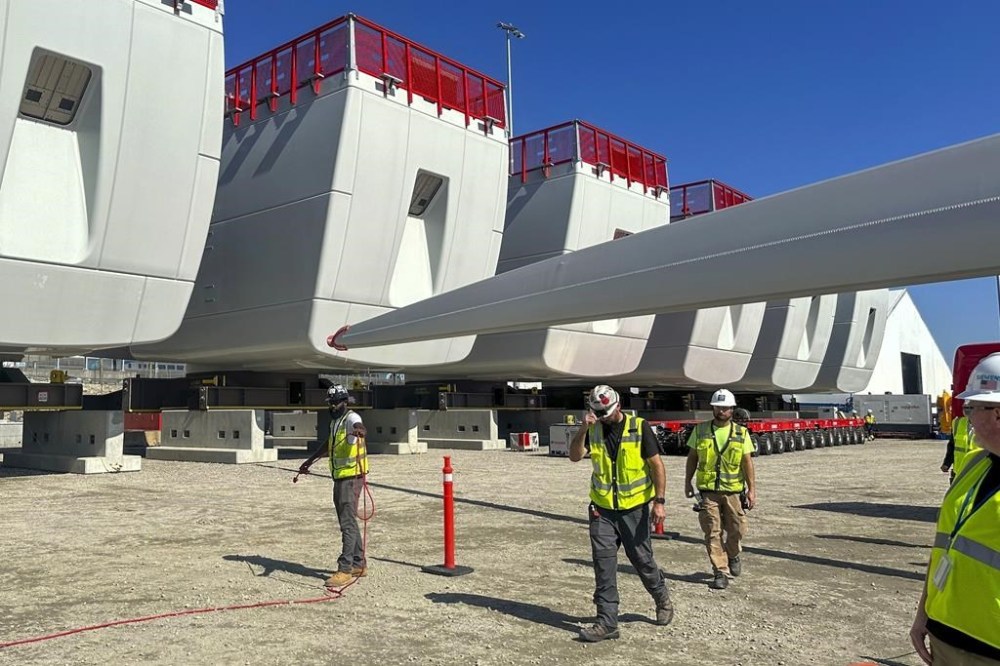
In total, the cancellations equate to nearly one-fifth of President Joe Biden’s goal of 30 gigawatts of offshore wind power by 2030.
Despite the setbacks, offshore wind continues to move forward, the White House said, citing recent investments by New York state and approval by the Interior Department of the nation’s largest planned offshore wind farm in Virginia. Interior’s Bureau of Ocean Energy Management also announced new offshore wind lease areas in the Gulf of Mexico.
“While macroeconomic headwinds are creating challenges for some projects, momentum remains on the side of an expanding U.S. offshore wind industry — creating good-paying union jobs in manufacturing, shipbuilding and construction,″ while strengthening the power grid and providing new clean energy resources for American families and businesses, the White House said in a statement Thursday.
Industry experts now say that while the U.S. likely won’t hit 30 gigawatts by 2030, a significant amount of offshore wind power is still attainable by then, roughly 20 to 22 gigawatts or more. That’s far more than the nation has today, with just two small demonstration projects that provide a small fraction of a single gigawatt of power.
Large, ocean-based wind farms are the linchpin of government plans to shift to renewable energy, particularly in populous East Coast states with limited land for wind turbines or solar arrays. Eight East Coast states have offshore wind mandates set by legislation or executive actions that commit them to adding a combined capacity of more than 45 gigawatts, according to ClearView Energy Partners, a Washington-based research firm.
“I think very few people would argue that the U.S. will have the gigawatts the Biden administration wants″ by 2030, said Timothy Fox, a ClearView vice president. “But I do think eventually we will have it and will likely exceed it.”
Offshore wind developers have publicly lamented the global economic gales they’re facing. Molly Morris, president of U.S. offshore wind for the Norwegian company Equinor, said the industry is facing a “perfect storm.”
High inflation, supply chain disruptions and the rising cost of capital and building materials are making projects more expensive while developers are trying to get the first large U.S. offshore wind farms opened. Ørsted is writing off $4 billion, due largely to cancellation of the two New Jersey projects.
David Hardy, group executive vice president and CEO Americas at Ørsted, said it’s crucial to lower the levelized cost of offshore wind in the United States so Americans aren’t debating between affordability and clean energy. Hardy spoke at the American Clean Power industry group’s offshore wind conference in Boston last month on a panel with Morris.
“We’re probably a little bit too ambitious,” he said. “We came in hot, we came in fast, we thought we could build projects that were inexpensive, large projects right out of the gate. And it turns out that we probably still need to go through the same learning curve that Europe did, with higher prices in the beginning and a little slower pace.”
In May, there were 27 U.S. offshore wind projects that had negotiated agreements with states to provide power before the brunt of the cost increases hit, according to Walt Musial, offshore wind chief engineer at the National Renewable Energy Laboratory, an arm of the Energy Department. The delay between signing purchase agreements and getting final approval to build allowed unexpected cost increases to render many projects economically unfeasible, he said.
Musial called Ørsted’s announcement a setback for the industry but “not a fatal blow by any means.”
On Tuesday, the Biden administration announced approval of the nation’s largest offshore wind project. The Coastal Virginia Offshore Wind project will be a 2.6 gigawatt wind farm off of Virginia Beach to power 900,000 homes. And even as Ørsted announced the New Jersey cancellations, it said it was investing with utility Eversource to move forward with construction of Revolution Wind, Rhode Island and Connecticut’s first utility-scale offshore wind farm, a 704-megawatt project.
The current outlook from S&P Global Commodity Insights is 22 gigawatts by 2030, though that will be revised due to the recent industry announcements.
New York state, meanwhile, recently announced the award of 4 gigawatts of offshore wind capacity as it seeks to obtain 70% of its electricity from renewable sources by 2030 and 9 gigawatts of offshore wind by 2035. That announcement came shortly after New York regulators rejected a request for bigger payments for four offshore wind projects worth a combined 4.2 gigawatts of power. Those developers said they were assessing the viability of their projects.
Any delay in offshore wind means continued reliance on fossil fuel-burning power plants, according to environmental advocates.
“The quicker they come online, the quicker our air quality improves,” said Conor Bambrick, director of policy for Environmental Advocates NY.
New Jersey, under Democratic Gov. Phil Murphy, has established increasingly stringent clean energy goals, moving from 100% clean energy by 2050 to 100% by 2035. Murphy cast Ørsted’s decision as “outrageous” and an abandonment of its commitments, but the two-term Democrat said New Jersey plans to move forward with offshore wind. Additional offshore projects are pending before the state’s utility regulators.
“We definitely remain optimistic,” said Catherine Klinger, Murphy’s climate action and green economy executive director. “Offshore wind is a lot bigger than Ørsted.”
The first U.S. commercial-scale offshore wind farms are currently under construction: Vineyard Wind off Massachusetts and South Fork Wind off Rhode Island and New York.
Catherine Bowes, a senior director at Turn Forward, a nonprofit that advocates for offshore wind, believes the industry still has strong momentum because of the quality of the wind resources off the coastlines and the growing demand for clean electricity to meet decarbonization goals. The nonprofit is advocating for 100 gigawatts of U.S. offshore wind power.
“The bumpiness we’re seeing right now in no way indicates an inability of offshore wind to play a major role in the U.S. electric grid,″ Bowes said Thursday.
Terminated contracts can be rebid, presumably with higher prices to cover development costs. Offshore wind developers are asking the federal government to ensure the industry can take advantage of tax credits under the Inflation Reduction Act to help these first projects become operational.

Michael Brown, CEO of Ocean Winds North America, which is developing several offshore projects, including one in New Jersey, said at the clean power conference that the industry will thrive in the U.S. but “it might be a little bit slower than we all want it.”
___
McDermott reported from Providence, Rhode Island; Hill from Albany, New York and Catalini from Trenton, New Jersey.
___
Associated Press climate and environmental coverage receives support from several private foundations. See more about AP’s climate initiative here. The AP is solely responsible for all content.