Few community college students go on to earn 4-year degrees. Some states have found ways to help

Advertisement

Advertise with us

After delaying college for two years because of the COVID-19 pandemic, Jaden Todd wasn’t sure a four-year school was the right place to start.

Read this article for free:


or

Already have an account? Log in here »

To continue reading, please subscribe:

Subscribe and receive a limited-edition Free Press branded hat or tote.

Digital Subscription

One year of digital access for only $205*

  • Enjoy unlimited reading on winnipegfreepress.com
  • Read the E-Edition, our digital replica newspaper
  • Access News Break, our award-winning app
  • Play interactive puzzles

*First annual payment billed as $205.00 + GST for one year. This annual subscription will automatically renew at $233.00 + GST every 52 weeks (10% off the regular annual price of $259.35). Offer available to new and qualified returning subscribers only. Cancel any time.

To continue reading, please subscribe:

Add Free Press access to your Brandon Sun subscription for only an additional

$1 for the first 4 weeks*

  • Enjoy unlimited reading on winnipegfreepress.com
  • Read the E-Edition, our digital replica newspaper
  • Access News Break, our award-winning app
  • Play interactive puzzles
Start now

*Your next Brandon Sun subscription payment will increase by $1.00 and you will be charged $17.95 plus GST for four weeks. After four weeks, your payment will increase to $24.95 plus GST every four weeks.

Hey there, time traveller!
This article was published 09/11/2023 (1072 days ago), so information in it may no longer be current.

After delaying college for two years because of the COVID-19 pandemic, Jaden Todd wasn’t sure a four-year school was the right place to start.

“I was extremely concerned that I forgot how to learn,” he said.

Community college appealed as a stepping stone, but he also had heard stories of students who had to start over when they transferred because their credits didn’t count at the new school.
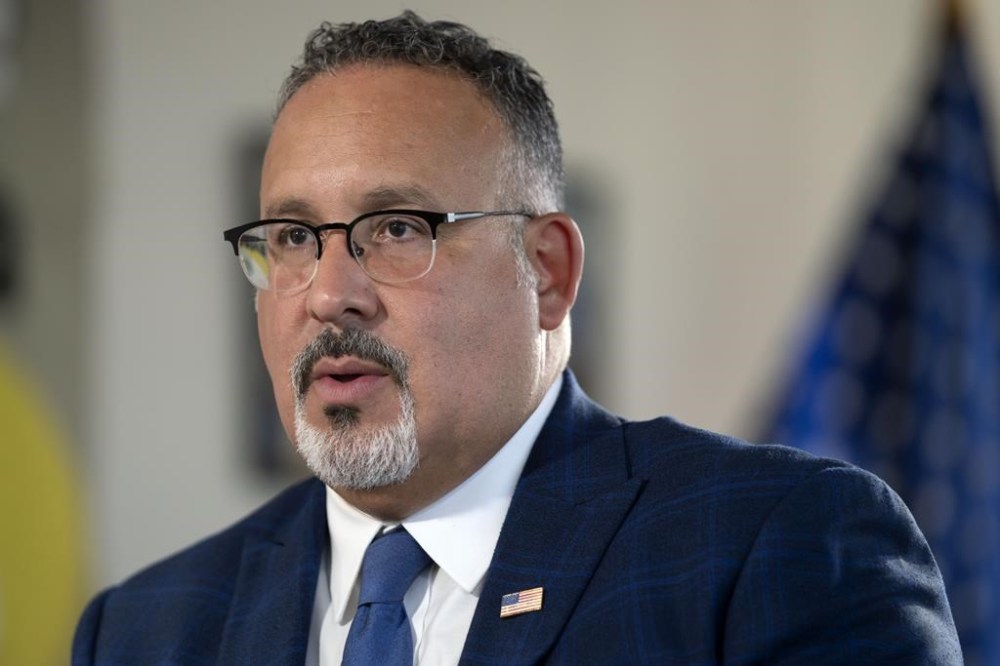
FILE - Education Secretary Miguel Cardona speaks during an interview with The Associated Press in his office at the Department of Education, Sept. 20, 2023, in Washington. Partnerships between two- and four-year colleges and universities could help more community college students go on to earn bachelor’s degrees, according to data released Thursday, Nov. 9, by the U.S. Education Department. “Our current higher education system stacks the deck against community college students who aspire to earn four-year degrees,” Cardona said. (AP Photo/Mark Schiefelbein, File)

Todd, 21, was relieved to wind up at Northern Virginia Community College’s ADVANCE program, a partnership with George Mason University that put him on a clear path to his goal of a bachelor’s degree in computer science.

Such established arrangements between two- and four-year colleges and universities have shown promise in helping more community college students go on to earn bachelor’s degrees, according to data released Thursday by U.S. Education Department.

Only 13% of federal financial aid recipients who enrolled in community college in 2014 received a bachelor’s degree within eight years, the data found.

Hundreds of thousands of those who enroll annually at the more affordable two-year schools plan to transfer to a four-year program at a college or university, but obstacles get in the way. Frequently, students lack the guidance they need to navigate the transfer, and their credits don’t transfer the way they planned.

“Our current higher education system stacks the deck against community college students who aspire to earn four-year degrees,” Education Secretary Miguel Cardona said ahead of a gathering of 200 higher education leaders convened Thursday by his department to examine state and school transfer policies.

The new data tracked roughly 620,000 federal financial aid recipients. The outcomes are especially concerning for Black, Hispanic and low-income students, who are more likely to start at community colleges.

Colleges in New Jersey, New York and Illinois graduated the most transfer students, with schools in South Dakota, Delaware, Indiana and New Mexico recording the lowest numbers.

“One of the things that I think has really played a pivotal role in transfer student success is our goal to make as much information transparent,” said Alicia Alvero, associate vice chancellor for academic and faculty affairs at the City University of New York.

CUNY relies on an online transfer explorer, known as T-Rex, that makes it easier for students to see which of their courses will transfer between campuses, Alvero said.

The State University of New York is experimenting with artificial intelligence to let students map courses between any of the community and four-year campuses in the system, said Dan Knox, a director at the National Association of System Heads, an organization of 48 public higher education systems across the country formed to advance innovation in higher education.

“At SUNY, that’s 30 community colleges and … 64 campuses in total, so the choice sets in a system that large for students are just overwhelming,” Knox said.

“It’s just very tough to map all that out manually,” he said.
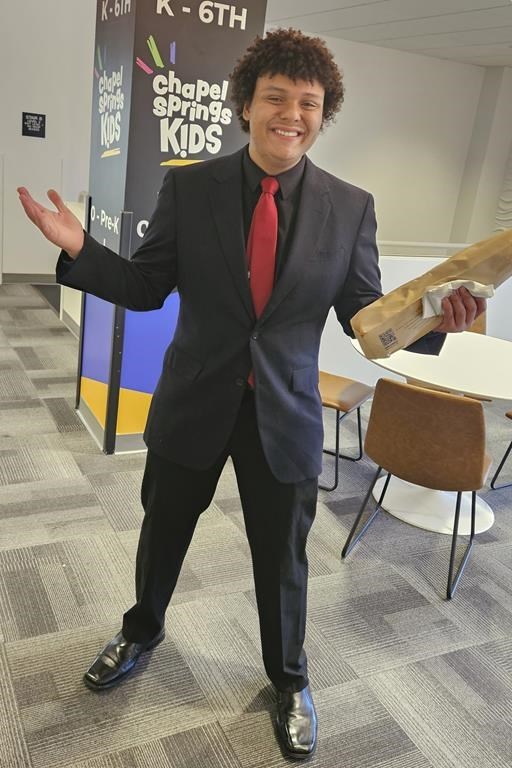
Northern Virginia Community College student Jaden Todd, 21, poses for a photo in his suit in June 2023, on campus in Annandale, VA. Todd has plans to transfer to George Mason University to finish a degree in computer science. (Matthew Todd via AP)

The Education Department data also found widely varying results when it looked at pairings between two- and four-year institutions in each state to evaluate how often community college students graduated from the four-year institutions they would most likely attend.

Among the highest-performing pairings were those with established partnerships designed to ease the transfer process, like the one at George Mason.

Todd, a 2020 high school graduate in Woodbridge, Virginia, said he liked that the co-enrollment program set from the start the classes he would take in community college and at George Mason. He’d heard of others paying thousands for tuition only to lose credits and find themselves behind when they transferred.

“I mean, I could spend $15,000 a year and want to try another college out,” he said.

Researchers said evaluating why certain pairings do better than others would help improve transfer systems as a whole. The findings are expected to guide higher education leaders who are struggling with declining enrollment and students concerned about adding to the $1.77 trillion in student loan debt.

“We have never before had national data that look at how well students do when they move among colleges and universities,” said James Kvaal, undersecretary of education, “so this study we’ve done, looking at people who get student aid, is really groundbreaking and has shed new light onto the role that both community colleges and four-year colleges play in helping their students get that college degree.”

The summit also is expected to address statewide policies such as assigning codes to courses to create consistency across schools and guaranteed admission for certain students.

___

The Associated Press education team receives support from the Carnegie Corporation of New York. The AP is solely responsible for all content.


Report Error Submit a Tip

More Stories

Convicted harasser accused of targeting old, new victims, including judge

Dean Pritchard 6 minute read Preview

Convicted harasser accused of targeting old, new victims, including judge

Dean Pritchard 6 minute read Updated: 2:48 PM CDT

Agnieszka Ciochon-Newton, who was sentenced to six years in prison for mercilessly harassing two people she believed had wronged her, as well as other crimes, wasted no time when her sentence ended to launch fresh attacks on victims new and old, including the judge who convicted her, court documents allege.

The 58-year-old former nurse was arrested last month after Winnipeg police “became aware that (Ciochon-Newton) was engaging in aggressive and harassing behaviours again, starting almost immediately upon the expiry of her parole conditions” on May 13, Det. Sgt Kylie Case wrote in search warrant documents obtained by the Free Press.

Ciochon-Newton is charged with seven counts of criminal harassment, two counts of uttering threats and one count each of fraud, breaking and entering, attempting to obstruct justice, intimidation of a justice official, mischief and defamatory libel. She remains in custody.

Search warrant documents say provincial court Judge Keith Eyrikson learned in late August that Ciochon-Newton had emailed CBC Manitoba days earlier and threatened him.

Read
Updated: 2:48 PM CDT

MPI leadership not fooling anyone by forcing PUB’s hand

Dan Lett 5 minute read Preview

MPI leadership not fooling anyone by forcing PUB’s hand

Dan Lett 5 minute read Yesterday at 1:33 PM CDT

It is not a question you will hear raised at Public Utilities Board hearings into Autopac rates, but you can bet it’s the one on most people’s minds.

When will the NDP government step in and repair leadership at Manitoba Public Insurance? For the third year in a row, MPI has limped into PUB hearings like a badly damaged vehicle that should have been written off years ago.

This week, the Crown corporation’s chief actuary admitted the 2.38-per-cent increase requested for the 2027-28 fiscal year was too low, in part because of the impact of last summer’s multiple hailstorms and the premiums MPI pays for re-insurance that protects the public insurer from surges in claims costs.

Chief actuary Cara Low said the rate application was not updated because of “uncertainty.” That is sort of like a firefighter complaining about not being able to do the job because there was too much smoke and flame.

Read
Yesterday at 1:33 PM CDT

Federal funding extension falls short: Ministers

Carol Sanders 3 minute read Preview

Federal funding extension falls short: Ministers

Carol Sanders 3 minute read 8:02 PM CDT

Provincial and territorial health ministers say a one-year extension of a 10-year $1.2 billion annual funding agreement announced by the federal health minister late Wednesday isn’t good enough.

“We are still facing an enormous fiscal cliff,” Health Minister Uzoma Asagwara, who is hosting the ministers in Winnipeg, said at a press conference Thursday at The Leaf in Assiniboine Park.

The one-year extension of funding for mental health, substance use and home and community care that was set to expire March 31, 2027 was announced by federal Health Minister Marjorie Michel, who meets with her provincial and territorial counterparts Friday.

“We welcome that first step, however, there’s a lot of work that needs to be done, a lot of engagement that needs to happen (Friday),”Asagwara said.

Read
8:02 PM CDT

Police HQ inquiry final report will be released next week: Kinew

Chris Kitching 4 minute read Preview

Police HQ inquiry final report will be released next week: Kinew

Chris Kitching 4 minute read 6:37 PM CDT

The final report of the public inquiry into the Winnipeg Police Service headquarters will be released next week, days before voters elect a mayor and city council, Premier Wab Kinew announced Thursday.

Read
6:37 PM CDT

Additional $5.4 million in federal sports funding to ease financial burdens, invest in athletes

Joshua Frey-Sam 7 minute read Preview

Additional $5.4 million in federal sports funding to ease financial burdens, invest in athletes

Joshua Frey-Sam 7 minute read Updated: 9:12 PM CDT

Skylar Park hearkens back to the same story anytime she reflects on the support she’s received throughout her career.

It’s one she can’t help but grow emotional about.

It was 2017 when Winnipeg’s prized taekwondo athlete made the World Taekwondo Grand Prix for the first time in her career. The international event, held in Moscow, Russia, featured the top 32 athletes in the world, and Park was the only Canadian.

In many ways, she felt the weight of the country on her shoulders.

Read
Updated: 9:12 PM CDT

Mayoral candidates share faves, test knowledge in Free Press culture quiz

Conrad Sweatman 5 minute read Preview

Mayoral candidates share faves, test knowledge in Free Press culture quiz

Conrad Sweatman 5 minute read Yesterday at 5:17 PM CDT

It’s been said that politics is downwind of culture. However true that is, where politicians stand on hot-button cultural debates such as artificial intelligence, whether they prefer sports over arts and what local restaurants they patronize can offer a window into their sensibilities and outlooks.

The Free Press invited the four leading mayoral candidates among decided voters — according to a recent Abacus poll — to take part in a cultural quiz. (Kevin Klein, who was polling second, did not respond.) While most of the questions are lighthearted, they speak to some of the personalities behind the heated rivalries over budgets, buses, business taxation and beyond.

What was the last book you finished?

● Scott Gillingham: I’m almost done Winnipeg author Paul Vincent Jacuzzi’s book Blind Eyes. It’s a Dalton Drake novel.

Read
Yesterday at 5:17 PM CDT