Eating less meat would be good for the Earth. Small nudges can change behavior
Advertisement
Read this article for free:
or
Already have an account? Log in here »
To continue reading, please subscribe:

Digital Subscription
One year of digital access for only $205*
- Enjoy unlimited reading on winnipegfreepress.com
- Read the E-Edition, our digital replica newspaper
- Access News Break, our award-winning app
- Play interactive puzzles
*First annual payment billed as $205.00 + GST for one year. This annual subscription will automatically renew at $233.00 + GST every 52 weeks (10% off the regular annual price of $259.35). Offer available to new and qualified returning subscribers only. Cancel any time.
To continue reading, please subscribe:
Add Free Press access to your Brandon Sun subscription for only an additional
$1 for the first 4 weeks*
- Enjoy unlimited reading on winnipegfreepress.com
- Read the E-Edition, our digital replica newspaper
- Access News Break, our award-winning app
- Play interactive puzzles
*Your next Brandon Sun subscription payment will increase by $1.00 and you will be charged $17.95 plus GST for four weeks. After four weeks, your payment will increase to $24.95 plus GST every four weeks.
Read unlimited articles for free today:
or
Already have an account? Log in here »
Hey there, time traveller!
This article was published 16/11/2023 (1035 days ago), so information in it may no longer be current.
NEW YORK (AP) — Preston Cabral eats meat nearly every day at home, but his favorite meals at school are served on “Meatless Mondays” and “Vegan Fridays.”
“Today I ate chips, tangerines and this thing that looked like chili but without the meat — just beans,” the 12-year-old said after lunch on a Friday at I.S. 318 Eugenio Maria De Hostos.
The Monday and Friday lunches have inspired Preston’s family to make more vegetarian meals at home, sparking what experts say is a healthy shift for them — and for the planet.
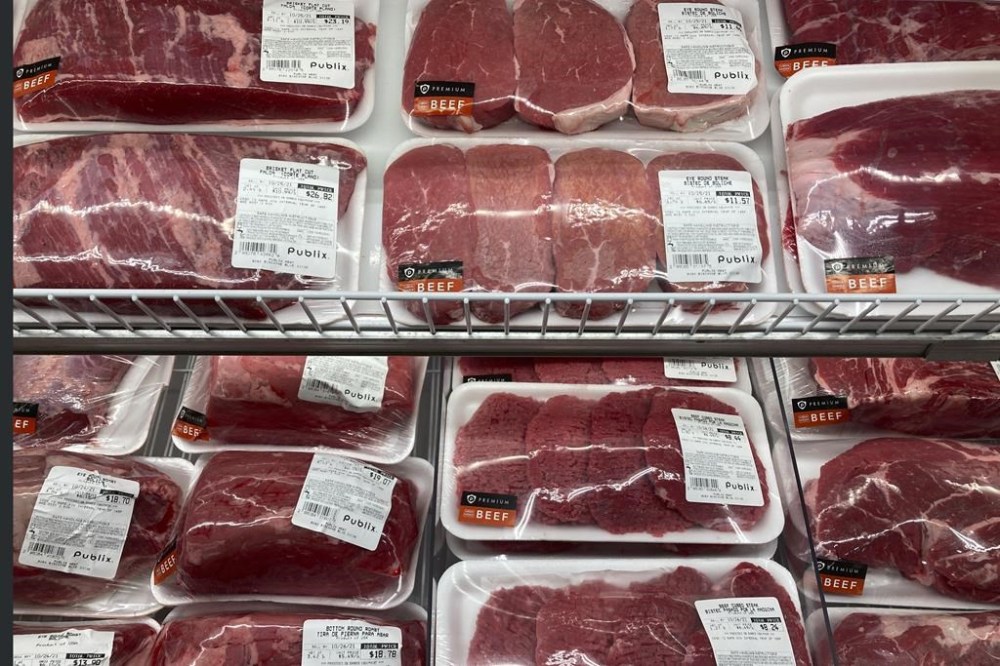
Programs like these are among the few proven to work for one of the thorniest problems of the 21st century: How to get people to eat less meat.
___
EDITORS’ NOTE — This story is part of The Protein Problem, an AP series that examines the question: Can we feed this growing world without starving the planet?
___
A new poll conducted by The Associated Press-NORC Center for Public Affairs Research found that most U.S. adults said they eat meat at least several times each week. About two-thirds (64%) said they eat chicken or turkey that often, and 43% eat beef that frequently.
But experts agree that the urgency of climate change and the demands of a surging global population call for an overhaul of how humans get their protein.
“There has arguably never been a more important time in human history to transform our food system for the sake of humans and nature,” a coalition of United Kingdom climate scientists concluded in a 2020 analysis.
That will require changing consumer behavior around meat, particularly in rich countries, experts said. From a health perspective, people in places like the U.S., Canada and Europe eat far more meat, especially red meat and processed meat, than recommended. That puts them at risk for obesity, heart disease, stroke and other problems plaguing wealthy nations.
Scientists say the average U.S. adult consumes about 100 grams of protein, mostly meat, each day — about twice the recommended amount. That adds up to more than 328 pounds of meat per person each year, including 58 pounds of poultry, 37 pounds of beef, 30 pounds of pork and 22 pounds of fish and seafood, according to the Food and Agricultural Organization of the United Nations.
At the same time, meat production is a key driver of climate change. The livestock sector is responsible for at least 14.5% of global greenhouse gas emissions and is the single greatest source of methane, a top threat to Earth’s climate, according to the Food and Agriculture Association of the United Nations.
There’s no question that cutting back on meat consumption could have real and lasting effects.
Researchers at the University of Oxford recently reported that vegans have 30% of the dietary environmental impact as people who eat high amounts of meat. Vegans produced 25% of greenhouse gas emissions and land use impact, 46% of water use, 27% of water pollution and 34% of the impact on biodiversity than the top meat-eaters.
Significantly, even low-meat diets contributed only about 70% of the environmental impact of high-meat diets, wrote Keren Papier, a co-author of the study.
“You don’t have to go full vegan or even vegetarian to make a big difference,” Papier said.
Younger people could be key. They may be open to new ways of eating because they’re more aware of climate change and the environmental costs of our current eating patterns, said Dr. Martin Bloem, an environmental health professor at the Johns Hopkins Bloomberg School of Public Health.
But he’s worried about the pace of change: “I think it goes too slow.”
Changing human behavior, especially regarding something as important and intimate as the food we eat, is challenging, no matter a person’s age.
Eating meat is an ingrained, habitual part of daily life in most parts of the world, said Julia Wolfson, who studies nutrition at Johns Hopkins University. Meat consumption is “orders of magnitude higher” in the U.S. than in low-income countries, and meals are often centered around it. She recalled a well-known advertisement from the mid-1990s that resonated across the country: “Beef: It’s What’s for Dinner.”
Besides its central role in U.S. and other cultures, there are firm perceptions that meat is necessary, especially for “young boys to grow up healthy and strong,” she said.
At the same time, research shows most people are reluctant to even learn about the negative impacts of eating meat and they’re stymied by the so-called “meat paradox.” That’s the term scientists use to describe the psychological conflict that occurs in people who like to eat meat but don’t like to contemplate the animals that died providing it.
The AP-NORC poll illustrates that conundrum.
About 8 in 10 U.S. adults said taste was an extremely or very important factor when buying food, with its cost and nutritional value following close behind. Americans are much less likely to prioritize the food’s effect on the environment (34%) or its effect on animal welfare (30%).
Despite those hurdles, certain interventions can cut meat consumption, research shows.
Stressing the connection between meat and animals seems to work. For instance, experiments that displayed photos of meat dishes on restaurant menus alongside pictures of the animals that they came from have consistently proven to reduce meat consumption, according to researchers at Stanford University.
Another strategy is to emphasize animal welfare. Research subjects exposed to information about it are more likely than control groups to buy or eat less meat or to say they intended to eat less meat, studies show.
Interventions described as “nudges,” or small choices aimed at influencing behavior, appear to be among the most effective at cutting meat consumption. Many are designed to help make healthy choices more convenient.
They can be as simple as decreasing portion sizes of meat and boosting veggies at home and in restaurants. Or they can involve positioning vegetarian offerings more prominently in grocery stores and buffet lines. In a 2021 study in the Journal of Public Health, vegetarian choices surged from as low as 2% to nearly 90% when researchers made non-meat meals the default option on conference menus.
Some nations are mulling more drastic measures. In the Netherlands, the agriculture minister proposed introducing a tax on meat, an idea that is still being debated. The city of Haarlem, outside of Amsterdam, is set to ban advertising of “industrialized meat” in public spaces starting in 2025.
Those options wouldn’t go over well in the U.S., according to the AP-NORC poll. About 7 in 10 U.S. adults said they would somewhat or strongly oppose raising taxes on the sale of meat and 43% would oppose banning public advertising for meat on government property.
Meanwhile, meat-free menu days are becoming more common, with Meatless Monday programs taking root around the world.
“Meatless Monday has had a lot of success in raising awareness and starting a conversation just about small changes that one can make that make it seem not overwhelming to people,” Wolfson said.
It seems to be working at Preston Cabral’s school. Ricardo Morales, a cook ambassador, said more kids get school lunch on Fridays than any other day of the week.

“Vegan day is just the biggest day we serve right now,” he said. “It’s bigger than hamburger and even pizza day.”
___
The poll of 1,247 adults was conducted Feb. 16-20 using a sample drawn from NORC’s probability-based AmeriSpeak Panel, which is designed to be representative of the U.S. population. The margin of sampling error for all respondents is plus or minus 3.7 percentage points.
___
The Associated Press Health and Science Department receives support from the Howard Hughes Medical Institute’s Science and Educational Media Group. The AP is solely responsible for all content.