Residents battling a new train line in northern Mexico face a wall of government secrecy
Advertisement
Read this article for free:
or
Already have an account? Log in here »
To continue reading, please subscribe:

Digital Subscription
One year of digital access for only $205*
- Enjoy unlimited reading on winnipegfreepress.com
- Read the E-Edition, our digital replica newspaper
- Access News Break, our award-winning app
- Play interactive puzzles
*First annual payment billed as $205.00 + GST for one year. This annual subscription will automatically renew at $233.00 + GST every 52 weeks (10% off the regular annual price of $259.35). Offer available to new and qualified returning subscribers only. Cancel any time.
To continue reading, please subscribe:
Add Free Press access to your Brandon Sun subscription for only an additional
$1 for the first 4 weeks*
- Enjoy unlimited reading on winnipegfreepress.com
- Read the E-Edition, our digital replica newspaper
- Access News Break, our award-winning app
- Play interactive puzzles
*Your next Brandon Sun subscription payment will increase by $1.00 and you will be charged $17.95 plus GST for four weeks. After four weeks, your payment will increase to $24.95 plus GST every four weeks.
Read unlimited articles for free today:
or
Already have an account? Log in here »
Hey there, time traveller!
This article was published 18/11/2023 (1063 days ago), so information in it may no longer be current.
MEXICO CITY (AP) — The family of Germán Robles set up a camera trap in 2002 and, to their surprise, caught a black bear wandering through their farm in northern Mexico where residents fear a new freight train line will soon bisect their properties.
The bear, spotted while Robles was in middle school, prompted the family to let a portion of their land go wild after rearing cattle for four generations.
Eventually they spotted ocelots and golden eagles, six different species of rattlesnake and a jaguar. Scientists flooded in and by 2011 the ranch was federally designated a Natural Protected Area.
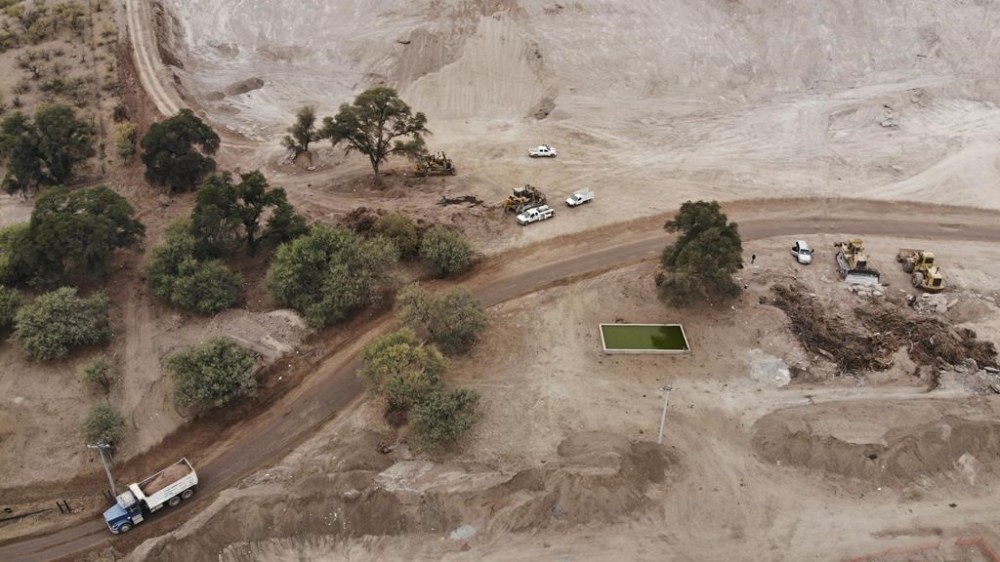
Now Robles fears the sanctuary he built with his father is in danger, as government contractors begin felling trees and bulldozing the path for the railroad toward his family’s Aribabi ranch and the town of Imuris, 40 miles (65 kilometers) south of the U.S.-Mexico border.
“Things will change completely in a matter of weeks, you know,” Robles said, adding that the project will fragment habitat his family worked hard to nurture. “It will create a kind of manmade wall that will not allow for animal species to migrate from one side to the other.”
The railroad project is billed as bolstering connections between a Pacific port and the border with Arizona. Local residents and conservationists say it ignores environmental concerns, but have had trouble fighting the project because it has been shrouded in secrecy.
In February, military officials travelled to Imuris to announce the project. Since then, there has been no official communication: no plan, consultation or environmental assessment, local residents say. The project is not mentioned on any state or federal government websites, or in Sonora state’s development plans.
Nor is it clear why the new route is necessary other than to bring the line closer to new mines owned by the rail operator’s parent company, Grupo Mexico.
Grupo Mexico, its rail subsidiary FerroMex, Sonora Gov. Alfonso Durazo’s office and Mexico’s defense department all did not respond to requests for comment about the project.
Meanwhile, construction began a few months ago on communal land north of Imuris.
The project has drawn comparisons to the much larger Maya Train project, a pet project of President Andrés Manuel López Obrador to transport tourists through the forested Yucatan peninsula. While smaller, the project in Imuris matches Obrador’s penchant for infrastructure projects with heavy military involvement and no apparent concern for the environment.
No official map of the new rail line has been published. But according to a map leaked by a local official in the spring, the project will create a second rail line for a portion of the existing route between Nogales and the port of Guaymas, this time following the Cocospera river south before cutting through the west perimeter of the Aribabi ranch and then pulling west, into Imuris.
Locals say the route rides roughshod over their farms’ irrigation canals and threatens the reservoir that provides water for the township’s 12,500 residents.
In addition to disrupting wildlife that rely on the river, construction will also cut up an important migration corridor over the Azul and El Pinito mountains for ocelots, black bears and jaguars, according to the Center for Biological Diversity.
The map’s details are contested, including by Durazo, who has said it won’t pass directly through Imuris. Locals say the map, with a few small changes, is borne out by construction so far, including by way-markers Robles has watched workers erect around his property.
About 80 homes and ranches lie on or next to the route, according to Wildlands Network’s analysis of the leaked map. The state’s infrastructure and urban development department has offered to buy portions of some properties for as little as 1.80 pesos (10 U.S. cents) per square meter.
“It is a mockery,” said Alberto Heredia, saying the state offered to buy a strip through his farm for the tracks themselves, splitting his house from the cows’ corral. “It is an abuse that they are committing.”
Asked why the offer was so low, the state infrastructure department’s chief of transparency, Alan Espinosa Araujo, declined to comment, saying the project was under federal jurisdiction, so his department had no information to share.
Imuris Mayor Jesús Leonardo García said he has tried to negotiate with state authorities for residents with affected properties to be reimbursed, but that he himself had no “official” information.
“One of the main problems was precisely that: the uncertainty that exists among the people because of the lack of communication,” García said.
Locals can only guess at the new railroad’s purpose, however, in the face of an almost complete vacuum of information. The new route will bring tracks within roughly 10 miles of Santa Cruz, where Grupo Mexico expect to open a new open-pit copper mine in 2025.
Mirna Manteca, a biologist with Wildlands Network, began researching when concerned locals approached her in March, but found there was very little to research.
“There’s no real information. There’s no official project,” said Manteca. “There’s nothing.”
Over the summer, government agencies deflected information requests into a torturous loop. First the town of Imuris said it was a state project. Then Sonora’s government insisted it fell under federal oversight. Months later, every federal department Manteca contacted said it had no information it could share about a train project in Imuris.
“They’ve kind of been ping ponging responsibilities back and forth, but we haven’t been able to get any real information,” said Manteca. “It’s so strange. It’s like fighting a ghost.”
Manteca’s struggle is mirrored in Yucatan, where advocates have battled López Obrador over the Maya Train. Initially, López Obrador exempted the project from environmental laws completely, arguing it was a “priority” issue of national security.
Then, in a move that sparked international outrage, his government produced piecemeal environmental impact statements months after construction had already begun.
In Sonora, Durazo, who served as Lopez Obrador’s national head of security from 2018 to 2020 before leaving to run for governor, hasn’t acknowledged the project since March, when he told local reporters some rights-of-way had been purchased and “we are already making great progress.”
Yvonne Siquieros organized a protest against the project in March, and said since then the community has been ignored, particularly when it comes to the risks a train accident could pose to the local water supply.
“The route passes meters from the dam” that is 50 years old, Siquieros said. “It has never been maintained to be capable of surviving the vibrations and everything the project entails.”
By weight, over half of the port of Guaymas’ traffic — arriving or departing either on Highway 15 or the railroad to Nogales — has been fossil fuel products, according to The Associated Press’ analysis of shipping data since 2015.
It might be difficult to imagine an accident causing as much environmental damage in the Sonoran desert as the Yucatan jungle, but Robles insists the ecosystem is rich and worth protecting.
“Yes, maybe less population, because it’s arid, but so many species,” he said.
Ecologists say that severing migratory corridors is particularly dangerous for species on the edge of their range, like black bears, who risk being cut off from larger populations as their habitat is increasingly fragmented.
It’s too late to stop the project now, Robles said, but there’s time to save as much as possible of his father’s vision sparked by that first picture of a black bear.
“This is one of the only towns in Mexico where you have both species,” black bears and jaguars: “one species representative of North America and one species representative of South America,” he said.
“The biodiversity, the importance of it, we will try to protect,” he said.
____
Follow AP’s climate coverage at: https://apnews.com/hub/climate-and-environment