Chasing the buck
Business of hockey delivers crunching hit to Canada’s beloved pasttime
Advertisement
Read this article for free:
or
Already have an account? Log in here »
To continue reading, please subscribe:

Digital Subscription
One year of digital access for only $205*
- Enjoy unlimited reading on winnipegfreepress.com
- Read the E-Edition, our digital replica newspaper
- Access News Break, our award-winning app
- Play interactive puzzles
*First annual payment billed as $205.00 + GST for one year. This annual subscription will automatically renew at $233.00 + GST every 52 weeks (10% off the regular annual price of $259.35). Offer available to new and qualified returning subscribers only. Cancel any time.
To continue reading, please subscribe:
Add Free Press access to your Brandon Sun subscription for only an additional
$1 for the first 4 weeks*
- Enjoy unlimited reading on winnipegfreepress.com
- Read the E-Edition, our digital replica newspaper
- Access News Break, our award-winning app
- Play interactive puzzles
*Your next Brandon Sun subscription payment will increase by $1.00 and you will be charged $17.95 plus GST for four weeks. After four weeks, your payment will increase to $24.95 plus GST every four weeks.
Read unlimited articles for free today:
or
Already have an account? Log in here »
Hey there, time traveller!
This article was published 25/11/2023 (1050 days ago), so information in it may no longer be current.
In elementary school, kids never forget that one anxious child, always furiously waving a hand at the teacher to answer her every question but being ignored.
It seems only yesterday that very kid exemplified unsatisfied hockey markets in the Maritimes, Quebec and the Prairies that were begging the National Hockey League to sell them franchises, watching with breaking hearts and puzzled heads as the league, administered from New York, anxiously tried instead to sign up indifferent American cities so ignorant of hockey they believe a skate is a fish, ice comes only in cubes and padding is for expense accounts.
A Whole New Game is a deep look inside the economics, politics and transformation of the business of hockey by a sports academic who charts how Canada’s game is arguably no longer ours at the highest level of play, but rather belongs today to big money in the U.S. that operates exclusively on cold corporate principles of profit and loss and the treasure chest of mass-market digital communications.

Phil Hossack / Winnipeg Free Press files
Author Neil Longley argues that while hockey in Canada goes ‘far beyond mere entertainment,’ today’s NHL is ‘very much an American institution.’
Neil Longley lives in Las Vegas and is professor emeritus in the Isenberg School of Management at the University of Massachusetts, holds a PhD in economics from Washington State University and is currently director of business at Nevada State University. His scholarly, systemic research of the NHL yields some truly blunt insights into the game and its future, including observations with which fans in Winnipeg, Edmonton and Calgary may disagree.
As Longley explains, the strategic truth is that the NHL, born in 1917 as little more than a cottage industry of four Canadian teams — two in Montreal and one each in Toronto and Ottawa — is now a corporate mammoth of 32 franchises only the rich can afford to call their own.
Longley comments that while hockey was surely born and bred here, it wasn’t that long before NHL teams in the U.S. outnumbered Canada’s. Now it’s even more lopsided — 25 to seven in favour of the U.S.
“The sense that the game of hockey was quite different 50 years ago is further reinforced by examining the rosters of the two teams competing for the 1967 Stanley Cup,” says Longley. “Every single player was born in Canada. Canadians comprised almost 100 per cent of the players in the NHL at that time. Today, that number (percentage) has fallen to under 50 per cent.” Later in his book he puts the figure at “just over 40 per cent.”
A theme through Longley’s in-depth examination of Canada’s love affair with ice hockey is that there were times when Canada could have adopted the European model — its own independent domestic professional league spawned by teams sponsored by local communities.
Instead, says Longley, “hockey in Canada quickly got consumed into a U.S.-style model where teams are all privately owned and explicit profit-seeking entities.” The result of all this, he says, is that Canada has become a “‘branch-plant’ for U.S. sport leagues, with no real domestic influence or control over the industry.”
Under the old economic order, says Longley, the local revenues of NHL clubs were first and foremost driven by gate receipts and, only secondarily, by (analog) TV contracts with regional providers. But, he says, “the emergence of digital technology began to change all that, and quickly. The local TV contracts of the U.S.-based franchises in markets with larger populations exploded, dwarfing those of most of the Canadian-based franchises and abruptly shifting the economic power base of the league.”
“Today’s NHL is very much an American institution,” concludes Longley. “With its slick marketing and branding, and carefully scripted messaging, it presents a highly sanitized and palatable product for its consumers, free of any uncomfortable and untidy historical narratives on hockey — in essence, a Disneyfied version of the game.” (Disney’s worst hockey nightmare would have been watching the headhunters of Philadelphia’s Broad Street Bullies and their physical mayhem.)
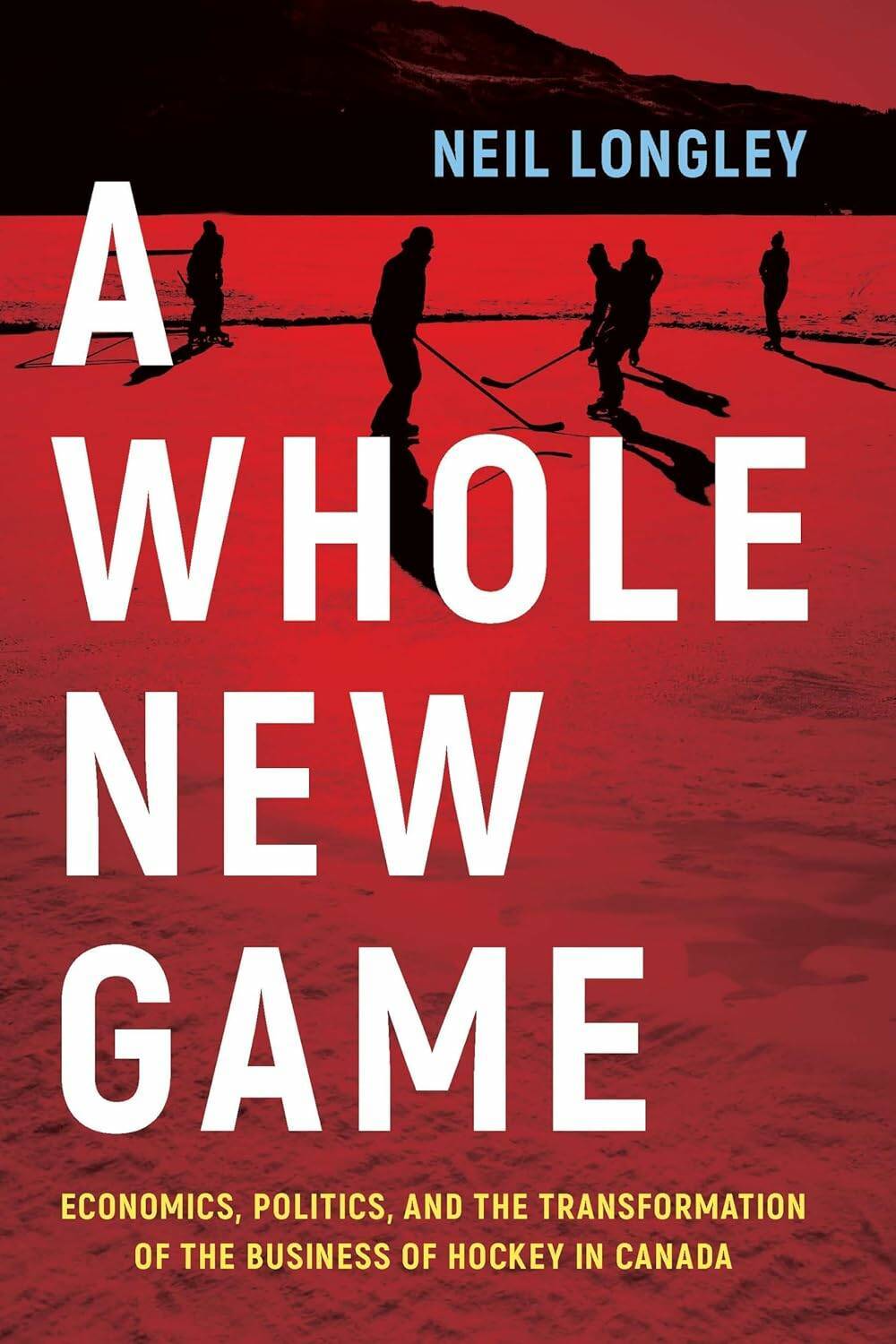
A Whole New Game

Meanwhile, Longley says, “In Canada, hockey goes far beyond mere entertainment, it is the essence of the country itself.”
On the future of the NHL on the Prairies, Longley raises the obvious: Does the economic structure of today’s NHL doom such clubs “to perpetual second-tier status within the league?” In answer to that Longley wonders if Calgary and Edmonton would be better served by having franchises in “some type of made-in-Canada league” similar to the CFL or the domestic soccer leagues in Europe. Inexplicably, he doesn’t mention Winnipeg in this scenario.
Longley argues another issue that is debatable. “With players today now having more control over where they will play, clubs like the Oilers and Flames (and Jets) that are located on the Canadian Prairies — with their relatively small populations, bitterly cold winters and general lack of cultural cachet — may find it difficult to attract or maintain high-end talent.”
Telling us we lack “cultural cachet” is rich from a man who lives in Las Vegas.
Barry Craig would love to send Longley a list of all the good things the Jets do in the community but, alas, he’s too busy here going to the symphony, the ballet, the opera, live theatre and the Winnipeg Art Gallery.