Skyscraper-studded Dubai has flourished during regional crises. Could it benefit from hosting COP28?
Advertisement
Read this article for free:
or
Already have an account? Log in here »
To continue reading, please subscribe:

Digital Subscription
One year of digital access for only $205*
- Enjoy unlimited reading on winnipegfreepress.com
- Read the E-Edition, our digital replica newspaper
- Access News Break, our award-winning app
- Play interactive puzzles
*First annual payment billed as $205.00 + GST for one year. This annual subscription will automatically renew at $233.00 + GST every 52 weeks (10% off the regular annual price of $259.35). Offer available to new and qualified returning subscribers only. Cancel any time.
To continue reading, please subscribe:
Add Free Press access to your Brandon Sun subscription for only an additional
$1 for the first 4 weeks*
- Enjoy unlimited reading on winnipegfreepress.com
- Read the E-Edition, our digital replica newspaper
- Access News Break, our award-winning app
- Play interactive puzzles
*Your next Brandon Sun subscription payment will increase by $1.00 and you will be charged $17.95 plus GST for four weeks. After four weeks, your payment will increase to $24.95 plus GST every four weeks.
Read unlimited articles for free today:
or
Already have an account? Log in here »
Hey there, time traveller!
This article was published 25/11/2023 (1018 days ago), so information in it may no longer be current.
DUBAI, United Arab Emirates (AP) — In a city known for its excesses, whether reaching toward the sky with the world’s tallest building or hard partying at its beach resorts and bars, Dubai has pulled off another record-breaking feat in the rolling dunes of its desert outskirts.
Mohammed bin Rashid Al Maktoum Solar Park, named for the ruling sheikh of Dubai, stretches across some 122 square kilometers (47 square miles) and represents a pledge of billions of dollars by this city-state to reach its goal of becoming carbon-neutral by 2050. It’s a solar-paneled gamble in a city where casinos have yet to arrive — though it always seems to be betting big no matter the risk.
Rising rapidly from a creek-bound pearling village to a city associated with international glamor, Dubai has a long history of finding economic success amid the war-ravaged woes of the wider Middle East. Its ruling family likely views the upcoming United Nations COP28 climate talks as another such opportunity, though it carries the significant peril of becoming synonymous with a collapse in negotiations on limiting greenhouse emissions, or being overshadowed by the Israel-Hamas war in the Gaza Strip.
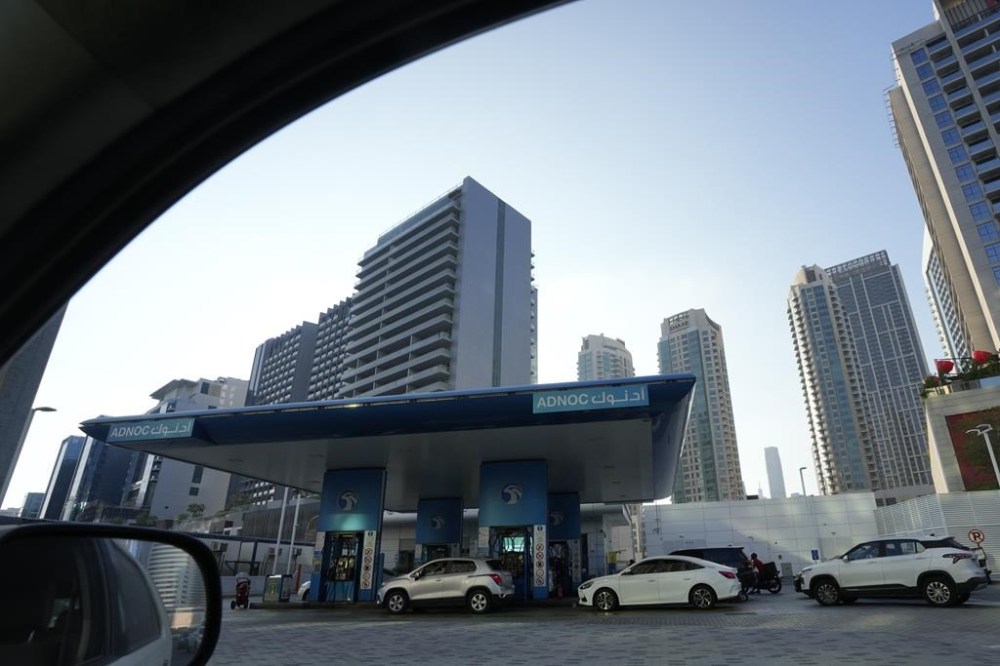
There’s a risk of reputational damage to the UAE if they fail to make any traction in the talks, particularly as they are a major oil producer, said Kristian Coates Ulrichsen, a research fellow at Rice University’s Baker Institute who has long studied the region.
“There is also a risk that media and civil society coverage will focus critically on issues such as the UAE’s planned expansion of oil production capacity and depict the UAE as part of the part of the problem rather than the solution in terms of climate politics,” Ulrichsen added.
FROM MUD WALLS TO STEEL AND GLASS
Given the futuristic skyline of downtown Dubai — and how it gleams at night as one side of the Burj Khalifa lights up with a massive 770-meter (2,525-foot) LED display — it can be easy to forget that the city only received its first electrical generator in 1952. Before that, only candles and kerosene lamps lit the night along its eponymous Dubai Creek, where the village first grew.
Oil, first discovered offshore of Dubai in 1966, was never at the levels found in the sands and waters of Abu Dhabi, which would become the capital of the United Arab Emirates when the country formed in 1971. Dubai instead used the oil as seed money for massive infrastructure projects that seemed to strike at just the right moment as the UAE grew into a home for some 9.3 million people — only 10% of them Emirati and the rest foreign workers and their families.
The massive Jebel Ali Port, the U.S. Navy’s busiest port of call outside of the United States, is the world’s largest human-made harbor. It opened in 1979, just ahead of the Iran-Iraq War. Many ships damaged in that conflict ended up dry-docking at Jebel Ali for repairs, bringing money to the area.
That money also built the Dubai World Trade Center, which in 1979 stood out as the sole high-rise in a desert expansive. Today, it is dwarfed by all the towers that followed, fueled by a boom in the city’s real estate market that came with a 2002 decision to allow foreigners to own property.
That decision came after the U.S.-led war in Afghanistan started, and just before the U.S. led an invasion of Iraq. Dubai became a safe harbor for people with the means to flee the conflicts — as well as those needing to park tens of millions of dollars in suspected ill-gotten gains, once again leading to major investments. That has continued with Russia’s war on Ukraine, with Russian investors injecting cash into Dubai real estate projects.
While benefiting during crises, the Emirates — a federation of seven sheikhdoms — waged a war on Yemen that saw its soldiers and allies criticized for indiscriminate strikes and abuses on the battlefield. The UAE also has ties to leaders who are viewed with great skepticism or, at the worst, targeted with financial sanctions in the West. They include Libyan military commander Khalifa Hifter and Sudan’s Rapid Support Forces leader Gen. Mohammed Hamdan Dagalo, who wages a civil war in Sudan with forces the State Department says have committed “conflict-related sexual violence and killings.”
“One of the likely goals of UAE’s hosting of COP28 is reputation laundering,” said Jodi Vittori, a nonresident scholar at the Carnegie Endowment for International Peace who has written extensively on Dubai being a money-laundering haven. “By hosting COP28, UAE can move the media headlines from their support for the murderous RSF in Sudan and facilitation of Russian sanctions busting to their supposed support of green causes.”
In response to questions from The Associated Press about criticism over its foreign policy and other issues, the Emirati government said that “the UAE is deeply committed to human rights and building upon its steady progress in this field.”
“As the host of COP28, the UAE will welcome constructive dialogue and continue to work with international partners and stakeholders to deliver impactful results,” the statement said. “Climate change is a global problem that demands a collective effort, and this significant, momentous event will be a conference of action.”
GOING GREEN WHILE PUMPING MORE OIL
Generators have powered Dubai’s growth for decades, first by noisy diesel units and later through natural gas plants that still provide the bulk of Dubai’s power for its skyscrapers and crucial desalination plants to provide water. The gas comes from both Abu Dhabi and nearby Qatar.
But in recent years, Dubai has started to focus on renewable energy — despite a moment where it appeared it would launch a coal-fired power plant before switching it to use natural gas instead as its hosting of COP28 loomed.
The jewel of Dubai’s clean energy efforts is Mohammed bin Rashid Al Maktoum Solar Park, some 50 kilometers (30 miles) southeast of the city’s downtown. There, solar panels stretch far into the distance, taking in the rays in a country that sees, on average, 10 hours of sunlight 350 days a year.
Towering over everything in the distance is the world’s tallest solar tower at some 260 meters (850 feet). It collects the light off of 70,000 reflectors to boil salt to run an electricity-generating turbine.
In the sparse surroundings of the desert, where camels freely roam, the glowing tower appears otherworldly over the dunes.
Dubai spent billions of dollars on the plant, which involves businesses from China, Saudi Arabia and other countries. By 2030, the city hopes to get 5 gigawatts of electricity from the plant, which could power some 1.3 million homes based on U.S. averages. These days, peak demand in the city-state is nearly 10 gigawatts, according to the Dubai Electricity and Water Authority, its sole utility provider.
Overall, the Emirates says it plans to be carbon neutral by 2050. While not specifically outlining plans to achieve the goal, projects like the solar park and Abu Dhabi’s Barakah nuclear power plant, the first on the Arabian Peninsula, aim to make generating electricity a “green” endeavor.
But reporting on these projects is difficult in the Emirates, where speech remains tightly controlled. Authorities have not responded to multiple requests for AP journalists to visit the solar plant. Requests to see the country’s four-reactor nuclear power plant have been pending for years.
On top of all that, while the UAE pledges to zero out its own emissions, it’s also planning to ramp up oil production.
A member of OPEC, the UAE produces some 4 million barrels of crude oil a day. In the coming years, it aims to produce 5 million barrels a day, fuel that will be exported, used by other countries and contribute to climate change.
Those plans have sparked criticism by activists ahead of COP28, with most aimed particularly at the upcoming talks’ president-designate, the oil company chief Sultan al-Jaber.
“The UAE must end its greenwashing campaign, abandon its plans to dramatically increase state oil and gas production and rectify the profound conflict of interest created by” al-Jaber’s appointment, more than 200 groups said in a joint letter in September.
Al-Jaber, who also has led billions of dollars in Emirati investments in renewable energy, has dismissed criticism from those who “just go on the attack without knowing anything, without knowing who we are.”
The U.S. has backed al-Jaber’s appointment, with the White House’s top energy envoy praising the Emirati strategy of bringing activists and the oil industry to COP28.
“I think that the COP28 being hosted here in this region in an oil-producing country gives us moment of opportunity of bringing together the fossil fuel industry and climate advocates to say, ‘How do we work together?’” American envoy Amos Hochstein said at a summit in Bahrain last week.
WORLD’S FAIR SITE TO AGAIN HOST THE GLOBE
Dubai’s $7-billion Expo City, built for the 2020 world fair that was delayed a year by the coronavirus pandemic, will host the upcoming climate talks. In recent weeks, hard-hatted workers have been preparing the site in Dubai’s far southern reaches for the event. Its exhibition center will host the talks, with the site divided into one secure side for delegates and another, more open site for advocates, business interests and others.
“The decision to host the conference at Expo City in Dubai is designed to keep Dubai firmly on the world stage and to bolster its credentials as a hub for soft power and aspirational appeal,” Ulrichsen said. “Expo 2020 … was supposed to symbolize Dubai’s reemergence from the global financial crisis a decade earlier.”
In the time since the Expo, Dubai has pivoted to offering the site as a new real estate development, something that will be advertised during the climate talks. One official email from the site about the talks included a link offering “spacious and secluded four-and five-bed semi-detached homes” for sale, beginning at $1.6 million.
But the selection of Expo City also raises questions about Dubai’s reliance on low-paid foreign workers in its construction boom. Many from Asian and African nations travel to the Emirates to work in jobs to send money back home. However, some find themselves trapped by abusive employers.
The Expo site work saw at least three workers killed and some 200,000 laborers exposed to high heat and potentially exploitative labor practices ahead of the world’s fair. Those labor abuses continue at Expo City, renewable energy projects and elsewhere in the Emirates, according to Equidem, a labor advocacy group.
“African and Asian workers … are doubly impacted by the global climate crisis — they migrate in response to climate impacts and find employment in exploitative industrial and service contexts where they work long hours in extreme heat,” Equidem said.
While the Expo didn’t draw all the world’s biggest names, the climate conference already has King Charles and Pope Francis confirming they’ll attend, along with other world leaders. That makes it an opportunity for Dubai, as well as a risk given the wider regional tensions over the Israel-Hamas war.
Already, a water-and-energy deal signed between the Emirates, Jordan and Israel during the Expo has collapsed due to the war.
Meanwhile, the UAE has pledged to allow protests at the summit. The Emirati government told the AP that “participants can assemble peacefully and have their voices heard in designated areas in both the Blue and Green Zones” of the venue. The Green Zone will be accessible to the general public under Emirati control, while the Blue Zone will be the site of formal negotiations, an area governed by the U.N.

“We invite all participants to express their opinions in a positive and constructive manner, sharing solutions to address the climate crisis,” the government said.
That promised openness adds to the challenge ahead for the Emirates, where political parties and unions remain illegal and protests are rare, given the threat of arrest.
There’s a “hypocrisy of having a host that outright forbids and stringently represses human rights, civil society, free speech and political activity amongst its own citizens and residents,” Vittori said.
___
Associated Press climate and environmental coverage receives support from several private foundations. See more about AP’s climate initiative here. The AP is solely responsible for all content.