

Community-building businesses look to fill societal gap
Advertisement
Read this article for free:
or
Already have an account? Log in here »
To continue reading, please subscribe:

Digital Subscription
One year of digital access for only $205*
- Enjoy unlimited reading on winnipegfreepress.com
- Read the E-Edition, our digital replica newspaper
- Access News Break, our award-winning app
- Play interactive puzzles
*First annual payment billed as $205.00 + GST for one year. This annual subscription will automatically renew at $233.00 + GST every 52 weeks (10% off the regular annual price of $259.35). Offer available to new and qualified returning subscribers only. Cancel any time.
To continue reading, please subscribe:
Add Free Press access to your Brandon Sun subscription for only an additional
$1 for the first 4 weeks*
- Enjoy unlimited reading on winnipegfreepress.com
- Read the E-Edition, our digital replica newspaper
- Access News Break, our award-winning app
- Play interactive puzzles
*Your next Brandon Sun subscription payment will increase by $1.00 and you will be charged $17.95 plus GST for four weeks. After four weeks, your payment will increase to $24.95 plus GST every four weeks.
Read unlimited articles for free today:
or
Already have an account? Log in here »
Hey there, time traveller!
This article was published 07/12/2023 (1041 days ago), so information in it may no longer be current.
TORONTO – When Joshua Zachariah was a teenager, he was enamoured with bars — or at least his idea of them.
Too young to visit them himself, he envisioned Enlightenment-style salons as described by his great-grandfather’s memoirs, which suggested bars were the only place that fostered true intellectual thought.
When Zachariah was old enough to go to pubs, he found they were not, by and large, bastions of intellectualism, but he loved them nonetheless.
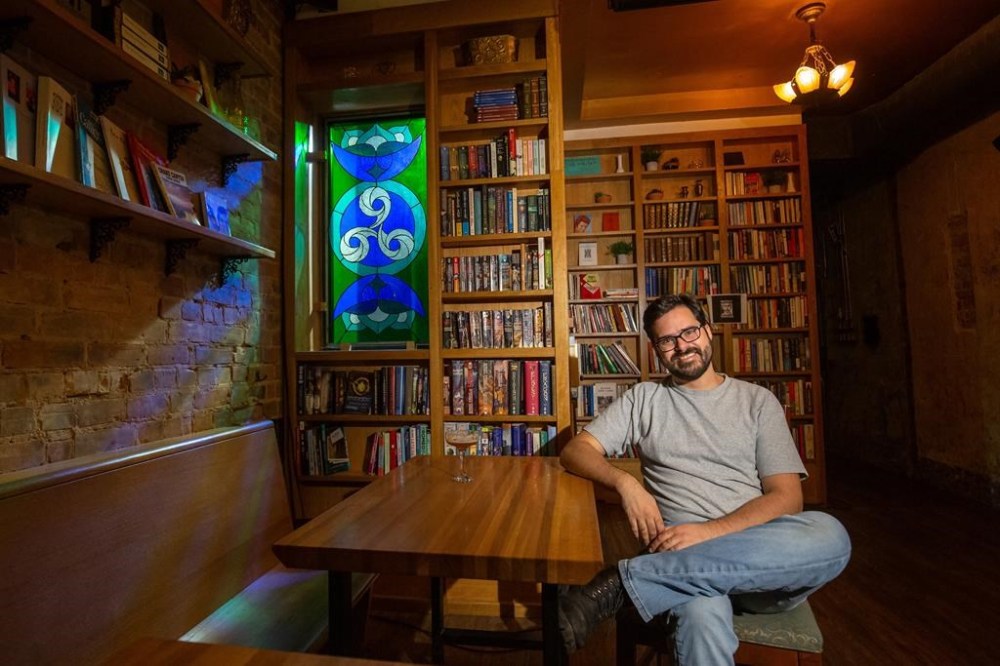
So much so that he wanted to create the modern-day salon of his dreams: “A place for people to gather and talk about interesting things, and to build movements, and to discuss issues and to learn things,” he said, bemoaning a lack of public places for people to connect.
“Over time, that idea became less about the salon and more about the community,” said Zachariah, now the proprietor of Danu Social House in Toronto’s Parkdale neighbourhood.
Danu is among a crop of business focused on filling a growing hole in a segmented society: a “third place” for people to spend time other than work and home.
In decades past, religious institutions played this role for many Canadians, but the proportion of the population that reports no religious affiliation has more than doubled in the last two decades. Census data released last year show that in 2021, 34.6 per cent of Canadians reported no religious affiliation, compared to 16.5 per cent in 2001.
The lasting impact of the pandemic and a proliferation of online social spaces have also left people feeling isolated, said Zachariah, who kept community-building in mind at every step of planning his bar.
From the near-nightly events — including pub mainstays like trivia and less common bar activities like fortnightly Dungeons and Dragons — to the design of the space, it’s all intentional.
For instance, he said, many establishments put a little candle at each table to give people sitting there a sense of privacy, in which the rest of the room fades into the background. Candles would fit into Danu’s cozy esthetic of warm wood, exposed brick and fairy lights overhead but they might discourage people at different tables from interacting with one another, Zachariah said.
But beyond all of those tactics, Zachariah said making his intention known has been the most effective: “Just saying, ‘We’re going to be this,’ in a city that deeply craves it,” he said.
These days, a crew of regulars often stay hours at a time. They have lengthy conversations over cocktails, welcoming new people into the fray.
The regular events also have loyal followings, without much overlap between them, Zachariah said. In essence, the bar has created not just one community but many.
As the structure of our society shifts over time, so too must our concept of community, said Lori G. Beaman, a professor at the University of Ottawa and Canada Research Chair in religious diversity and social change.
“When people talk about community, some people go back to the idea of religious communities,” she said. “And we think about buildings and we think about consistent membership and we think about consistency and commitment.”
While that is still valuable, she said there are other meaningful ways for people to be in community with one another.
“I think that we need to stop romanticizing past versions of community and ask ourselves: What is working in community? How do people build community?”
For Nakita Buenbrazo and Karalee Harbridge, the answer — to the latter question at least — is time, patience and a shared hobby.
The duo opened a fabric store and sewing studio in Dundas, a district of Hamilton, earlier this year. Main Fabric offers classes and a membership program, which, they say, is where the community comes in.
“It’s kind of like a gym membership,” said Buenbrazo. “You pay a monthly fee and you can come in any time the store is open to sew and to use our equipment.
“You don’t have to buy stuff here. It’s just about coming together and teaching and learning from each other, learning from other members and talking about your projects.”
They also host “open sew” times each week, when members can come in and use the equipment in the evenings after the store closes.
At first, nobody showed up, Harbridge said. Then, just a couple of people. It took four months of hosting weekly events for them to attract a full house, she said.
“It was just like the most random crew of people, too, which I always love in a class or in an open sew situation, where we have so many different kinds of people. It’s not just 35-year-old women.”
Their classes and open sew times are now regularly full, Buenbrazo said. They have a sign-up sheet, and sometimes have to turn people away.
It’s offered a valuable lesson in community-building.
“If you provide something for them to be at, people will catch on,” said Buenbrazo.
“They know every Friday night it’s here, we’re here, we’re going to be here. And I think that’s the biggest part of community, is just showing up.”

That said, the open sew isn’t actually bringing in any money.
Likewise, encouraging people to stick around for hours is not as profitable as bringing in new customers and ushering out the old ones, Zachariah said. The bar is sustaining itself for now, but Zachariah said he has yet to pay himself a salary.
Capitalism and community do not necessarily go hand-in-hand, he said, but he’s trying to make it work.
“We need to figure out ways for both capitalism to be happy and not break our principles.”
This report by The Canadian Press was first published Dec. 7, 2023.
The Free Press acknowledges the financial support it receives from members of the city’s faith community, which makes our coverage of religion possible.




