Supporters see body-worn cameras as aid to policing
Read this article for free:
or
Already have an account? Log in here »
To continue reading, please subscribe:

Digital Subscription
One year of digital access for only $205*
- Enjoy unlimited reading on winnipegfreepress.com
- Read the E-Edition, our digital replica newspaper
- Access News Break, our award-winning app
- Play interactive puzzles
*First annual payment billed as $205.00 + GST for one year. This annual subscription will automatically renew at $233.00 + GST every 52 weeks (10% off the regular annual price of $259.35). Offer available to new and qualified returning subscribers only. Cancel any time.
To continue reading, please subscribe:
Add Free Press access to your Brandon Sun subscription for only an additional
$1 for the first 4 weeks*
- Enjoy unlimited reading on winnipegfreepress.com
- Read the E-Edition, our digital replica newspaper
- Access News Break, our award-winning app
- Play interactive puzzles
*Your next Brandon Sun subscription payment will increase by $1.00 and you will be charged $17.95 plus GST for four weeks. After four weeks, your payment will increase to $24.95 plus GST every four weeks.
Read unlimited articles for free today:
or
Already have an account? Log in here »
Hey there, time traveller!
This article was published 10/12/2023 (1035 days ago), so information in it may no longer be current.
It’s time for the Winnipeg Police Service to be outfitted with body-worn cameras, says the brother of Sean Thompson, a 30-year-old Anishinaabe man who died after being pulled down several porch stairs, shin-pinned and handcuffed by Winnipeg police in 2019.
Sean’s death is being examined as part of a joint inquest into the deaths of five men following altercations with Winnipeg police over a roughly 12-month period beginning in July 2018.
In an interview prior to the inquest, Felix Thompson, Sean’s younger brother, said there needs to be more accountability for the Winnipeg police, especially when it comes to officers’ interactions with Indigenous people.
“They need some kind of surveillance on them, watching them. The (Independent Investigation Unit of Manitoba) and the watchdog are good, but they need actual footage cameras on them when they’re out on duty,” he said.
Thompson is not alone in his call. In recent months, several other families whose loved ones were shot and killed by Winnipeg police officers, or who died following altercations with law enforcement, have told the Free Press they also hope city officers are outfitted with cameras.
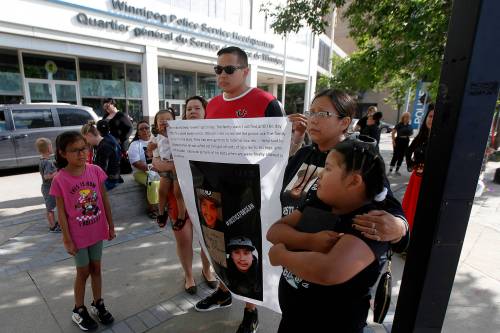
PHIL HOSSACK / WINNIPEG FREE PRESS FILES Felix Thompson holds a portrait of his brother Sean in front of police headquarters with his family, a week after Sean died in police custody in July 2019.
“Hopefully this shines the light onto the problems,” Thompson said.
The IIU, which investigates serious incidents involving police officers, said Winnipeg police, who were called to a North End home after reports of a break-in, did nothing to cause or contribute to Sean Thompson’s death. His official cause of death was deemed to be “mixed drug intoxication (cocaine, methamphetamine and ethanol).”
Winnipeg police leadership has been pursuing funding for the body-worn cameras for more than a decade, according to a 2021 city report. Last month, Winnipeg’s police board chair Coun. Markus Chambers told the Free Press it’s inevitable that body-worn cameras become the default for most police services, though he noted no real request is before the city council with regards to the technology.
Despite support of decision-makers, the demand for cameras comes at a time when the city is emphasizing it’s under significant fiscal pressure.
Body-worn cameras are not a panacea to issues in policing – and researchers are not unified on their potential to reduce officers’ use of force. Some raise concerns regarding over-surveillance and privacy. But supporters cite benefits in transparency, public trust in police, and evidence-gathering.
Footage, testimony at inquest
The interaction between Sean and the Winnipeg police began in the early morning hours of June 26, 2019, after 911 calls saying that Sean – acting erratically and seeming confused — had broken into two houses.
Video footage of the incident, taken from the city’s police helicopter, was shown in court at the inquest last month. The recording’s audio includes only police radio transmissions.
The helicopter’s footage shows Sean falling over, struggling to stand, seemingly tangled up in a folding chair on a porch.
The interaction between Sean and the Winnipeg police began in the early morning hours of June 26, 2019, after 911 calls saying that Sean – acting erratically and seeming confused — had broken into two houses.
Video footage of the incident, taken from the city’s police helicopter, was shown in court at the inquest last month. The recording’s audio includes only police radio transmissions.
The helicopter’s footage shows Sean falling over, struggling to stand, seemingly tangled up in a folding chair on a porch.
When Winnipeg police officers arrive, one pulls him down several porch steps onto the ground and they handcuff him. An officer radioes for an ambulance. Later, an officer asks for a “rush” on that ambulance and indicates CPR has been started on Sean.
In an interview with IIU investigators, Marcus Marasign said he awoke to Sean breaking his bedroom window while yelling “help me!”
Before police arrived, Marasign and his brother found Sean on the ground outside their house – shaking and still yelling for help.
He watched a female officer pull Sean off the porch steps, saying it “looked like it hurt.” Marasign said he didn’t see Sean do anything aggressive.
He did not testify at the inquest; instead, his interview with the IIU was entered as evidence.
During her testimony at the inquest, Cst. Courtney Ross was asked what she said to Sean when she first arrived on scene. After a pause to consult her notes, the constable said she instructed Sean to get on his stomach and show his hands, “to which he did not comply.”
She said she then took him by the waistband and rolled him down the porch steps.
Ross told the court that after he was handcuffed, Sean was on his stomach, and then, when he became unresponsive, he was placed on his side.
Cst. Derek Verwymeren, meanwhile, testified that when he arrived, Sean was on his back – then was moved onto his side.
Toward the end of her testimony, Ross appeared to become confused when Judge Choy attempted to clarify the position Sean had been in when — after being handcuffed — Ross had a short conversation with him.
Ross said he was on his side. The judge replied she thought Sean was already unresponsive once rolled onto his side. After another pause to review her notes, Ross said Sean was, in fact, on his stomach.
Asked by reporters at the inquest about inconsistencies in officers’ testimony, Erica Thompson, Sean’s older sister, said: “I just think it’s BS.”
The ongoing inquest into Sean’s death — which is also examining the deaths of Matthew Fosseneuve, Randy Cochrane, Patrick Gagnon and Michael Bagot — has highlighted the ways body-camera footage might benefit such preceedings.
While the court has viewed video footage related to each of the men’s deaths, much of it has been of poor quality: taken from a distant cellphone; a restaurant’s surveillance camera, which didn’t include any audio; or, in Sean’s case, from a police helicopter: grainy black-and-white footage in which the activity is sometimes blocked by trees.
While it remains to be seen whether the ongoing inquest — which is being presided over by provincial court Judge Lindy Choy — will consider the question of body-worn cameras, a previous inquest weighed in on the technology.
In her inquest report into the death of Craig McDougall, who was shot and killed by a Winnipeg police officer in 2008, Judge Anne Krahn recommended the province and its police services “study and consider” the use of body cameras. In response to the 2017 report, Manitoba Justice said the Manitoba Police Commission had already reviewed the use of body cameras and determined they should not be used.
In 2021, the city had an opportunity implement the technology. Winnipeg police Chief Danny Smyth put his support behind the idea, writing in a report that while there did not seem to be conclusive evidence cameras “decrease violent incidents with police, there are substantive other benefits associated to increased public trust and confidence.” (Police declined to comment for this story, citing ongoing inquests.)
That year, city council voted down a proposal to direct additional funds to the service’s budget for the cameras.
Jonathan Williams, whose son Chad Williams was fatally shot by three Winnipeg police officers in 2019, argues the city’s officers should all wear body cameras.
“Cameras should be on every officer. And apparently the City of Winnipeg can’t afford them… but they can go around and waste money on other stupid crap,” Williams told the Free Press earlier this year, adding that if the service had body cameras, “then they wouldn’t have these inquests.”
Had the officers who shot Chad been wearing body cameras, he added in a recent Facebook message, “maybe there would have been a truth to the story of my son.” The IIU cleared police officers’ actions in Williams’ death and a subsequent inquest made no recommendations.
Related Articles
Family hoped inquest into death following an altercation with police would bring closure. Instead, they have more unanswered questions


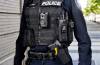

Kris Saxberg, a lawyer representing the family of Viengxay Chommany in an upcoming inquest and civil lawsuit, also pointed to the importance of the technology. The IIU report into Chommany’s 2019 death indicates Winnipeg police officers punched him in the face at least five times, as well as in other parts of his body, and Tasered him at least twice. (The IIU cleared the officers of criminal wrongdoing.)
“Can you imagine how great it would have been if there were cameras on the officers?” Saxberg said. “Would any of this be happening?”
“You just cannot understand what caused the death in a situation where the one party that could testify on their behalf, as to what actually happened, is deceased. The other parties are grossly biased to not wind up in jail,” Saxberg said. “You need objective evidence.”
Speaking to the Free Press last month, Felix Thompson described Sean as his best friend, a great father and a hard worker, who was long employed in the construction industry. The Thompson family is from Little Saskatchewan First Nation, which is about about 250 kilometres northwest of Winnipeg.
“You just cannot understand what caused the death in a situation where the one party that could testify on their behalf, as to what actually happened, is deceased. The other parties are grossly biased to not wind up in jail.”–Lawyer Kris Saxberg
As children, Thompson said, Sean was his protector, despite being just a year older – helping him deal with the death of their father at a young age, during a childhood that wasn’t always easy.
“He was always there for me,” Thompson said. “If you were having a bad day, he’d know what to say … he would just tell me, ‘can’t go back in the past, bro’ … ‘we’ve been through a lot worse stuff than this.’ And we have.”
The last time he saw Sean, just hours before he died, “he hugged me and told me he loved me,” Thompson said.
“Ever since my brother’s death, I spent many times deep in addictions – alcohol, drugs – trying to cope,” Thompson said.
“I realize there’s a grieving process,” he added. “There’s the denial. Then there’s, ‘I wish it was me,’ and all of this. The five stages of grief. It took me a lot to accept.”
marsha.mcleod@freepress.mb.ca

Marsha McLeod
Investigative reporter
Signal
Marsha McLeod is an investigative reporter at the Free Press. She joined the Free Press in 2023. Read more about Marsha.
Every piece of reporting Marsha produces is reviewed by an editing team before it is posted online or published in print — part of the Free Press‘s tradition, since 1872, of producing reliable independent journalism. Read more about Free Press’s history and mandate, and learn how our newsroom operates.
Our newsroom depends on a growing audience of readers to power our journalism. If you are not a paid reader, please consider becoming a subscriber.
Our newsroom depends on its audience of readers to power our journalism. Thank you for your support.
History
Updated on Sunday, December 10, 2023 6:07 PM CST: Tweaks reference to Williams’ inquest report.