More non-Indigenous and Indigenous people aware of residential schools: report
Advertisement
Read this article for free:
or
Already have an account? Log in here »
To continue reading, please subscribe:
Digital Subscription
One year of digital access for only $1.44 a week*
- Enjoy unlimited reading on winnipegfreepress.com
- Read the E-Edition, our digital replica newspaper
- Access News Break, our award-winning app
- Play interactive puzzles
*Billed as $5.77 plus GST every four weeks. After 52 weeks, price increases to the regular rate of $19.95 plus GST every four weeks. Offer available to new and qualified returning subscribers only. Cancel any time.
To continue reading, please subscribe:
Add Free Press access to your Brandon Sun subscription for only an additional
$1 for the first 4 weeks*
- Enjoy unlimited reading on winnipegfreepress.com
- Read the E-Edition, our digital replica newspaper
- Access News Break, our award-winning app
- Play interactive puzzles
*Your next Brandon Sun subscription payment will increase by $1.00 and you will be charged $17.95 plus GST for four weeks. After four weeks, your payment will increase to $24.95 plus GST every four weeks.
Read unlimited articles for free today:
or
Already have an account? Log in here »
Hey there, time traveller!
This article was published 13/12/2023 (1045 days ago), so information in it may no longer be current.
WINNIPEG – Research suggests public awareness of past harms from residential schools has increased but more work needs to be done educating Canadians on lasting effects of the institutions.
In a report released Wednesday, researchers from the University of Manitoba, University of Victoria and Toronto Metropolitan University, in collaboration with the National Centre for Truth and Reconciliation, measured the progress of non-Indigenous and Indigenous Peoples in their shared journey toward reconciliation in 2022.
This is the second year the group has tracked reconciliation awareness using what they call the Canadian reconciliation barometer.

The team surveyed 3,174 Indigenous and non-Indigenous people in six regions across the country through an online questionnaire.
Researchers found 90 per cent of non-Indigenous respondents and 94 per cent of Indigenous respondents had read or heard about residential schools, up from 65 per cent and 87 per cent respectively in 2021.
The report notes researchers did not recruit the same respondents from 2021 for the 2022 survey, and any changes year-over-year do not reflect the evolving views of the same people.
The polling industry’s professional body, the Canadian Research Insights Council, also says online surveys cannot be assigned a margin of error because they do not randomly sample the population.
“Indigenous Peoples have unquestioningly been sounding the alarm bell, really, since the dawn of time in this country, about the challenges the Canadian state is creating for the full enjoyment of the rights of Indigenous Peoples,” said Ry Moran, a Métis researcher on the project and associate university librarian-reconciliation at the University of Victoria.
“The fact that we’re seeing some greater consensus emerge is perhaps reflective of the fact that people, especially non-Indigenous Canadians, are starting to understand a little bit better where we’re at.”
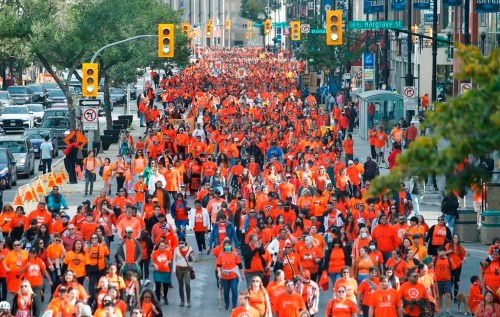
Moran said this is likely due to: widespread publicity of unmarked burial sites at several former residential schools; a visit to Canada last year by Pope Francis, who apologized for harms at the schools; and the federal government opting to make Orange Shirt Day the National Day for Truth and Reconciliation.
An estimated 150,000 First Nations, Inuit and Métis children were forced to attend the government-funded, church-run schools, which were largely overseen by the Catholic Church.
An estimated 6,000 Indigenous children died at the institutions, while many experts believe the number to be higher. The National Centre for Truth and Reconciliation has recorded the names of more than 4,000 who died.
Respondents in the survey said they were more aware of past and ongoing harms in 2022 than in the previous year.
Researchers said this is hopeful, but an ongoing focus on education is important because awareness is only the start of the journey.
In 2022, Indigenous respondents said groups that have harmed Indigenous people have not taken full responsibility for their actions. Non-Indigenous respondents were slightly more inclined to think groups have done enough, the report says.
The study found the attitudes of Indigenous respondents didn’t change from 2021 to 2022 when it came to their thoughts on Canada making progress on apologies, nation-to-nation relationships and personal equality.
Respondents reported similar scores when it came to quality of life for Indigenous Peoples. On average, 23 per cent of non-Indigenous respondents and 26 per cent of Indigenous respondents said Indigenous and non-Indigenous people in Canada have equal life outcomes, compared to 28 per cent and 24 per cent respectively in 2021.
“We’ve got some more work to do to create that common understanding and that empathetic understanding of human rights and equality in this society,” Moran said.
“These are things that people can ask their politicians to do, we can make them electoral issues in society, and certainly policymakers can redouble their efforts to create better policy.”
While the report found an uptick in several other important measures of reconciliation, there were some areas that did not see a positive trend, including the engagement of non-Indigenous people with Indigenous communities.
Stephanie Scott, executive director of the National Centre for Truth and Reconciliation, welcomed the report, saying it can guide policymakers to bolster reconciliation. But she warned of residential school denialism.

“We cannot discount or deny the dangerous rise in denialism in both mainstream and online media, and it must be countered with ongoing accurate knowledge and information,” she said in a news release.
Unlike other projects that track implementation of the Truth and Reconciliation Commission’s 94 calls to action, the group’s research delved into the perceptions of reconciliation held by both Indigenous and non-Indigenous people in Canada.
The researchers said tracking reconciliation awareness can motivate people, organizations and governments to act.
“This is not the end of the journey by any means,” said Moran. “Awareness is really a precursor to understanding the more complex histories that created the residential school system and the personal and structural inequities that have been caused by those institutions.”
This report by The Canadian Press was first published Dec. 13, 2023.