

Hookah lounge is alcohol-free
Habibiz Cafe offers safe, comfortable space in city

Advertisement
Read this article for free:
or
Already have an account? Log in here »
To continue reading, please subscribe:

Digital Subscription
One year of digital access for only $205*
- Enjoy unlimited reading on winnipegfreepress.com
- Read the E-Edition, our digital replica newspaper
- Access News Break, our award-winning app
- Play interactive puzzles
*First annual payment billed as $205.00 + GST for one year. This annual subscription will automatically renew at $233.00 + GST every 52 weeks (10% off the regular annual price of $259.35). Offer available to new and qualified returning subscribers only. Cancel any time.
To continue reading, please subscribe:
Add Free Press access to your Brandon Sun subscription for only an additional
$1 for the first 4 weeks*
- Enjoy unlimited reading on winnipegfreepress.com
- Read the E-Edition, our digital replica newspaper
- Access News Break, our award-winning app
- Play interactive puzzles
*Your next Brandon Sun subscription payment will increase by $1.00 and you will be charged $17.95 plus GST for four weeks. After four weeks, your payment will increase to $24.95 plus GST every four weeks.
Read unlimited articles for free today:
or
Already have an account? Log in here »
Hey there, time traveller!
This article was published 26/12/2023 (964 days ago), so information in it may no longer be current.
Four chums play a friendly game of dominoes in the corner of Habibiz Cafe. At adjacent tables, a couple quietly studies at one while a group of gal pals talks among themselves at another. It’s early, but a weekday, nonetheless, and it won’t be long before they all call it a night and safely make their way home.
The walls are barren of TVs, unusual for a lounge — rhythmic Arabic music, the aroma of delectable eats and the smoke from each table’s hookah pipe are what fill this space every night. Alcohol is also absent from each table, not that guests have a choice. Habibiz Cafe is the only hookah lounge in Winnipeg to adopt a spirit-free business model.
Sibling owners Ali and Sammy Zeid say their alcohol-free menu has fostered a select and comfortable space in the city, just what they had hoped for when they opened two years ago. Indeed, business is going according to plan, but the brothers can’t help but fear for how long their unproven business model will last with looming city bylaws looming.
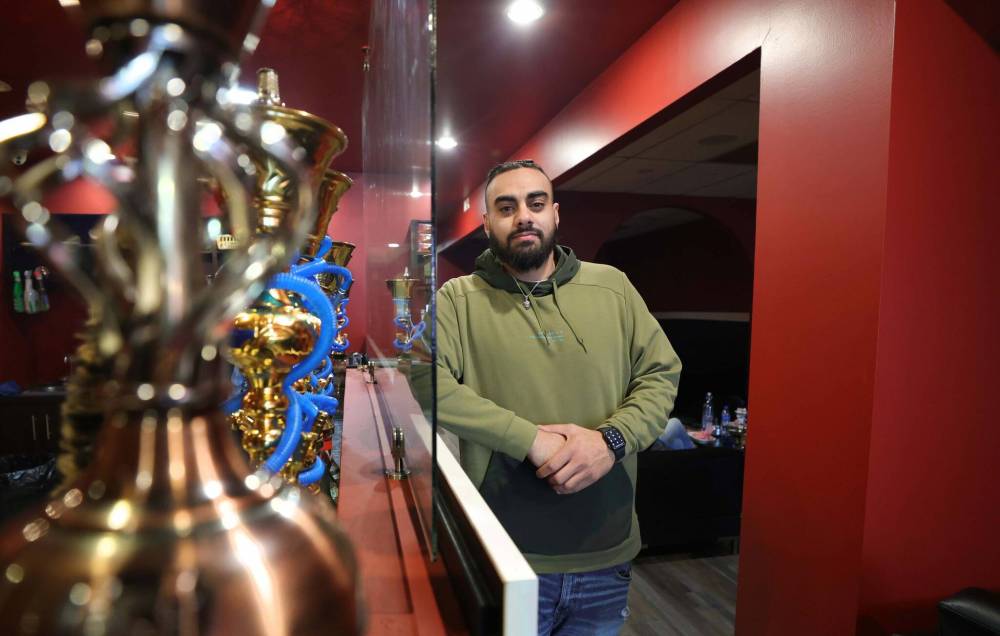
Ali has experienced firsthand the ebbs and flows of a business that survives on its alcohol sales. He managed the now-shuttered Citizen Nightclub and Mazaj Hookah Lounge, which operated out of the same building in The Exchange for three years before closing in 2019.
“At first, it was probably one of the best spots in Winnipeg,” Ali said of Mazaj. That changed once the owners began hiring DJs for their weekly events.
“I saw the older crowd started leaving,” he continued. “They’re like, ‘A DJ is not our vibe.’”
The live beats ushered in a new, younger crowd — one that often had different intentions than enjoying a few casuals on a Friday night.
“The money was crazy,” Ali said. “The money (with) a DJ, you’re making seven or eight (thousand dollars) on a dead night… because people are drinking.
“Now, what comes with alcohol? Problems.”
Citizen and Mazaj became the site for weekly altercations, some more serious than others, like a bloody attack in 2018 that saw three patrons stabbed outside the nightclub. More security was hired, but despite their best efforts, they couldn’t stop the drunken violence.
“Alcohol brought so much negative energy in that place,” Ali maintained. “The money was good … but the headache that came with it, it kind of evened out.”
Shortly after the owners sold the building, Sammy, who had recently graduated as a power mechanic, had an idea for the brothers to open a hookah lounge of their own.
Ali entertained his younger brother’s vision and within a week the pair had signed an agreement to lease the space at 1373 Portage Ave.
The biggest decision that remained was whether they would serve alcohol.
“Do we want that environment?” Ali reflected.
“What happens at Habibiz Cafe today, I did not envision this. It came with our modern life living here in Canada with our culture, our roots… we combined it.”– Ali Zeid
“If you asked me, ‘Is this what you envisioned?’ No, I did not envision this at all. What happens at Habibiz Cafe today, I did not envision this. It came with our modern life living here in Canada with our culture, our roots — we combined it.”
Ali, 30, and Sammy, 26, are two of five children to Palestinian-born parents.
Hookah was common in their household. It’s standard cultural practice in many Middle Eastern and African countries. Hookah is a water pipe that is used to smoke shisha, a mixture of tobacco and molasses, sugar or fruit.
Western countries have adopted the practice as immigration soars. South of the border, 2.6 million people smoke hookah and more than 100 million smoke it globally, according to a study by the Canadian Medical Association Journal. Comparably, the report reads that its high prevalence, particularly among young adults (due to its variety of flavours, social nature and accessibility), is a matter of growing concern in Canada.
In November, the city’s community services committee passed a motion for city staff to draft a bylaw that would prohibit hookahs indoors and on patios. It would destroy the core product for the city’s 15 hookah lounges and could also banish the two cigar lounges that operate in Winnipeg.
City councillors say hookah lounges currently operate within a loophole under the provincial smoking ban and the City of Winnipeg bylaw No. 62/2011, neither of which details shisha smoking in public places among its bans.
Hookah lounges are already prohibited in Vancouver, North Vancouver, Edmonton, Regina and Toronto. Consumption is illegal in Ottawa and parts of Alberta.
Despite several attempts, the Free Press was unable to reach the appropriate city councillors for comment by press time.
It’s worth noting that most hookah lounges are operated by immigrant business owners, which could send a negative message to young entrepreneurs looking to make their way in a new city.
“In a regular, average Joe’s eyes, a hookah is like a vape or a cigarette, right? But in our eyes, and everyone that’s sitting here, this is a huge part of our culture,” Ali said. “We grew up on this.”
Ali conceded he’s fearful that the banning will come to fruition.
“Of course. Us losing hookah, we lose that generation that doesn’t want to go out and drink and party. We lose our young staff that’s all in university. I have 20 employees… if hookah is gone, there’s no need for anybody anymore.”
The brothers are determined to show their alcohol-free business model can thrive in Winnipeg, but it’s not without its risks.
Most bars and clubs attempt to establish a culture designed to attract a specific market segment, according to Sean MacDonald, professor of business strategy at the University of Manitoba’s Asper School of Business.
“But the common denominator in those clubs is the sale of alcohol. So what (Habibiz Cafe) is attempting to do is create a culture that does not have alcohol, yet will still appeal to specific market segments,” MacDonald told the Free Press.
“To me, in looking at the consumer behaviour, I would say that the market segments that they would be going after would, of course, be those that are not drinking, those that do not enjoy the culture of an alcohol establishment.”
A 2018 report by Berenberg Research revealed alcohol consumption among Generation Z (born from 1997-2012) is down 20 per cent per capita from that of Millennials.
Millennials are also drinking less than both Gen X and baby boomers.
“There’s more of, what I’m gonna call a pre-game culture. The second thing that we’re trying to figure out still, is has the introduction of cannabis substituted for alcohol in any measurable way,” MacDonald said.
“I think the impact of the pandemic changed new drinkers, meaning people that were turning 18 during that time, they were introduced to a new culture.”– Sean MacDonald, professor of business strategy at the University of Manitoba’s Asper School of Business
“I think the impact of the pandemic changed new drinkers, meaning people that were turning 18 during that time, they were introduced to a new culture,” he continued. Possibly a marginal affect from the widespread availability of cannabis and I would throw in that there’s a greater healthy lifestyle consciousness among younger folks.”
MacDonald was intrigued by the idea of a spirit-free business, noting its a strategy known as the first-mover advantage. In this case, Habibiz could be the first in a line of businesses that adopt a similar model in a health-conscious generation. There’s no data to show whether a similar model has proven successful elsewhere in the country.
But MacDonald warned that the shelf lives of bars and lounges are historically short, which can be compounded by a lack of alcohol sales.
“But that all aside, I think this is the type of place… that Winnipeg needs — that will focus on a safe environment,” he said. “And I’m not sure if it’s a culturally based market that they’re going after … which, if they do, they find a niche market in some of the diversity in Winnipeg, this has some real strong potential with or without the hookah bar.”

The Zeids recently opened Shawarama Delight, a sister company of Habibiz Cafe that serves food but no hookah.
Perhaps it will serve as a viable Plan B should the city follow through with its motion. But for the time being, Ali will continue serving what he knows best in the way he’s come to love.
“People ask us, ‘Do you have alcohol? No? Why not?’ Because this is what we like. We want a safe, new environment in Winnipeg,” Ali said.
“This is our culture and this is huge now, it’s growing in the community of Winnipeg because everyone’s loving it.”
jfreysam@freepress.mb.ca
Josh Frey-Sam reports on sports and business at the Free Press. Josh got his start at the paper in 2022, just weeks after graduating from the Creative Communications program at Red River College. He reports primarily on amateur teams and athletes in sports. Read more about Josh.
Every piece of reporting Josh produces is reviewed by an editing team before it is posted online or published in print — part of the Free Press‘s tradition, since 1872, of producing reliable independent journalism. Read more about Free Press’s history and mandate, and learn how our newsroom operates.
Our newsroom depends on a growing audience of readers to power our journalism. If you are not a paid reader, please consider becoming a subscriber.
Our newsroom depends on its audience of readers to power our journalism. Thank you for your support.
Josh Frey-Sam reports on sports and business at the Free Press. Josh got his start at the paper in 2022, just weeks after graduating from the Creative Communications program at Red River College. He reports primarily on amateur teams and athletes in sports. Read more about Josh.
Every piece of reporting Josh produces is reviewed by an editing team before it is posted online or published in print — part of the Free Press‘s tradition, since 1872, of producing reliable independent journalism. Read more about Free Press’s history and mandate, and learn how our newsroom operates.
Our newsroom depends on a growing audience of readers to power our journalism. If you are not a paid reader, please consider becoming a subscriber.
Our newsroom depends on its audience of readers to power our journalism. Thank you for your support.
Related Articles
Manitoba to join other provinces in excise tax on vape products

Advertisement Advertise With Us
Advertisement Advertise With Us