Zelenskyy, Blinken, Israeli president and more will come to Davos to talk about global challenges

Advertisement

Advertise with us

LONDON (AP) — More than 60 heads of state and government and hundreds of business leaders are coming to Switzerland to discuss the biggest global challenges during the World Economic Forum's annual gathering next week, ranging from Israeli President Isaac Herzog to Ukrainian President Volodymyr Zelenskyy.

Read this article for free:


By clicking the button above, an account will be created and you will begin to receive some of our recommended newsletters. You may opt out of any newsletter by visiting your Email and Communication Preferences page or by clicking "unsubscribe" at the bottom of any email.

or

Already have an account? Log in here »

To continue reading, please subscribe:

Digital Subscription

One year of digital access for only $1.44 a week*

  • Enjoy unlimited reading on winnipegfreepress.com
  • Read the E-Edition, our digital replica newspaper
  • Access News Break, our award-winning app
  • Play interactive puzzles

*Billed as $5.77 plus GST every four weeks. After 52 weeks, price increases to the regular rate of $19.95 plus GST every four weeks. Offer available to new and qualified returning subscribers only. Cancel any time.

To continue reading, please subscribe:

Add Free Press access to your Brandon Sun subscription for only an additional

$1 for the first 4 weeks*

  • Enjoy unlimited reading on winnipegfreepress.com
  • Read the E-Edition, our digital replica newspaper
  • Access News Break, our award-winning app
  • Play interactive puzzles
Start now

*Your next Brandon Sun subscription payment will increase by $1.00 and you will be charged $17.95 plus GST for four weeks. After four weeks, your payment will increase to $24.95 plus GST every four weeks.

Hey there, time traveller!
This article was published 09/01/2024 (1018 days ago), so information in it may no longer be current.

LONDON (AP) — More than 60 heads of state and government and hundreds of business leaders are coming to Switzerland to discuss the biggest global challenges during the World Economic Forum’s annual gathering next week, ranging from Israeli President Isaac Herzog to Ukrainian President Volodymyr Zelenskyy.

The likes of U.S. Secretary of State Antony Blinken, Chinese Premier Li Qiang, EU Commission President Ursula von der Leyen, French President Emmanuel Macron, U.N. Secretary-General Antonio Guterres and many others will descend on the Alpine ski resort town of Davos on Jan. 15-19, organizers said Tuesday.

Attendees have their work cut out for them with two major wars — the Israel-Hamas conflict and Russia’s invasion of Ukraine — plus problems like climate change, major disruptions to trade in the Red Sea, a weak global economy and misinformation powered by rapidly advancing artificial intelligence in a major election year.
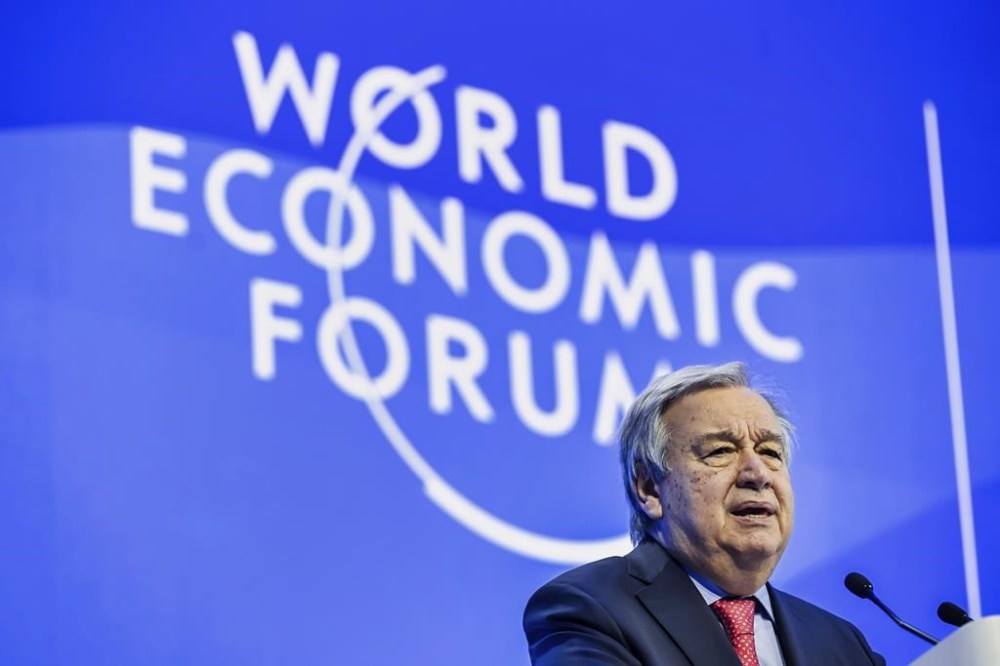
FILE - United Nations Secretary-General Antonio Guterres speaks during the 53rd annual meeting of the World Economic Forum, WEF, in Davos, Switzerland, Wednesday, Jan. 18, 2023. More than 60 heads of state and government and hundreds of business leaders are coming to Switzerland to discuss the biggest global challenges during the World Economic Forum's annual gathering next week, ranging from Israeli President Isaac Herzog to Ukrainian President Volodymyr Zelenskyy. (Gian Ehrenzeller/Keystone via AP, File)

Trust has eroded on peace and security, with global cooperation down since 2016 and plummeting since 2020, forum President Borge Brende said at a briefing.

“In Davos, we will make sure that we bring together the right people to see how can we also end this very challenging world, look at opportunities to cooperate,” he said.

Brende noted that there are fears about escalation of the conflict in Gaza and that key stakeholders — including the prime ministers of Qatar, Lebanon and Jordan as well as Herzog — were coming to Davos to “look how to avoid a further deterioration and also what is next, because we also have to inject some silver linings.”

Zelenskyy will give an address next week during the event, while more than 70 national security advisers from around the world will gather in Davos on Sunday to discuss ways forward on Zelenskyy’s peace plan, Brende said. It’s the fourth such meeting, but Russian officials have never participated.

Major figures — including U.S. national security adviser Jake Sullivan, new Argentina President Javier Milei, OpenAI CEO Sam Altman, Microsoft CEO Satya Nadella — will discuss big ideas in hundreds of public sessions and speeches or in other talks surrounding the event.

There’s also more secretive backroom deal-making in the upscale hotels along Davos’ Promenade, near the conference center that hosts the gathering.

How much all these discussions will result in big announcements is uncertain. The World Economic Forum’s glitzy event has drawn criticism for being a place where high-profile figures talk about big ideas but make little headway on finding solutions to the world’s biggest challenges.

It’s also been criticized for hosting wealthy executives who sometimes fly in on emissions-spewing corporate jets.

___

Follow AP’s coverage of the World Economic Forum meeting at https://apnews.com/hub/world-economic-forum.
Report Error Submit a Tip

More Stories

Puzzles Palace

1 minute read Friday, Oct. 16, 2026

To solve our puzzles, please subscribe with this special offer: |

Hutterite colonies embrace the manufacturing business – while staying faithful to their way of life

Gabrielle Piché 13 minute read Preview

Hutterite colonies embrace the manufacturing business – while staying faithful to their way of life

Gabrielle Piché 13 minute read Yesterday at 5:02 PM CDT

Tucked away at Oak Bluff Hutterite Colony, past rows of communal housing and farm buildings, Aaron Maendel tinkers in a laboratory.

Black-and-white sheets smeared with grey-test formulas cover a counter. A Thermotron — a refrigerator-looking machine — is powered off but standing by to simulate any desired temperature.

Maendel moves to a worktop littered with partly full mixing cups. He pulls out a small, rectangular sample — a sheet showing the drying time of his new fixation, floor coatings.

“Very simple, actually. Very simple machine. Drags a stick through the mud,” Maendel says.

Read
Yesterday at 5:02 PM CDT

Chief medical officer quits, cites work environment ‘challenges’

Chris Kitching 6 minute read Preview

Chief medical officer quits, cites work environment ‘challenges’

Chris Kitching 6 minute read Yesterday at 5:47 PM CDT

Manitoba’s provincial chief medical officer is resigning from his position at Shared Health, citing the role’s demands and work environment challenges in an email viewed by the Free Press.

Dr. José François, who’s held the executive position since April 2024, sent an email to provincial medical specialty leads that said his final day will be Jan. 17, 2027, after he submitted his resignation Wednesday. Several other senior leaders have departed the provincial health authority in recent months.

“Serving in this role has been a privilege,” François, a longtime family physician from Ste. Anne, wrote in the email.

He said his “greatest pleasure” was working alongside and supporting an “exceptional group” of provincial medical specialty leads and chief medical officers.

Read
Yesterday at 5:47 PM CDT

Hydro is getting ahead of itself

Tim Sale 5 minute read 2:00 AM CDT

Manitoba Hydro is pressing ahead with its proposed $3-billion gas-turbine project in Brandon as though approval was a foregone conclusion.

Don’t let good health reforms fade or fossilize

Alan Menkis 5 minute read 2:00 AM CDT

When Canada’s health ministers left Winnipeg on Oct. 16, they took with them a promise to keep talking. The federal health minister did not commit to long-term funding. She offered one-year extensions for programs that were about to run out, and asked officials to begin work on “the next 10 years.”

The provinces, in the words of Manitoba Health Minister Uzoma Asagwara, wanted to avoid “fiscal cliffs” and needed “predictable, stable, sustainable funding.”

Both sides have a point. And both are talking almost entirely about money — how much, for how long, under what formula.

Missing from the conversation is the question that decides whether any of it works — once the money flows, who must answer for what it does, or does not, achieve? We have been here before. In 2002, a Senate committee chaired by Michael Kirby warned that new federal money “must be used to buy change, not merely to support the system as it is presently structured.” It proposed an independent national health care commissioner, reporting every year to the public on how the system and the health of Canadians were faring.

Rich get richer as NDP policy shifts leave opponents in dust

Dan Lett 5 minute read Preview

Rich get richer as NDP policy shifts leave opponents in dust

Dan Lett 5 minute read Wednesday, Oct. 21, 2026

Last week, Finance Minister Adrien Sala made two announcements that showed why the NDP will remain the party to beat in the next provincial election.

Read
Wednesday, Oct. 21, 2026