Canadian-built underwater observatory transmitting data from around Antarctica

Advertisement

Advertise with us

VICTORIA - A cache of scientific equipment that could fit in the back of an SUV has been lowered into the Southern Ocean, north of the Antarctic Peninsula, and is already streaming open-source data for anyone wanting to monitor the ocean's health.

Read this article for free:


or

Already have an account? Log in here »

To continue reading, please subscribe:

Subscribe and receive a limited-edition Free Press branded hat or tote.

Digital Subscription

One year of digital access for only $205*

  • Enjoy unlimited reading on winnipegfreepress.com
  • Read the E-Edition, our digital replica newspaper
  • Access News Break, our award-winning app
  • Play interactive puzzles

*First annual payment billed as $205.00 + GST for one year. This annual subscription will automatically renew at $233.00 + GST every 52 weeks (10% off the regular annual price of $259.35). Offer available to new and qualified returning subscribers only. Cancel any time.

To continue reading, please subscribe:

Add Free Press access to your Brandon Sun subscription for only an additional

$1 for the first 4 weeks*

  • Enjoy unlimited reading on winnipegfreepress.com
  • Read the E-Edition, our digital replica newspaper
  • Access News Break, our award-winning app
  • Play interactive puzzles
Start now

*Your next Brandon Sun subscription payment will increase by $1.00 and you will be charged $17.95 plus GST for four weeks. After four weeks, your payment will increase to $24.95 plus GST every four weeks.

Hey there, time traveller!
This article was published 18/01/2024 (942 days ago), so information in it may no longer be current.

VICTORIA – A cache of scientific equipment that could fit in the back of an SUV has been lowered into the Southern Ocean, north of the Antarctic Peninsula, and is already streaming open-source data for anyone wanting to monitor the ocean’s health.

Scientists say the underwater observatory collects measurements, including temperature, oxygen concentration and chlorophyll levels, and will fill a gap in data to help understand the impacts of climate change in the waters around Antarctica.

The project is being jointly run by Ocean Networks Canada, out of the University of Victoria, and the Spanish National Research Council.
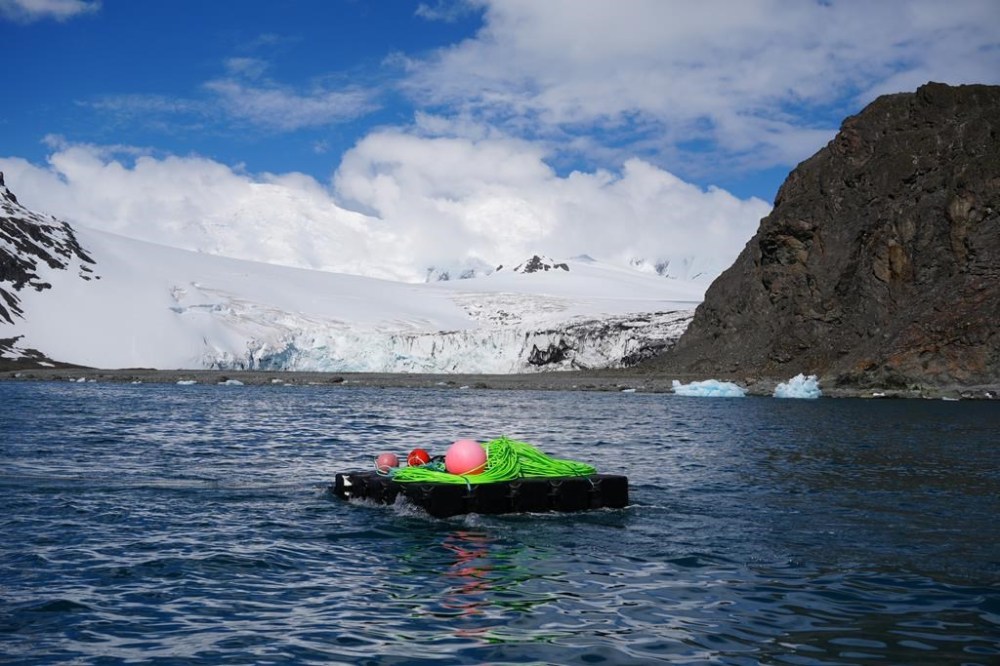
The Southern Ocean observatory, a package of sensors which includes equipment to measure temperature, oxygen concentration and chlorophyll levels on the water, is shown being deployed at the Juan Carlos I Antarctic scientific station, in Antarctica in an undated handout photo. THE CANADIAN PRESS/HO-Consejo Superior de Investigaciones Científicas, Didac Casado Rodriguez, *MANDATORY CREDIT*

Ocean Networks’ CEO Kate Moran says data in the Antarctic, prior to the station being installed, primarily came from surface satellites, some floating research equipment and people on cruises.

The Canadian-built equipment is now about 23 metres deep near a Spanish research station on Livingston Island in the South Shetlands Archipelago, where it is expected to stay for years.

Kohen Bauer, a senior staff scientist at Ocean Networks Canada, says the Southern Ocean and its circumpolar current are critical to how much the water in the area circulates, and having long-term data from a stationary location will help researchers spot changes.

The current that circles the continent connects basins for the Atlantic, Indian and South Pacific oceans.

The observatory, which also measures conductivity, depth and clarity in the water, posts updated data to Ocean Networks Canada’s online dashboard about every 30 minutes.

“This is meant to be a long, continuous, time series and there’s actually very few of those in the world, let alone in the Southern Ocean,” Bauer says.

“We’re trying to establish a continuous time series of these ocean variables. And it’s with these established time series that we can start to ask, or interpret the data, in the context of key questions, both at the local and actually at the regional and potentially global scale.”

Data could pick up changes to sea ice, glacier formation and ice retreat, he says.

“Then, ultimately, it’s about connecting those types of observations to, let’s say, more global questions such as climate change,” he says.

Moran says understanding how the ocean is absorbing the carbon dioxide emitted by greenhouse gases helps to predict the future.

“Colder oceans, like the Arctic, and the Southern Ocean, can absorb more CO2 than other places,” she says.

“So, understanding how that is happening now, and how we can forecast it, helps us to understand further the natural carbon system to help us forecast the future, no matter what happens in terms of emissions.”

Last year, following a symposium focused on the Southern Ocean, 300 scientists from 25 nations issued a statement calling for better observation.

It says the ocean has seen record low levels of sea-ice, record high temperatures and dramatic shifts in penguin populations, among other changes.

“The chronic lack of observations for the Southern Ocean challenges our ability to detect and assess the consequences of change,” the statement says.

“As such, it is more pressing than ever to have a sustained and co-ordinated Southern Ocean observing system to provide an understanding of current conditions, inform predictions of future states, and support policies and regulations for the benefit of society.”

David Hik, the chief scientist for Polar Knowledge Canada, which manages Canada’s scientific contributions in the Antarctic under the Ministry of Northern Affairs, says the observatory and the work with Spain is an example of the kind of contribution Canada can make to Antarctic science.

“Any new observations are going to have a significant impact on our ability to better understand what’s happening in those environments, and how they’re changing over time,” he says.

This report by The Canadian Press was first published Jan. 18, 2024.

Report Error Submit a Tip

More Stories

Trustees call for e-scooter safety education

Maggie Macintosh 4 minute read Preview

Trustees call for e-scooter safety education

Maggie Macintosh 4 minute read 6:00 AM CDT

School trustees are calling on the province to bolster public education around e-bike and e-scooter safety ahead of back-to-school season.

The Manitoba School Boards Association brought members’ concerns about a growing number of students using electronic devices to get to and from classes to the education minister’s office this month.

“There’s a concerning lack of safety knowledge on the part of Manitoba youth,” executive director Alan Campbell said.

Campbell, a long-time trustee in the Interlake School Division, resigned from elected office this summer to run the association that mobilizes school boards and provides them with labour relations support.

Read
6:00 AM CDT

Oliveira shines in win over Redblacks, Collaros rocked again

Taylor Allen 5 minute read Preview

Oliveira shines in win over Redblacks, Collaros rocked again

Taylor Allen 5 minute read Saturday, Aug. 15, 2026

It wasn’t a stellar performance by any stretch.

But at this point, the Winnipeg Blue Bombers will take a win no matter what it looks like.

The Blue and Gold outlasted the winless Ottawa Redblacks 33-21 on a rainy Friday night at Princess Auto Stadium to improve to 5-4.

“It’s great to finally get a win at home for our fans and to go out and play a better game is very encouraging,” said right guard Patrick Neufeld.

Read
Saturday, Aug. 15, 2026

Today’s horoscope

Georgia Nicols 4 minute read Preview

Today’s horoscope

Georgia Nicols 4 minute read Yesterday at 2:00 AM CDT

MOON ALERT: There are no restrictions to shopping or important decisions today. The moon is in Libra.

ARIES (March 21-April 19)

The day is a mixed bag. For the most part, it’s romantic, friendly, congenial and a great time to socialize with others and enjoy playful activities with kids. Nevertheless, you might meet a real sourpuss or someone who is a wet blanket. Keep things light!

TAURUS (April 20-May 20)

Read
Yesterday at 2:00 AM CDT

RCMP searching for missing 34-year-old woman

1 minute read Updated: 8:07 AM CDT

Police are asking for the public’s help locating a 34-year-old woman last heard from almost a week ago.

Tamara Stevens, who also goes by Tammy, was last heard from on Sunday last weekend and was reported missing Tuesday morning, said a Thompson RCMP news release Saturday.

RCMP and family are worried for her well-being.

Stevens is believed to be in Thompson and is described as 5'7, with a slender build and long red hair, said RCMP. She also has a piercing on her lip and was last seen wearing black T-Shirt featuring the Twilight character Jacob, pants and work boots.

Shelters overwhelmed as rising vet costs forcing some owners to surrender pets

Tiago Resko 4 minute read Preview

Shelters overwhelmed as rising vet costs forcing some owners to surrender pets

Tiago Resko 4 minute read 6:00 AM CDT

In the fall of 2022, Tara Miller was faced with a difficult decision: keep her car or sell it to pay for a second knee surgery for her dog.

Ultimately, she needed her car to commute during the winter and decided to manage her dog Corby’s arthritis with medication and home therapy.

“Mentally it probably broke me,” said the 54-year-old.

While insurance covered two-thirds of the dog’s initial $6,000 surgery, Miller had to pay the remaining $2,000. That was on top of the $500 checkup before the surgery and the monthly $175 pet insurance premium.

Read
6:00 AM CDT

‘You vote with your bike’: cyclists celebrate freedoms, call for increased safety

Maggie Macintosh 5 minute read Preview

‘You vote with your bike’: cyclists celebrate freedoms, call for increased safety

Maggie Macintosh 5 minute read Updated: 9:24 AM CDT

Patty Wiens got dressed up in her sparkly, hot pink cowboy boots to pedal and talk politics with more than 100 other people on Sunday.

The founder of Winnipeg’s Fancy Women Bike Ride called on attendees of the 2026 event to ask candidates in the upcoming civic election — a half-dozen of whom were in attendance — about their active transportation platforms.

“We’re here today, in an election year, to remind you that you vote with your bike,” Wiens told a crowd of nearly 120 cyclists gathered on the legislature grounds for the group ride.

“When (city council) candidates come to your door and ask what’s important to you, you’re going to say, ‘I want to ride my bike safely in the city. What are you going to do about it?’”

Read
Updated: 9:24 AM CDT