Film techniques aim to demonstrate cognitive decline
Grandmother’s Alzheimer’s examined by filmmaker

Advertisement
Read this article for free:
or
Already have an account? Log in here »
To continue reading, please subscribe:
Digital Subscription
One year of digital access for only $1.44 a week*
- Enjoy unlimited reading on winnipegfreepress.com
- Read the E-Edition, our digital replica newspaper
- Access News Break, our award-winning app
- Play interactive puzzles
*Billed as $5.77 plus GST every four weeks. After 52 weeks, price increases to the regular rate of $19.95 plus GST every four weeks. Offer available to new and qualified returning subscribers only. Cancel any time.
To continue reading, please subscribe:
Add Free Press access to your Brandon Sun subscription for only an additional
$1 for the first 4 weeks*
- Enjoy unlimited reading on winnipegfreepress.com
- Read the E-Edition, our digital replica newspaper
- Access News Break, our award-winning app
- Play interactive puzzles
*Your next Brandon Sun subscription payment will increase by $1.00 and you will be charged $17.95 plus GST for four weeks. After four weeks, your payment will increase to $24.95 plus GST every four weeks.
Read unlimited articles for free today:
or
Already have an account? Log in here »
Hey there, time traveller!
This article was published 25/01/2024 (999 days ago), so information in it may no longer be current.
St. Boniface-born, Montreal-based filmmaker Ryan McKenna is concerned with the geography of memory.
His Winnipeg-set 2020 film Cranks delved into what critic Alison Gillmor described as a “hyper-local form of nostalgia,” laden with references to Kern Hill Furniture and local radio broadcasting icon Peter Warren’s Action Line.
His recent short film Four Mile Creek travelled back in time to investigate an enduring family ghost story.
SUPPLIED
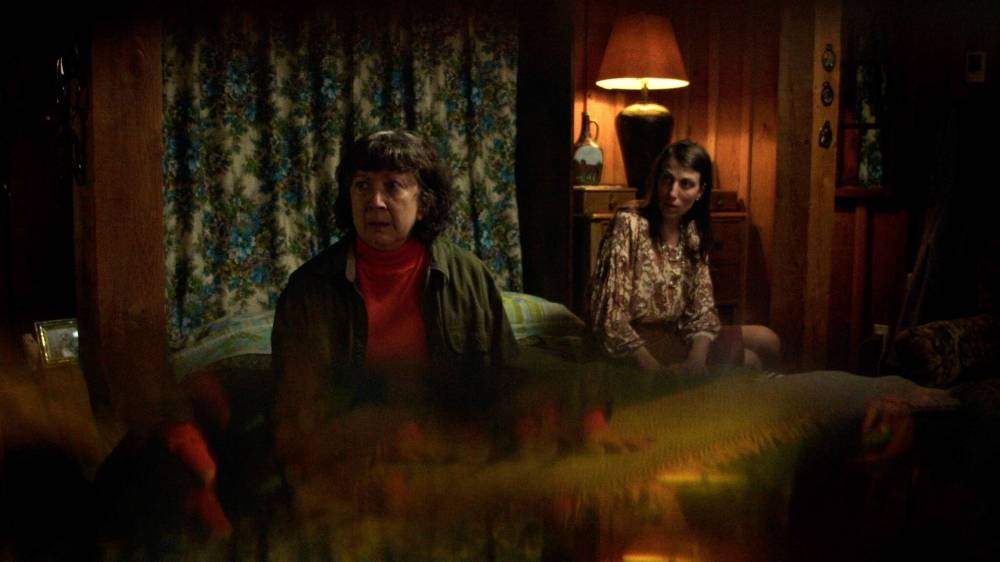
Ryan McKenna observed the changes in his grandmother’s mental well-being over 15 years.
If there is one thing McKenna doesn’t allow himself to do as a director, it is to forget where he comes from. His newest feature, Promenades Nocturnes — screening Saturday at the Dave Barber Cinematheque — follows a woman who isn’t so lucky.
Promenades Nocturnes (Late Night Walks), took form as McKenna returned home each year over a 15-year period, witnessing the gradual shift in his own grandmother’s awareness as she experienced Alzheimer’s disease, accompanied by a slow, yet somehow unpredictable loss of language and coherence.
“I wanted to take those observations and compress them into an hour of cinema. We’re questioning reality just as she is,” says McKenna, 41.
The film places the viewer directly in the experience of the fading but still vibrant Ethel (played by Quebec stage legend Marie Brassard). As her daughter Pam (Sarianne Cormier) tells her mother stories about her upbringing, Ethel hears them as if for the first time.
The scenes with dialogue are shot with documentary realism, and while the words spoken give McKenna’s film a clear and familiar underpinning of dementia-related art, his visual rendering of the terror of memory loss is inventive, immersive and transportative.
“I learned about this painter named William Utermohlen, who when he was diagnosed with dementia painted a series of self-portraits. As the illness progressed, the images became more and more abstract, and I figured it might be interesting to emulate that on a visual level,” McKenna says. (Promenades Nocturnes’ poster is an homage to Utermohlen.)
As Ethel’s condition worsens, she wanders off into the night, seeing the world through a terrifying prism: the edges of reality become foggy and the street light dances like a firework, the after-image shimmering across the screen. It’s not fair to call it dream-like or nightmarish because for Ethel this is everyday life.
To achieve that effect, McKenna put crystals in front of the camera lens, spinning them and twisting them until he found the desired refractions. During one scene, as Ethel “returns” to her childhood on the farm, an entire segment of the screen is missing.
“Ethel grew up on a farm in my mind, and her memories are superimposed as her coherence becomes fragmented on top of her reality,” McKenna says.
Originally written as a chapter in Cranks, McKenna saw that the story could stand on its own. He then interviewed his mother, Elaine, about her experience dealing with her mother’s memory loss, which opened up another avenue for storytelling.
Promenades Nocturnes — which won the award for outstanding film at last year’s Festival du Nouveau Cinema in Montreal — is dedicated to Elaine and her mother Stella.
McKenna’s feature comes in at 63 minutes, so Cinematheque will screen the filmmaker’s latest short, I Used To Live There, a 14-minute blend of documentary and fiction that also focuses on changing ability and sensory experience.
The funny, compelling short follows McKenna’s friend, the photographer Daniel Gerson, a Winnipegger who is losing his vision.

“Dan is really talking about his visual impairment and his own experience,” says McKenna.
Asked to take headshots for an acquaintance, played by Montreal actor Monika Schneider, Gerson dusts off his camera.
Like Promenades Nocturnes, I Used To Live There uses hands-on film effects to explore the deterioration of image: some of the film McKenna shot was processed in a lab, some went through a lomography machine to alter images, and some was “scrunched up like a bird’s nest inside a bucket.”
The short premiered at the Locarno Film Festival and is playing at the TIFF Top Ten showcase next week in Toronto.
ben.waldman@winnipegfreepress.com
Ben Waldman is a National Newspaper Award-nominated reporter on the Arts & Life desk at the Free Press. Born and raised in Winnipeg, Ben completed three internships with the Free Press while earning his degree at Ryerson University’s (now Toronto Metropolitan University’s) School of Journalism before joining the newsroom full-time in 2019. Read more about Ben.
Every piece of reporting Ben produces is reviewed by an editing team before it is posted online or published in print — part of the Free Press‘s tradition, since 1872, of producing reliable independent journalism. Read more about Free Press’s history and mandate, and learn how our newsroom operates.
Our newsroom depends on a growing audience of readers to power our journalism. If you are not a paid reader, please consider becoming a subscriber.
Our newsroom depends on its audience of readers to power our journalism. Thank you for your support.
Film Preview
Promenades Nocturnes
- Dave Barber Cinematheque
- Saturday, 7 p.m.
- With the film I Used to Live There
- Admission $6-$10
Ben Waldman is a National Newspaper Award-nominated reporter on the Arts & Life desk at the Free Press. Born and raised in Winnipeg, Ben completed three internships with the Free Press while earning his degree at Ryerson University’s (now Toronto Metropolitan University’s) School of Journalism before joining the newsroom full-time in 2019. Read more about Ben.
Every piece of reporting Ben produces is reviewed by an editing team before it is posted online or published in print — part of the Free Press‘s tradition, since 1872, of producing reliable independent journalism. Read more about Free Press’s history and mandate, and learn how our newsroom operates.
Our newsroom depends on a growing audience of readers to power our journalism. If you are not a paid reader, please consider becoming a subscriber.
Our newsroom depends on its audience of readers to power our journalism. Thank you for your support.
Advertisement Advertise With Us
Advertisement Advertise With Us
History
Updated on Thursday, January 25, 2024 9:29 AM CST: Formats text