Science sleuths are using technology to find fakery and plagiarism in published research

Advertisement

Advertise with us

Allegations of research fakery at a leading cancer center have turned a spotlight on scientific integrity and the amateur sleuths uncovering image manipulation in published research.

Read this article for free:


By clicking the button above, an account will be created and you will begin to receive some of our recommended newsletters. You may opt out of any newsletter by visiting your Email and Communication Preferences page or by clicking "unsubscribe" at the bottom of any email.

or

Already have an account? Log in here »

To continue reading, please subscribe:

Digital Subscription

One year of digital access for only $1.44 a week*

  • Enjoy unlimited reading on winnipegfreepress.com
  • Read the E-Edition, our digital replica newspaper
  • Access News Break, our award-winning app
  • Play interactive puzzles

*Billed as $5.77 plus GST every four weeks. After 52 weeks, price increases to the regular rate of $19.95 plus GST every four weeks. Offer available to new and qualified returning subscribers only. Cancel any time.

To continue reading, please subscribe:

Add Free Press access to your Brandon Sun subscription for only an additional

$1 for the first 4 weeks*

  • Enjoy unlimited reading on winnipegfreepress.com
  • Read the E-Edition, our digital replica newspaper
  • Access News Break, our award-winning app
  • Play interactive puzzles
Start now

*Your next Brandon Sun subscription payment will increase by $1.00 and you will be charged $17.95 plus GST for four weeks. After four weeks, your payment will increase to $24.95 plus GST every four weeks.

Hey there, time traveller!
This article was published 28/01/2024 (997 days ago), so information in it may no longer be current.

Allegations of research fakery at a leading cancer center have turned a spotlight on scientific integrity and the amateur sleuths uncovering image manipulation in published research.

Dana-Farber Cancer Institute, a Harvard Medical School affiliate, announced Jan. 22 it’s requesting retractions and corrections of scientific papers after a British blogger flagged problems in early January.

The blogger, 32-year-old Sholto David, of Pontypridd, Wales, is a scientist-sleuth who detects cut-and-paste image manipulation in published scientific papers.
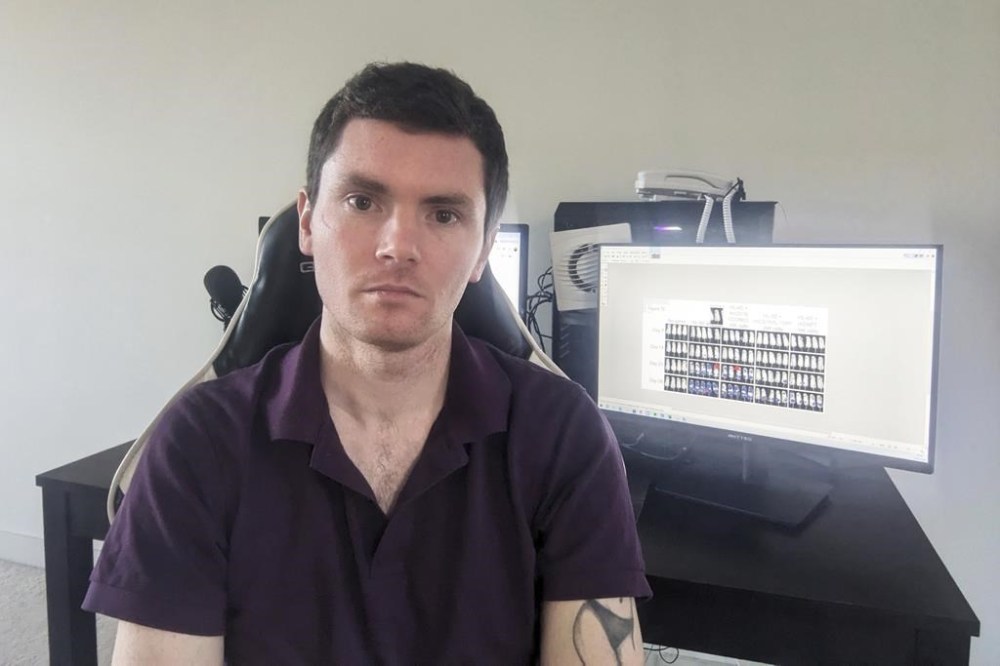
This photo provided by Sholto David shows David at his home in Pontypridd, Wales, Friday, Jan. 26, 2024. David is a scientist-sleuth who detects image manipulation in published scientific papers. Dana-Farber Cancer Institute announced it is requesting six retractions and 31 corrections of scientific papers after he flagged problems in a recent blog post. (Sholto David via AP)

He’s not the only hobbyist poking through pixels. Other champions of scientific integrity are keeping researchers and science journals on their toes. They use special software, oversize computer monitors and their eagle eyes to find flipped, duplicated and stretched images, along with potential plagiarism.

A look at the situation at Dana-Farber and the sleuths hunting sloppy errors and outright fabrications:

WHAT HAPPENED AT DANA-FARBER?

In a Jan. 2 blog post, Sholto David presented suspicious images from more than 30 published papers by four Dana-Farber scientists, including CEO Laurie Glimcher and COO William Hahn.

Many images appeared to have duplicated segments that would make the scientists’ results look stronger. The papers under scrutiny involve lab research on the workings of cells. One involved samples from bone marrow from human volunteers.

The blog post included problems spotted by David and others previously exposed by sleuths on PubPeer, a site that allows anonymous comments on scientific papers.

Student journalists at The Harvard Crimson covered the story on Jan. 12, followed by reports in other news media. Sharpening the attention was the recent plagiarism investigation involving former Harvard president Claudine Gay, who resigned early this year.

HOW DID DANA-FARBER RESPOND?

Dana-Farber said it already had been looking into some of the problems before the blog post. By Jan. 22, the institution said it was in the process of requesting six retractions of published research and that another 31 papers warranted corrections.

Retractions are serious. When a journal retracts an article that usually means the research is so severely flawed that the findings are no longer reliable.

Dr. Barrett Rollins, research integrity officer at Dana-Farber, said in a statement: “Following the usual practice at Dana-Farber to review any potential data error and make corrections when warranted, the institution and its scientists already have taken prompt and decisive action in 97 percent of the cases that had been flagged by blogger Sholto David.”

WHO ARE THE SLEUTHS?

California microbiologist Elisabeth Bik, 57, has been sleuthing for a decade. Based on her work, scientific journals have retracted 1,133 articles, corrected 1,017 others and printed 153 expressions of concern, according to a spreadsheet where she tracks what happens after she reports problems.

She has found doctored images of bacteria, cell cultures and western blots, a lab technique for detecting proteins.

“Science should be about finding the truth,” Bik told The Associated Press. She published an analysis in the American Society for Microbiology in 2016: Of more than 20,000 peer-reviewed papers, nearly 4% had image problems, about half where the manipulation seemed intentional.

Bik’s work brings donations from Patreon subscribers of about $2,300 per month and occasional honoraria from speaking engagements. David told AP his Patreon income recently picked up to $216 per month.

Technology has made it easier to root out image manipulation and plagiarism, said Ivan Oransky, who teaches medical journalism at New York University and co-founded the Retraction Watch blog. The sleuths download scientific papers and use software tools to help find problems.

Others doing the investigative work remain anonymous and post their findings under pseudonyms. Together, they have “changed the equation” in scientific publication, Oransky said.

“They want science to be and do better,” Oransky said. “And they are frustrated by how uninterested most people in academia — and certainly in publishing — are in correcting the record.” They’re also concerned about the erosion of public trust in science.

WHAT MOTIVATES MISCONDUCT?

Bik said some mistakes could be sloppy errors where images were mislabeled or “somebody just grabbed the wrong photo.”

But some images are obviously altered with sections duplicated or rotated or flipped. Scientists building their careers or seeking tenure face pressure to get published. Some may intentionally falsify data, knowing that the process of peer review — when a journal sends a manuscript to experts for comments — is unlikely to catch fakery.

“At the end of the day, the motivation is to get published,” Oransky said. “When the images don’t match the story you’re trying to tell, you beautify them.”

WHAT HAPPENS NEXT?

Scientific journals investigate errors brought to their attention but usually keep their processes confidential until they take action with a retraction or correction.

Some journals told the AP they are aware of the concerns raised by David’s blog post and were looking into the matter.

___

The Associated Press Health and Science Department receives support from the Howard Hughes Medical Institute’s Science and Educational Media Group. The AP is solely responsible for all content.
Report Error Submit a Tip

More Stories

Police HQ report ‘outrageous’: Kinew

Joyanne Pursaga 6 minute read Preview

Police HQ report ‘outrageous’: Kinew

Joyanne Pursaga 6 minute read Yesterday at 6:18 PM CDT

Premier Wab Kinew says public inquiry findings that taxpayers were overcharged more than $40 million for the Winnipeg Police Service headquarters project and two city leaders broke the public trust are “outrageous.”

Inquiry commissioner Garth Smorang’s report, which was released Monday, concluded former mayor Sam Katz “violated the public trust” and council code of conduct, while the city’s former chief administrative officer Phil Sheegl suffered from a “complete lack of a moral compass.”

Smorang also found the city was overcharged $43.3 million for the project, with $42 million of that going to key contractor Caspian Projects.

“It’s outrageous that people who were elected betrayed the public here in the city. It’s outrageous that there were people in business who ripped you off, ripped me off — I was paying property taxes in Winnipeg at the time — and ripped all of us off to the tune of $43.3 million. That’s crazy,” said Kinew.

Read
Yesterday at 6:18 PM CDT

Accused used fuel-filled bottle to set blaze that killed two, court hears

Dean Pritchard 4 minute read Preview

Accused used fuel-filled bottle to set blaze that killed two, court hears

Dean Pritchard 4 minute read Monday, Oct. 19, 2026

Alex Courchene failed once to set a North End church ablaze, then returned a day later and tried again, starting a fire that killed two people living in an upstairs apartment suite, a jury was told Monday.

Read
Monday, Oct. 19, 2026

Klein calls union’s attack ads ‘dirty politics,’ urges Gillingham to reject support

Matthew Frank 4 minute read Preview

Klein calls union’s attack ads ‘dirty politics,’ urges Gillingham to reject support

Matthew Frank 4 minute read Updated: Yesterday at 5:47 PM CDT

Mayoral candidate Kevin Klein said attack ads from Winnipeg’s largest union are an example of “dirty politics” and verge on United States-style campaigning.

The pamphlets, signed by the Canadian Union of Public Employees Local 500, show a United States flag draped behind Klein, with text stating he has sided with “the broader alt-right political movement” and defends the U.S.

“As Canadians we have to hold ourselves to a higher standard. This is not the politics that we have experienced in the City of Winnipeg. This is not the type of politics we want to experience in Canada,” he said during a Tuesday news conference at his campaign headquarters.

He called on incumbent candidate Scott Gillingham to denounce the ads and reject the union’s campaign support.

Read
Updated: Yesterday at 5:47 PM CDT

Empty desks: Advocates talk chronic school absenteeism

Maggie Macintosh 5 minute read Preview

Empty desks: Advocates talk chronic school absenteeism

Maggie Macintosh 5 minute read Updated: Yesterday at 3:16 PM CDT

Concerned that school and government leaders are downplaying the state of student absenteeism, community organizers are strategizing to create urgency around who’s regularly missing class — and why — in Winnipeg.

The inaugural Youth at Risk in Winnipeg Symposium, held over the weekend at the Canadian Mennonite University, drew roughly 100 people to discuss barriers to attendance and brainstorm ways to remove them.

Nearly 20 years after he began calling attention to the issue, first as a volunteer with the Point Douglas Residents Committee, Sel Burrows gave an impassioned speech about the lack of political will to take meaningful action to help students from “dysfunctional homes.”

“I’ve dealt with nine cabinet ministers, Conservative and NDP, and five deputy ministers, and the issue has not gotten any better,” Burrows told teachers, reseachers and community support workers gathered Saturday on CMU’s Shaftesbury campus.

Read
Updated: Yesterday at 3:16 PM CDT

Be careful with old flame’s power games

Maureen Scurfield 5 minute read Yesterday at 2:00 AM CDT

DEAR MISS LONELYHEARTS: I just ran into the short-haired girl I was crazy in love with back in high school. She wore all black clothes, kind of looked like a guy, but used dark lipstick and dyed her hair different weird colours. She always looked like a scary, powerful woman and she loved to tease me, because I was shy back then.

She was standing there in the sun, and I liked her new look — blue-black hair, dressed in a black suit, hot-looking and powerful as ever! But after we started talking, she suggested we go catch up over a drink and lunch.

After eating and drinking a lot on my tab, she was a bit tipsy and confessed she already has a boyfriend she quite likes, because he doesn’t bow down to her.

To get even, I told her I had a girlfriend, “but that could change.” Then I paid the tab. She finally liked something about me!

Maple leaf love: Albertans vote strongly to stay in Canada

Jack Farrell, The Canadian Press 6 minute read Preview

Maple leaf love: Albertans vote strongly to stay in Canada

Jack Farrell, The Canadian Press 6 minute read Updated: Yesterday at 5:00 AM CDT

EDMONTON - O Canada, Alberta is staying put.

In a historic referendum Monday, voters marked their ballots in overwhelming numbers to remain in the country that made Alberta a province 121 years ago.

In early returns, about 76 per cent of Albertans said yes to Confederation, while 24 per cent said they wanted the province to hold a second, binding referendum on leaving.

Both Alberta Premier Danielle Smith and Prime Minister Mark Carney lauded the result.

Read
Updated: Yesterday at 5:00 AM CDT