Extreme heat, wildfire smoke harm low-income and nonwhite communities the most, study finds
Advertisement
Read this article for free:
or
Already have an account? Log in here »
To continue reading, please subscribe:
Digital Subscription
One year of digital access for only $1.44 a week*
- Enjoy unlimited reading on winnipegfreepress.com
- Read the E-Edition, our digital replica newspaper
- Access News Break, our award-winning app
- Play interactive puzzles
*Billed as $5.77 plus GST every four weeks. After 52 weeks, price increases to the regular rate of $19.95 plus GST every four weeks. Offer available to new and qualified returning subscribers only. Cancel any time.
To continue reading, please subscribe:
Add Free Press access to your Brandon Sun subscription for only an additional
$1 for the first 4 weeks*
- Enjoy unlimited reading on winnipegfreepress.com
- Read the E-Edition, our digital replica newspaper
- Access News Break, our award-winning app
- Play interactive puzzles
*Your next Brandon Sun subscription payment will increase by $1.00 and you will be charged $17.95 plus GST for four weeks. After four weeks, your payment will increase to $24.95 plus GST every four weeks.
Read unlimited articles for free today:
or
Already have an account? Log in here »
Hey there, time traveller!
This article was published 02/02/2024 (988 days ago), so information in it may no longer be current.
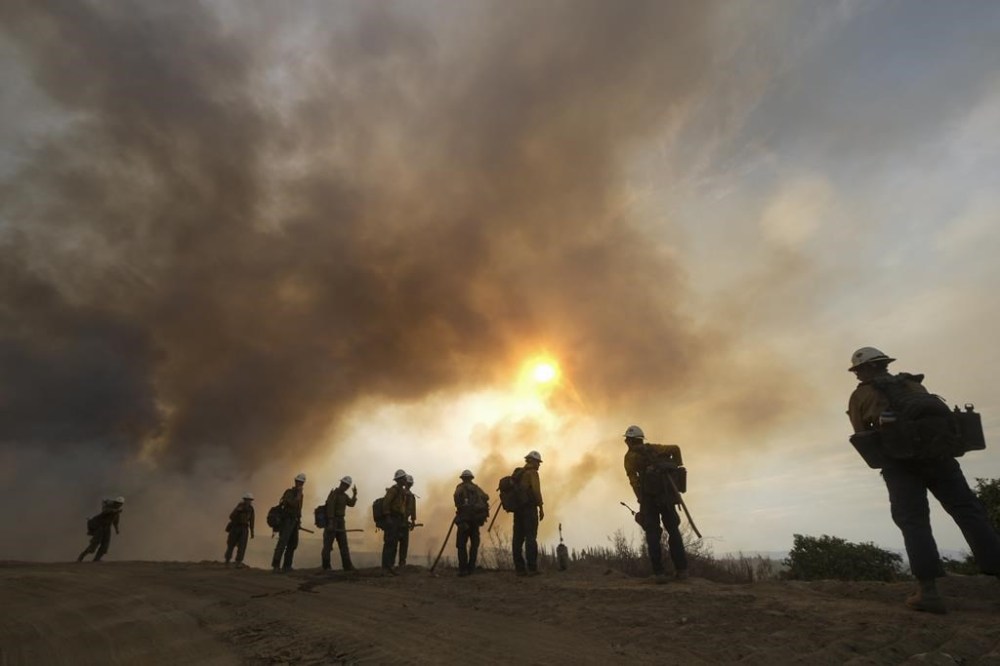
LOS ANGELES (AP) — Extreme heat and wildfire smoke are independently harmful to the human body, but together their impact on cardiovascular and respiratory systems is more dangerous and affects some communities more than others.
A study published Friday in the journal Science Advances said climate change is increasing the frequency of both hazards, particularly in California. The authors found that the combined harm of extreme heat and inhalation of wildfire smoke increased hospitalizations and disproportionately impacted low-income communities and Latino, Black, Asian and other racially marginalized residents.
The reasons are varied and complicated, according to the authors from the Scripps Institution of Oceanography at the University of California, San Diego and the UCLA Fielding School of Public Health. Structural racism, discriminatory practices, lack of medical insurance, less understanding of the health damages and a higher prevalence of multiple coexisting conditions are among the reasons.
Infrastructure, the surrounding environment and available resources are also factors. Homes and work places with air conditioning and neighborhoods with tree canopy cover are better protected from extreme heat, and some buildings filter smoke from wildfires and insulate heat more efficiently. Areas with access to cooling centers, such as libraries, also offer more protection.
“Even if you’re very susceptible — you have a lot of comorbidities — you may have many opportunities to not be impacted, not being hospitalized, not having to go to the ER, but if you live in a place that is quite remote that does not have access to a lot of social services or amenities, … it may be more trouble,” said Tarik Benmarhnia, a study author and climate change epidemiologist at UC San Diego.
Experts warn that climate change — which is worsening extreme weather events such as droughts, heat waves and wildfires — will increase the frequency and intensity in which they occur simultaneously.
While the study focused on California, similar patterns can be found in other parts of the western United States such as Oregon and Washington state, in parts of Canada including British Columbia, and in regions with Mediterranean climate, said Benmarhnia.
Researchers analyzed California health records — broken down by 995 ZIP codes covering most of the state’s population — during episodes of extreme heat and toxic air from wildfires. They discovered that between 2006 and 2019, hospitalizations for cardiorespiratory issues increased by 7% on days where both conditions existed, and they were higher than that in ZIP codes where people were likelier to be poor, nonwhite, living in dense areas and not have health care.
California’s Central Valley and the state’s northern mountains had higher incidences of both hot weather and wildfires, likely driven by more forest fires in surrounding mountains.
Residents in the Central Valley agricultural heartland are particularly vulnerable to the adverse health effects of both because they are likelier to work outdoors and be exposed to pesticides and other environmental hazards, said Benmarhnia.
Beyond the health risks, being hospitalized has other significant consequences, such as losing hours of work or school, or being left with hefty medical bills.
During extremely hot days, the human body has a harder time cooling itself off through sweating, said Christopher T. Minson, professor of human physiology at the University of Oregon, who wasn’t part of the study. The body can become dehydrated, forcing the heart to beat faster, which elevates blood pressure.
“If you’re dehydrated or if you have any kind of cardiovascular disease, … you’re going to be less able to tolerate that heat stress, and that heat stress can become very, very dangerous,” he said.
Some particles found in wildfire smoke can enter easily through the nose and throat, eventually arriving at the lungs, according to the Environmental Protection Agency. The smallest particles can even enter the bloodstream.
The combination of heat and smoke can cause inflammation in the body, Minson said, which is “going to make all your cardiovascular regulation worse, and you’re going to be at even more risk of heart attacks and other problems like long term, poor health outcomes from that. So it’s definitely a snowball effect.”
A 2022 study by the University of Southern California found that the risk of death surged on days when extreme heat and air pollution coincided. During heat waves, the likelihood of death increased by 6.1%; when air pollution was extreme, it rose by 5%; and on days when both combined, the threat skyrocketed to 21%.
When Dr. Catharina Giudice worked at a hospital in Los Angeles, she noticed an uptick of emergency room visits from patients with various health conditions on extremely hot days. When wildfires blazed, she saw more people with exacerbated asthma and other respiratory diseases.
As climate change fuels the intensity and frequency of heat waves and wildfires, Giudice worries about the low-income and minority communities that are less adapted to them.
“For a variety of reason, they tend to feel climate change much worse than other non-underserved communities, and I think it’s really important to highlight this social injustice aspect of climate change,” said the emergency physician and fellow at the Harvard T.H. Chan School of Public Health, who was not part of the study.
The authors noted that agencies like the National Weather Service and local air quality districts issue separate advisories and warnings on days of extreme heat and toxic air. But they argue that “issuing a joint warning earlier considering the compound exposure would be beneficial.”
———
The Associated Press receives support from the Walton Family Foundation for coverage of water and environmental policy. The AP is solely responsible for all content. For all of AP’s environmental coverage, visit https://apnews.com/hub/climate-and-environment
Related Articles
Change is in the air
Advertisement Advertise With Us
Advertisement Advertise With Us