Saturn’s Death Star-looking moon may have vast underground ocean

Advertisement

Advertise with us

CAPE CANAVERAL, Fla. (AP) — Astronomers have found the best evidence yet of a vast, young ocean beneath the icy exterior of Saturn’s Death Star lookalike mini moon.

Read this article for free:


or

Already have an account? Log in here »

To continue reading, please subscribe:

Subscribe and receive a limited-edition Free Press branded hat or tote.

Digital Subscription

One year of digital access for only $205*

  • Enjoy unlimited reading on winnipegfreepress.com
  • Read the E-Edition, our digital replica newspaper
  • Access News Break, our award-winning app
  • Play interactive puzzles

*First annual payment billed as $205.00 + GST for one year. This annual subscription will automatically renew at $233.00 + GST every 52 weeks (10% off the regular annual price of $259.35). Offer available to new and qualified returning subscribers only. Cancel any time.

To continue reading, please subscribe:

Add Free Press access to your Brandon Sun subscription for only an additional

$1 for the first 4 weeks*

  • Enjoy unlimited reading on winnipegfreepress.com
  • Read the E-Edition, our digital replica newspaper
  • Access News Break, our award-winning app
  • Play interactive puzzles
Start now

*Your next Brandon Sun subscription payment will increase by $1.00 and you will be charged $17.95 plus GST for four weeks. After four weeks, your payment will increase to $24.95 plus GST every four weeks.

Hey there, time traveller!
This article was published 07/02/2024 (919 days ago), so information in it may no longer be current.

CAPE CANAVERAL, Fla. (AP) — Astronomers have found the best evidence yet of a vast, young ocean beneath the icy exterior of Saturn’s Death Star lookalike mini moon.

The French-led team analyzed changes in Mimas’ orbit and rotation and reported Wednesday that a hidden ocean 12 to 18 miles (20 to 30 kilometers) beneath the frozen crust was more likely than an elongated rocky core. The scientists based their findings on observations by NASA’s Cassini spacecraft, which observed Saturn and its more than 140 moons for more than a decade before diving through the ringed planet’s atmosphere in 2017 and burning up.

Barely 250 miles (400 kilometers) in diameter, the heavily cratered moon lacks the fractures and geysers — typical signs of subsurface activity — of Saturn’s Enceladus and Jupiter’s Europa.

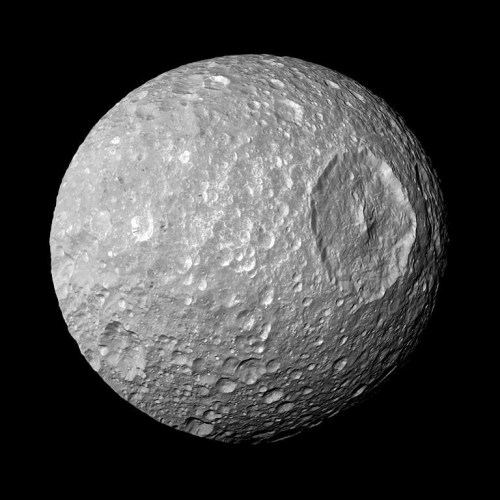
This Feb. 13, 2010 image provided by NASA shows Saturn's moon Mimas and it's large Herschel Crater, captured by the Cassini spacecraft. The crater is 130 kilometers (80 miles) wide. Astronomers have reported the best evidence yet of a vast, relatively new ocean beneath the icy exterior of Mimas, believed between 5 million and 15 million years old. The findings were published Wednesday, Feb. 7, 2024, in the journal Nature. (NASA/JPL-Caltech/Space Science Institute via AP)

“Mimas was probably the most unlikely place to look for a global ocean — and liquid water more generally,” co-author Valery Lainey of the Paris Observatory said in an email. “So that looks like a potential habitable world. But nobody knows how much time is needed for life to arise.”

Results were published in the journal Nature.

The ocean is believed to fill half of Mimas’ volume, according to Lainey. Yet it represents only 1.2% to 1.4% of Earth’s oceans given the moon’s petite size. Despite being so small, Mimas boasts the second largest impact crater of any moon in the solar system — the reason it’s compared to the fictional Death Star space station in “Star Wars.”

“The idea that relatively small, icy moons can harbor young oceans is inspiring,” SETI Institute’s Matija Cuk and Southwest Research Institute’s Alyssa Rose Rhoden wrote in an accompanying editorial. They were not part of the study.

Believed between 5 million and 15 million years old, too young to mark the moon’s surface, this subterranean ocean would have an overall temperature right around freezing, according to Lainey. But at the seafloor, he said the water temperature could be much warmer.

Co-author Nick Cooper of Queen Mary University of London said the existence of a “remarkably young” ocean of liquid water makes Mimas a prime candidate for studying the origin of life.

Discovered in 1789 by English astronomer William Herschel, Mimas is named after a giant in Greek mythology.

___

The Associated Press Health and Science Department receives support from the Howard Hughes Medical Institute’s Science and Educational Media Group. The AP is solely responsible for all content.


Report Error Submit a Tip

More Stories

Missing pet tortoise found at Oak Hammock Marsh

Zoe Pierce 3 minute read Preview

Missing pet tortoise found at Oak Hammock Marsh

Zoe Pierce 3 minute read Tuesday, Aug. 11, 2026

Nobody at Oak Hammock Marsh expected to find an African spurred tortoise wandering through the wetlands. Least of all one that had travelled more than 20 kilometres from home to get there.

Read
Tuesday, Aug. 11, 2026

Blue Bombers return with Collaros at the controls

Taylor Allen 7 minute read Preview

Blue Bombers return with Collaros at the controls

Taylor Allen 7 minute read 5:22 PM CDT

There are worse places the Winnipeg Blue Bombers could be than 4-4.

But if they want to stay at or above .500, they can’t play anything like they have in their previous two outings, in which they’ve been outscored 87-49. Their latest setback was a 35-19 loss to the B.C. Lions on July 30.

“Everybody wants to win every single game in our locker room so I think we can empathize with people’s frustration,” said quarterback Zach Collaros after Thursday’s walkthrough at Princess Auto Stadium.

The Bombers have a glorious opportunity to get back on track when they host the lowly, winless Ottawa Redblacks (0-8) for a 7:30 p.m. kickoff on Friday night. The Redblacks dropped a 42-20 road result against the Saskatchewan Roughriders last week.

Read
5:22 PM CDT

‘Disrespectful’: residents frustrated after Wyatt arrives hour late to committee meeting

Joyanne Pursaga 3 minute read Preview

‘Disrespectful’: residents frustrated after Wyatt arrives hour late to committee meeting

Joyanne Pursaga 3 minute read 4:37 PM CDT

Several Winnipeggers attending a city development hearing on Thursday expressed frustration that one councillor arrived about an hour late, delaying the matter from being heard.

Coun. Russ Wyatt, who continues to attend city hall while facing criminal charges, began participating in the 9:30 a.m. East Kildonan-Transcona community committee meeting at 10:35 a.m.

A resident who hoped to speak at the meeting about a development plan in south Transcona noted the tardiness led the committee to bump the topic down on its agenda, while dozens waited to speak on it.

Christina Pyra eventually opted to leave city hall instead of waiting for her turn to make a presentation, to avoid missing a work commitment.

Read
4:37 PM CDT

Poilievre’s simplistic bluster a desperate bid for attention in a serious moment for nation

Tom Brodbeck 6 minute read Preview

Poilievre’s simplistic bluster a desperate bid for attention in a serious moment for nation

Tom Brodbeck 6 minute read Tuesday, Aug. 11, 2026

Conservative Leader Pierre Poilievre’s suggestion that Mark Carney needs more “backbone” to negotiate with Donald Trump would be easier to take seriously if anyone had actually figured out how to negotiate with the U.S. president.

Read
Tuesday, Aug. 11, 2026

Signs the Carney approach is working

Editorial 4 minute read Preview

Signs the Carney approach is working

Editorial 4 minute read Yesterday at 2:00 AM CDT

It was, if nothing else, a glowing review in trying times.

Matt Winkler, the editor in chief emeritus of Bloomberg News, spoke last week on Bloomberg Business News Daily about a recent Bloomberg analysis of the performance of the Canadian economy, and this country as a target for investment

“This is one of the greatest periods for overseas investment in Canada that we’ve seen in the century, and it may be unprecedented, because we have to wait for the rest of the year. … Money is pouring into Canada like we have not seen from everywhere. Stocks and bonds are the obvious beneficiaries,” Winkler said. He argued that Canada is both liked and seen as reasonable.

“The point is… Canada since Mark Carney became prime minister in 2025, has outperformed everyone in America and also the Eurozone and anywhere in the world. The 10 largest stock markets in the world, Canada appreciated the most, more than 40 per cent. … Its bond market is also doing great, partially because the inflation rate in Canada, unlike the Eurozone or America, is actually trending lower, and is outperforming both the Eurozone and the U.S.”

Read
Yesterday at 2:00 AM CDT

Saturn’s Death Star-looking moon may have vast underground ocean

Marcia Dunn, The Associated Press 3 minute read Preview

Saturn’s Death Star-looking moon may have vast underground ocean

Marcia Dunn, The Associated Press 3 minute read Wednesday, Feb. 7, 2024

CAPE CANAVERAL, Fla. (AP) — Astronomers have found the best evidence yet of a vast, young ocean beneath the icy exterior of Saturn’s Death Star lookalike mini moon.

The French-led team analyzed changes in Mimas’ orbit and rotation and reported Wednesday that a hidden ocean 12 to 18 miles (20 to 30 kilometers) beneath the frozen crust was more likely than an elongated rocky core. The scientists based their findings on observations by NASA’s Cassini spacecraft, which observed Saturn and its more than 140 moons for more than a decade before diving through the ringed planet's atmosphere in 2017 and burning up.

Barely 250 miles (400 kilometers) in diameter, the heavily cratered moon lacks the fractures and geysers — typical signs of subsurface activity — of Saturn’s Enceladus and Jupiter’s Europa.

“Mimas was probably the most unlikely place to look for a global ocean — and liquid water more generally,” co-author Valery Lainey of the Paris Observatory said in an email. “So that looks like a potential habitable world. But nobody knows how much time is needed for life to arise."

Read
Wednesday, Feb. 7, 2024