‘Energy needs’: Study shows polar bears can’t survive on extended land-based diet

Advertisement

Advertise with us

Polar bears along Hudson Bay stranded on land by a lengthening summer tried everything to feed themselves, from swimming after seal carcasses to munching on caribou antlers.

Read this article for free:


or

Already have an account? Log in here »

To continue reading, please subscribe:

Subscribe and receive a limited-edition Free Press branded hat or tote.

Digital Subscription

One year of digital access for only $205*

  • Enjoy unlimited reading on winnipegfreepress.com
  • Read the E-Edition, our digital replica newspaper
  • Access News Break, our award-winning app
  • Play interactive puzzles

*First annual payment billed as $205.00 + GST for one year. This annual subscription will automatically renew at $233.00 + GST every 52 weeks (10% off the regular annual price of $259.35). Offer available to new and qualified returning subscribers only. Cancel any time.

To continue reading, please subscribe:

Add Free Press access to your Brandon Sun subscription for only an additional

$1 for the first 4 weeks*

  • Enjoy unlimited reading on winnipegfreepress.com
  • Read the E-Edition, our digital replica newspaper
  • Access News Break, our award-winning app
  • Play interactive puzzles
Start now

*Your next Brandon Sun subscription payment will increase by $1.00 and you will be charged $17.95 plus GST for four weeks. After four weeks, your payment will increase to $24.95 plus GST every four weeks.

Hey there, time traveller!
This article was published 13/02/2024 (950 days ago), so information in it may no longer be current.

Polar bears along Hudson Bay stranded on land by a lengthening summer tried everything to feed themselves, from swimming after seal carcasses to munching on caribou antlers.

But a new research project found nothing worked, a conclusion that may be the last word on whether the bears can find enough food on shore to make up for the ever-declining time they have to hunt from sea ice.

“There really isn’t any terrestrial food that is going to meet their energy needs,” said Anthony Pagano, lead author of a paper published in Nature Communications on the much-studied polar bears of Hudson Bay’s west shore.
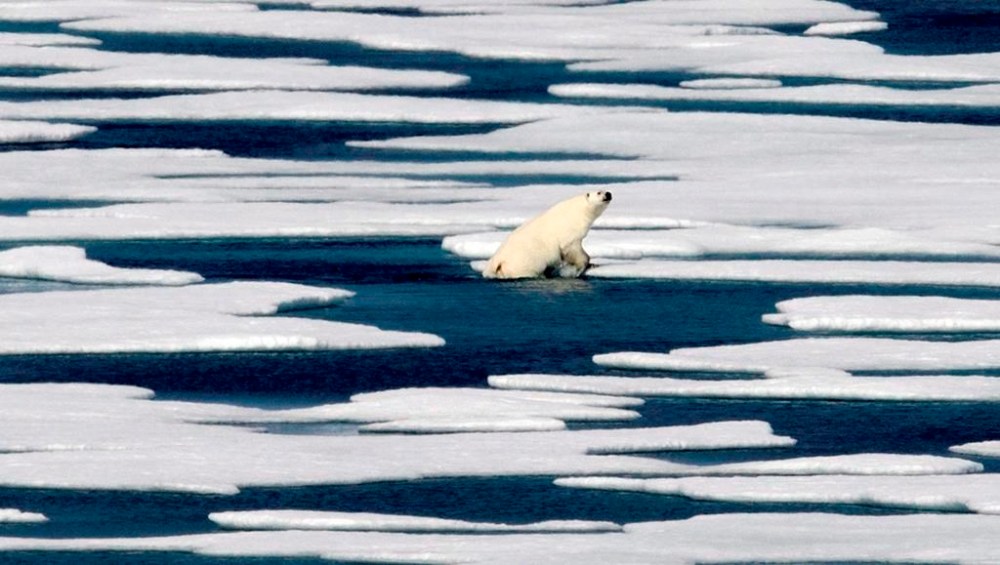
Polar bears along Hudson Bay stranded on land by a lengthening summer tried everything to feed themselves, from swimming after seal carcasses to munching on caribou antlers. A polar bear climbs out of the water to walk on the ice in the Franklin Strait in the Canadian Arctic Archipelago Saturday, July 22, 2017. THE CANADIAN PRESS/AP-David Goldman

Scientists have long been watching how the West Hudson Bay polar bears, one of the world’s most southerly populations, fare as the climate continues to change.

Because sea ice now melts earlier and forms later, the bears spend about three weeks longer on land than they did in the ’80s, extending the time they’re off the sea ice they use to hunt fat-rich seals, their main prey. That shorebound period is likely to lengthen by up to two weeks per decade.

The question is whether there’s enough food on land to sustain polar bears, the largest and therefore hungriest bears on Earth.

Pagano and his colleagues rigged up 20 bears with small video cameras around their necks, allowing the team to track the hour-by-hour wanderings of 20 individual bears for three weeks.

“We had a bear’s-eye view of their behaviour,” Pagano said. “They will scour the landscape, looking for anything.”

Some bears simply slept, up to 98 per cent of the time.

The rest put the “omni” in “omnivore.” Almost all munched down grasses and kelp. Most ate berries. Many gulped eggs, scavenged bird carcasses and crunched bones — including caribou antlers.

Some swam out into the bay, finding the occasional seal carcass. One swam all night, 50 kilometres offshore, to find a floating dead beluga whale, which the bear mostly used as a resting platform before swimming back.

But none maintained their body weight. All lost about two kilograms a day.

“Regardless of what strategy they were using, they all lost weight at a similar rate,” Pagano said. “They’re not really getting any net benefit beyond compensating for the higher energy demands they were using.”

It’s normal for bears to lose weight during the ice-free period. It’s not normal for them to be losing weight for longer and longer periods of time, forcing them to start the winter weaker.

Pagano said the longer ice-free period is hardest on younger animals.

“They’re smaller, they have higher energy expenditure, they may not be as skilled a hunter, and they aren’t able to accumulate as much body fat,” he said. “They’re going to be the individuals that are at greater risk.”

All bears made it through the study period. One had enough body fat remaining to survive into the following summer.

But two young females in Pagano’s study lost weight at a pace that made it unlikely they’d survive until the ice returned. Another young male seemed doomed until he found a large carcass to scavenge that probably saved his life.

Polar bears aren’t just grizzlies in white suits, Pagano concluded.

“Foods available from shore are pretty low in energetic content. (Polar bears) need a high-energy diet.”

This report by The Canadian Press was first published Feb. 13, 2024

Report Error Submit a Tip

More Stories

Puzzles Palace

1 minute read Monday, Jul. 27, 2026

To solve our puzzles, please subscribe with this special offer: |

United Way, other charities fight for dollars as donor base shrinks

Scott Billeck 7 minute read Preview

United Way, other charities fight for dollars as donor base shrinks

Scott Billeck 7 minute read Yesterday at 2:00 AM CDT

Winnipeg’s charitable sector is being squeezed from both sides: demand for help is growing while the pool of donors to meet that need is shrinking.

The imbalance is increasingly being carried by a relatively small group of deep-pocketed donors. Last year, 600 people — about three per cent of United Way Winnipeg’s individual donors — accounted for roughly $8 million, or 55 per cent of individual donations.

The fundraising pitch isn’t getting any easier.

Homelessness and public drug use have become increasingly visible, household budgets remain strained and the problems charities are trying to address can seem so entrenched that donors may reasonably wonder what difference another contribution can make.

Read
Yesterday at 2:00 AM CDT

Near-future U.S. the setting for surreal dual-world storyline

Reviewed by Morley Walker 4 minute read Preview

Near-future U.S. the setting for surreal dual-world storyline

Reviewed by Morley Walker 4 minute read 2:01 AM CDT

It’s not every day you encounter a seriously intended literary novel that attempts to dramatize a mind-bending physics theory like quantum entanglement.

But then the B.C.-born-and-raised Emily St. John Mandel is not your everyday Canadian literary writer.

In her late 40s, she has lived in the U.S. for her entire writing career. She is best known for her 2014 dystopian novel Station Eleven, about a Shakespearean acting troupe navigating a pandemic-ravaged America.

Her new outing, her seventh, Exit Party, shares DNA with detective and sci-fi genres more than with conventional literary fiction.

Read
2:01 AM CDT

Elmwood–East Kildonan candidate promises to tackle ‘inefficiency’ in government

Gabrielle Piché 3 minute read Preview

Elmwood–East Kildonan candidate promises to tackle ‘inefficiency’ in government

Gabrielle Piché 3 minute read 6:17 PM CDT

The former assistant of late Elmwood–East Kildonan councillor Jason Schreyer is again running for the seat.

Chris Sweryda officially launched his campaign Saturday. He did so with the backdrop of a grocery program he runs, where food is sold near-cost out of St. Gerard School’s gym.

Rows of cereal, pasta sauce and chips filled tables ahead of the program’s afternoon opening. Sweryda created the pop-up with Schreyer months ahead of the former councillor’s April 2025 death.

The program sees roughly 500 people each day it’s open (which is every other week on Saturday), Sweryda said.

Read
6:17 PM CDT

Manitoba abandoning spring, fall clock changes

Carol Sanders 8 minute read Preview

Manitoba abandoning spring, fall clock changes

Carol Sanders 8 minute read Updated: Yesterday at 8:48 AM CDT

Time’s up for the time change in Manitoba.

Manitobans won’t be setting their clocks back an hour in November. The province has decided to permanently stay on daylight time after surveying residents on the twice annual clock adjustment.

“We heard from Manitobans loud and clear — no more changing the clocks in Manitoba,” Premier Wab Kinew said in a news release Thursday.

Most of the 72,000 votes submitted in an online EngageMB survey — 92 per cent — said they would like to see the practice end. The survey asked if they preferred earlier sunrises in winter with standard time or the later sunsets in summer with daylight time. More than half of survey participants (58 per cent) indicated a preference to stay on permanent daylight time; 34 per cent voted to eliminate the time change but stay on standard time.

Read
Updated: Yesterday at 8:48 AM CDT

Desperate Poilievre wants Canadians to believe the sky is falling when it’s just cloudy outside

Tom Brodbeck 5 minute read Preview

Desperate Poilievre wants Canadians to believe the sky is falling when it’s just cloudy outside

Tom Brodbeck 5 minute read Yesterday at 12:47 PM CDT

Pierre Poilievre has a problem.

Canadians just don’t seem to be paying much attention to him anymore.

So, naturally, the Conservative Opposition leader has decided to turn up the volume.

At a recent party caucus retreat in Penticton, B.C., Poilievre delivered the familiar message: Canada is in trouble, Canadians are hurting and the Liberal government is making everything worse.

Read
Yesterday at 12:47 PM CDT