Room-service spirit guide for the gentleman rogue in Room 306

Advertisement
Read this article for free:
or
Already have an account? Log in here »
To continue reading, please subscribe:

Digital Subscription
One year of digital access for only $205*
- Enjoy unlimited reading on winnipegfreepress.com
- Read the E-Edition, our digital replica newspaper
- Access News Break, our award-winning app
- Play interactive puzzles
*First annual payment billed as $205.00 + GST for one year. This annual subscription will automatically renew at $233.00 + GST every 52 weeks (10% off the regular annual price of $259.35). Offer available to new and qualified returning subscribers only. Cancel any time.
To continue reading, please subscribe:
Add Free Press access to your Brandon Sun subscription for only an additional
$1 for the first 4 weeks*
- Enjoy unlimited reading on winnipegfreepress.com
- Read the E-Edition, our digital replica newspaper
- Access News Break, our award-winning app
- Play interactive puzzles
*Your next Brandon Sun subscription payment will increase by $1.00 and you will be charged $17.95 plus GST for four weeks. After four weeks, your payment will increase to $24.95 plus GST every four weeks.
Read unlimited articles for free today:
or
Already have an account? Log in here »
Hey there, time traveller!
This article was published 16/02/2024 (956 days ago), so information in it may no longer be current.
The sanitation workers are striking and so is the lightning as Martin Luther King Jr. (Ray Strachan) slogs through the downpour to his room at the Lorraine Motel, soaking up the electric blue of another lonesome night spent in Memphis diagnosing the malady of the American spirit.
It’s April 1968. He’s stayed here often, but this time, King struggles to open the door, fiddling with the knob as if it were a foreign object. A man defined by the appearance of grace, on this night, the reverend from Atlanta is consumed by nerves, the word of God vibrating in his heart after delivering his I’ve Been to the Mountaintop speech.
He knows what’s coming, but that doesn’t make him any less afraid.

The play is an imagining of the night before Martin Luther King, Jr.’s assassination in 1968. (Photo by Dylan Hewlett)
Here is a man whose public persona is so well-documented — by the press, by his disciples, by his detractors, by the FBI — that any semblance of a private life has all but been eliminated. But in the first few minutes of Katori Hall’s The Mountaintop, directed at Royal Manitoba Theatre Centre’s John Hirsch Theatre by Hazel Venzon, we hear King rehashing his latest speech while urinating in the ensuite: he is but a man.
In King’s autobiography, published posthumously, he quotes Goethe: “There’s enough stuff in me to make both a gentleman and a rogue.”
That duality is the key to The Mountaintop, which explores, through magical realism and biblical imagery, the chasm between dreams and reality, between fearful hope and hopeless fear, between impossible godliness and universal mortality.
The production is essentially set completely within Room 306 at the Lorraine Motel, an establishment that, without a hail of bullets yet to come, would likely be forgotten by history.
Designed by Brian Perchaluk, it’s an average room, its walls stained by its visitors’ reliance on the standing ashtray. The carpet is muddied. The bathroom is small. It’s hardly fit for a king.
In the quiet of that room, King’s paranoia runs amok: he searches for listening devices — suspicious that someone other than the Almighty is hearing what he’s saying.
Craving a drag from a Pall Mall to calm his nerves, King sends his man out to get a pack. While he’s waiting, a hotel maid (Cherissa Richards) arrives with a cup of coffee, sheltering herself from the rain with tomorrow’s paper, an element of winking prognostication.
Once Camae struts into the room, the gentleman gives way to a rogue. Leaning his entire body, King ogles Camae, his hangdog expression replaced with the unmistakable gleam of desire.
Camae, played with smoke and fire by Richards, is temptation incarnate, a mirror held up to reveal the married King’s mortal, immoral, gaze.
“The spirit is willing, but the flesh is weak,” Camae says, popping a cigarette out from the pack and quoting the Gospel of Matthew.
Strachan and Richards, the only two performers in the 90-minute production (no intermission), are terrific alone, but wonderful together, building a gradual physical chemistry as their characters’ conversation deepens.
Strachan revels in vocal code-switching, shifting his character’s voice to serve different purposes. On the phone with well-wishers and with holier company, his tendency is toward the timbre of sermonizing — the voice we hear when we think of Martin Luther King. Other times, he allows his character’s anxiety to bubble to the surface.
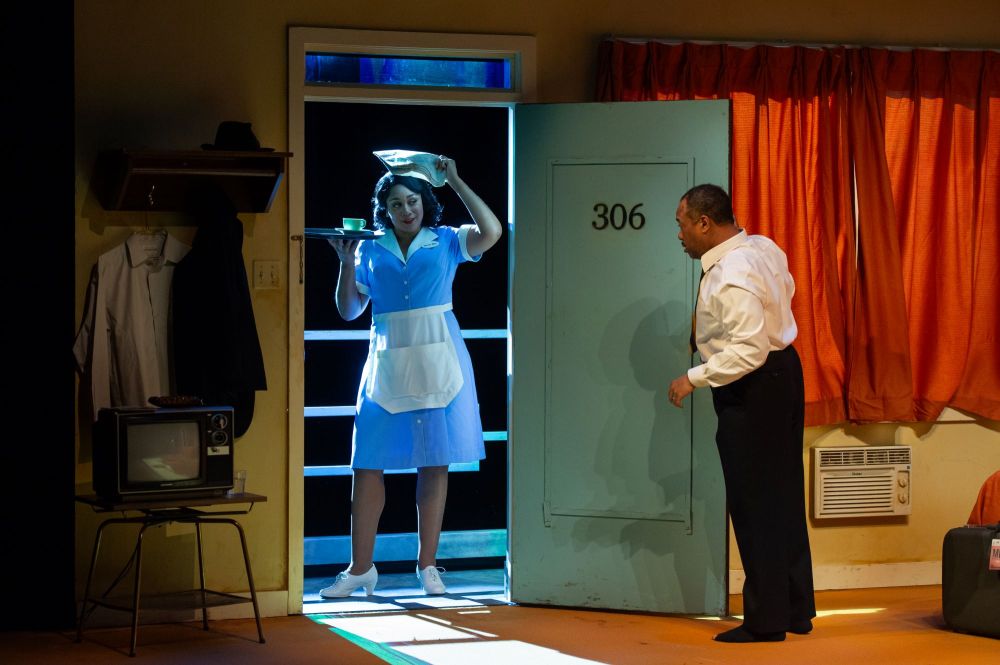
Actors Ray Strachan (right), as Martin Luther King, Jr., and Cherissa Richards, playing fictionalized motel maid Camae, have both lobbied to bring The Mountaintop to a Winnipeg stage. (Photo by Dylan Hewlett)
Richards does a more physical shift, using her height to provide the shorter Strachan with a companion unafraid of challenging King’s views or providing a vessel of comfort for a broken man looking to rest in her lap — a Tennessean La Pieta.
Camae boldly calls out King when his holier-than-thou tendencies emerge. In one standout scene, she imagines what she’d say if she were in his position, donning his sport coat and dress shoes and screaming “F—- the white man.”
“I think that’ll be the title for my next sermon,” says King, who doesn’t disagree with Camae but knows he can never say such a thing out loud.
Camae is the propellant for the story, a fact made apparent in the way she lights every cigarette smoked, a moment repeatedly punctuated with a bath of orange light. At various points, the lighting changes are accompanied by fiery projections, which are jarring but not ineffective.
Biblical undertones are everywhere, as the heavenly Camae helps King deal with the gradual realization that, like Moses, he won’t ever see the Promised Land. Through more effective video projections, designed by Hugh Conacher, Camae also gives him a glimpse beyond his own finality — a powerful moment allowing Strachan to show his character’s emotional arc, with Venzon casting King as a silhouette in front of a backdrop of progress.
Of course, for King, death comes, a moment handled with sincerity and gravity, with Strachan ascending a spiralling staircase to deliver one final sermon against a shimmering wall spangled with stars.
We are so close, but we are still so far away.
ben.waldman@winnipegfreepress.com

Ben Waldman is a National Newspaper Award-nominated reporter on the Arts & Life desk at the Free Press. Born and raised in Winnipeg, Ben completed three internships with the Free Press while earning his degree at Ryerson University’s (now Toronto Metropolitan University’s) School of Journalism before joining the newsroom full-time in 2019. Read more about Ben.
Every piece of reporting Ben produces is reviewed by an editing team before it is posted online or published in print — part of the Free Press‘s tradition, since 1872, of producing reliable independent journalism. Read more about Free Press’s history and mandate, and learn how our newsroom operates.
Our newsroom depends on a growing audience of readers to power our journalism. If you are not a paid reader, please consider becoming a subscriber.
Our newsroom depends on its audience of readers to power our journalism. Thank you for your support.
Theatre review
The Mountaintop
Royal Manitoba Theatre Centre
● John Hirsch mainstage
● To March 9
★★★★ out of five
Ben Waldman is a National Newspaper Award-nominated reporter on the Arts & Life desk at the Free Press. Born and raised in Winnipeg, Ben completed three internships with the Free Press while earning his degree at Ryerson University’s (now Toronto Metropolitan University’s) School of Journalism before joining the newsroom full-time in 2019. Read more about Ben.
Every piece of reporting Ben produces is reviewed by an editing team before it is posted online or published in print — part of the Free Press‘s tradition, since 1872, of producing reliable independent journalism. Read more about Free Press’s history and mandate, and learn how our newsroom operates.
Our newsroom depends on a growing audience of readers to power our journalism. If you are not a paid reader, please consider becoming a subscriber.
Our newsroom depends on its audience of readers to power our journalism. Thank you for your support.
Related Articles
The eve of mourning and martyrdom
Advertisement Advertise With Us
Advertisement Advertise With Us
History
Updated on Saturday, February 17, 2024 11:02 AM CST: Changes art