‘Soaring’ over hills or ‘playing’ with puppies, study finds seniors enjoy virtual reality
Advertisement
Read this article for free:
or
Already have an account? Log in here »
To continue reading, please subscribe:

Digital Subscription
One year of digital access for only $205*
- Enjoy unlimited reading on winnipegfreepress.com
- Read the E-Edition, our digital replica newspaper
- Access News Break, our award-winning app
- Play interactive puzzles
*First annual payment billed as $205.00 + GST for one year. This annual subscription will automatically renew at $233.00 + GST every 52 weeks (10% off the regular annual price of $259.35). Offer available to new and qualified returning subscribers only. Cancel any time.
To continue reading, please subscribe:
Add Free Press access to your Brandon Sun subscription for only an additional
$1 for the first 4 weeks*
- Enjoy unlimited reading on winnipegfreepress.com
- Read the E-Edition, our digital replica newspaper
- Access News Break, our award-winning app
- Play interactive puzzles
*Your next Brandon Sun subscription payment will increase by $1.00 and you will be charged $17.95 plus GST for four weeks. After four weeks, your payment will increase to $24.95 plus GST every four weeks.
Read unlimited articles for free today:
or
Already have an account? Log in here »
Hey there, time traveller!
This article was published 19/02/2024 (944 days ago), so information in it may no longer be current.
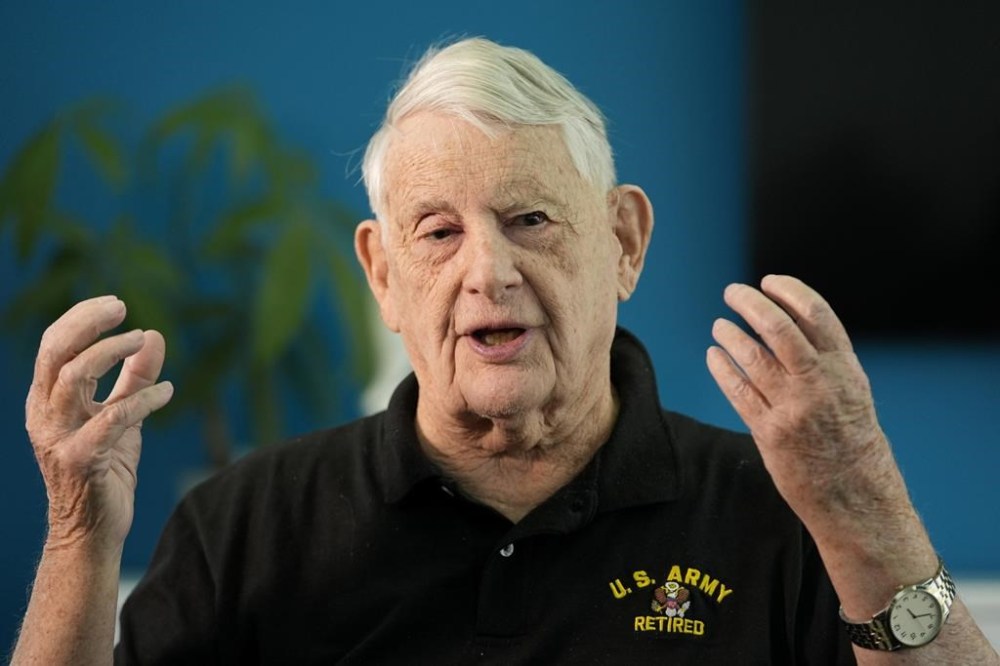
POMPANO BEACH, Fla. (AP) — Retired Army Col. Farrell Patrick taught computer science at West Point during the 1970s and then at two private universities through the 1990s, so he isn’t surprised by the progress technology has made over the decades.
But when the 91-year-old got his first virtual reality experience recently, he was stunned. Sitting in a conference room at John Knox Village, a suburban Fort Lauderdale, Florida, retirement community, Patrick sat up straight as his eyes and ears experienced what it would be like to be in a Navy fighter jet flying off the Florida coast.
“Oh my God, that’s beautiful,” he blurted before the VR program brought the jet in for a landing on an aircraft carrier.
John Knox Village was one of 17 senior communities around the country that participated in a recently published Stanford University study that found that large majorities of 245 participants between 65 and 103 years old enjoyed virtual reality, improving both their emotions and their interactions with staff.
The study is part of a larger effort to adapt VR so it can be beneficial to seniors’ health and emotional well-being and help lessen the impact dementia has on some of them.
During the testing, seniors picked from seven-minute virtual experiences such as parachuting, riding in a tank, watching stage performances, playing with puppies and kittens or visiting places like Paris or Egypt. The participants wore headsets that gave them 360-degree views and sounds, making it seem like they had been all but dropped into the actual experience.
“It brought back memories of my travels and … brought back memories of my experience growing up on a farm,” said Terry Colli, a former public relations director at the Canadian Embassy in Washington, D.C., of his 2022 experience. Colli, 76, liked swiveling in a chair to get a panoramic view. “That was kind of amazing.”
Anne Selby, a 79-year-old retired counselor and artist, found VR “stimulated virtually every area of my brain, all of the senses.”
“I particularly enjoyed the ones dealing with pets because I have a cat and I’ve had pets most of my life,” she said.
Stanford’s peer-reviewed study, working with the company Mynd Immersive, found that almost 80% of seniors reported having a more positive attitude after their VR session and almost 60% said they felt less isolated socially. The enjoyment lessened somewhat for older respondents whose sight and hearing had deteriorated. Those who found VR less enjoyable were also more likely to dislike technology in general.
In addition, almost 75% of caregivers said residents’ moods improved after using VR. More than 80% of residents and almost 95% caregivers said talking about their VR experience enhanced their relationships with each other.
“For the majority of our respondents, it was their first time using virtual reality. They enjoyed it. They were likely to recommend it to others, and they looked forward to doing it again,” said Ryan Moore, a Stanford doctoral candidate who helped lead the research.
“We are proving VR to be a tool that really does help with the well-being of our elders,” said Chris Brickler, Mynd’s CEO and co-founder. The Texas-based company is one of a handful that specializes in virtual reality for seniors. “It is far different than a two-dimensional television or an iPad.”
Separate from the study, John Knox Village uses virtual reality in its unit that houses seniors who have Alzheimer’s disease and other dementia. It helps spur memories that lead to conversations with caregivers.
“It is like they come back to life when they tell their story.” said Hana Salem, the facility’s meaningful life coordinator. She said that with others who don’t talk much perk up when given a VR experience putting them in nature.
“They’ll start laughing and saying, ‘Ooh, I’m going to catch the butterflies,’ ” Salem said. Catching butterflies is also part of a game Mynd developed that helps seniors enhance their mobility and flexibility as they stand and reach for objects.
“It’s more fun for these seniors to come in and catch butterflies and work on shoulder rehab than it is to go pick up a weight,” Brickler said.
Brickler said his company’s systems will soon attach to Google Earth, so seniors can virtually visit neighborhoods where they lived, schools they attended and places they have visited, sparking further conversations with caregivers.
Such virtual visits “can bring back a tremendous amount of joy, a tremendous amount of memories. And when the therapist or the other caregiver can work with that older adult and talk through things we see, we definitely see that it provides an uplift,” Brickler said.
The company has worked on the biggest complaints seniors in the study had about VR — the headsets were too heavy, the heat they generated made their foreheads sweat and sometimes the experience created nausea, he said. The new headsets weigh about six ounces (189 grams) instead of a pound (454 grams), they have a built-in fan for cooling, and the videos aren’t as jumpy.
The findings that seniors in their 80s and 90s enjoy VR less than those in their 70s might lead to changes for them such as requiring less neck rotation to see all of the scenery and making the visuals bigger, Moore said.
On a recent afternoon at John Knox, a handful of seniors who live independently took turns again using virtual reality. Pete Audet experienced what it would be like to fly in a wingsuit, soaring over show-capped mountains before landing in a field.
“Oooh, running stop!” exclaimed Audet, a 76-year-old retired information technology worker. He thinks other seniors “will really enjoy it. But they just need to learn how to use it.”
His wife, Karen, “played” with puppies and was so entranced by her virtual walk around Paris that she didn’t hear questions being asked of her.
“I was there. But I was here!” said Karen Audet, an 82-year-old retired elementary school teacher.
Farrell, the retired Army computer expert, said he hopes to live to 100 because he believes the next five years will see momentous change in VR. Still a technology enthusiast, he believes the cost of systems will drop dramatically and become part of everyday living, even for seniors.
“It is not going to be as elementary as it is now. It is going to be very realistic and very responsive,” he said. “It will probably be connected to your brain.”