Sports journalist looks back on conflicts, victories and luck

Advertisement
Read this article for free:
or
Already have an account? Log in here »
To continue reading, please subscribe:

Digital Subscription
One year of digital access for only $205*
- Enjoy unlimited reading on winnipegfreepress.com
- Read the E-Edition, our digital replica newspaper
- Access News Break, our award-winning app
- Play interactive puzzles
*First annual payment billed as $205.00 + GST for one year. This annual subscription will automatically renew at $233.00 + GST every 52 weeks (10% off the regular annual price of $259.35). Offer available to new and qualified returning subscribers only. Cancel any time.
To continue reading, please subscribe:
Add Free Press access to your Brandon Sun subscription for only an additional
$1 for the first 4 weeks*
- Enjoy unlimited reading on winnipegfreepress.com
- Read the E-Edition, our digital replica newspaper
- Access News Break, our award-winning app
- Play interactive puzzles
*Your next Brandon Sun subscription payment will increase by $1.00 and you will be charged $17.95 plus GST for four weeks. After four weeks, your payment will increase to $24.95 plus GST every four weeks.
Read unlimited articles for free today:
or
Already have an account? Log in here »
Hey there, time traveller!
This article was published 22/02/2024 (936 days ago), so information in it may no longer be current.
As a teenager in Mississauga, Ont., Morgan Campbell had aspirations of playing pro football in the NFL.
He excelled at high school ball, and at track and field, and followed his dream as far as he could, eventually playing college football at Northwestern University in Illinois — not far from Chicago’s South Side, where his parents had lived before he was born.
But life, and his relatively diminutive stature, had other plans for him.
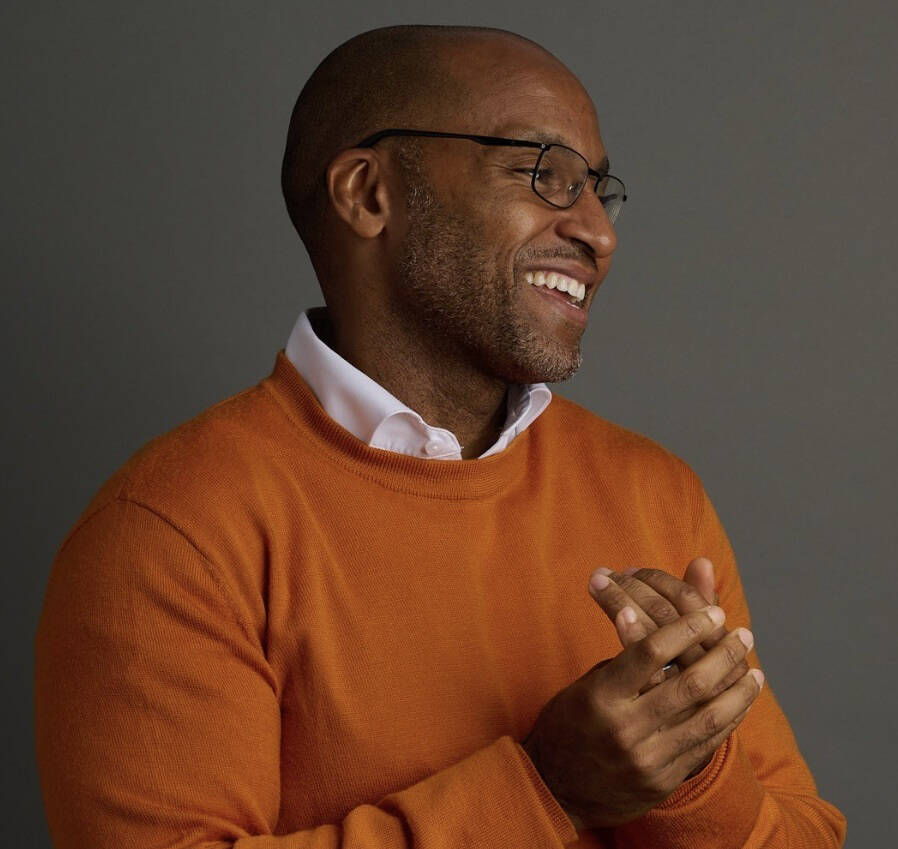
Quincy Carter photo
Morgan Campbell’s book describes growing up Black in Mississauga in the ‘80s and ‘90s.
While at Northwestern, Campbell earned a journalism degree, which he put to use back north of the border as a sports reporter for the Toronto Star.
With the prospect of becoming a columnist at the Star seemingly out of reach, Campbell decided it was time to leave; he took a buyout in December 2019.
“The day I left the Star, I was on Twitter announcing I was leaving, and I was getting messages from Chris Wilson from CBC (Sports) and Scott Sellars from Penguin Random House — they both were like, ‘We know exactly what to do with you,’” says the 47-year-old Campbell, laughing.
Today Campbell is a senior correspondent for CBC Sports and his debut memoir, My Fighting Family: Borders and Bloodlines and the Battles that Made Us, was published in January by McClelland & Stewart, an imprint of Penguin Random House Canada.
My Fighting Family chronicles Campbell’s experience growing up Black in Mississauga in the 1980s and ’90s, the conflicts between his parents and grandparents throughout his formative years, his desire to play pro football in America, his ties to Chicago’s South Side and, to a lesser extent, his enduring love of R&B slow jams he’d hear on WBLK, a Buffalo radio station he listened to as a kid.
In 1969, Campbell’s parents followed his mother’s father, accomplished jazz pianist Claude Jones, to Canada from Chicago.
Jones had been lured north in the mid-’60s by gigs and the prospect of escaping the more violent strains of racism in America. And while Campbell’s parents, Pete and Jeanie, knew they weren’t leaving racism entirely behind at the border, they saw the prospect of a better life in Canada for their future family.
They eventually divorced when Campbell was a boy; Pete died of cancer in September 1994.
Unlike in other immigrant communities in the area, there weren’t many African American families in Mississauga at the time, but those who were there shared a common experience.
“We’re all people who crossed this border, left the United States to find the American dream. It’s a very American thing to do, to pick up your whole family and move someplace to find the American dream,” says Campbell.
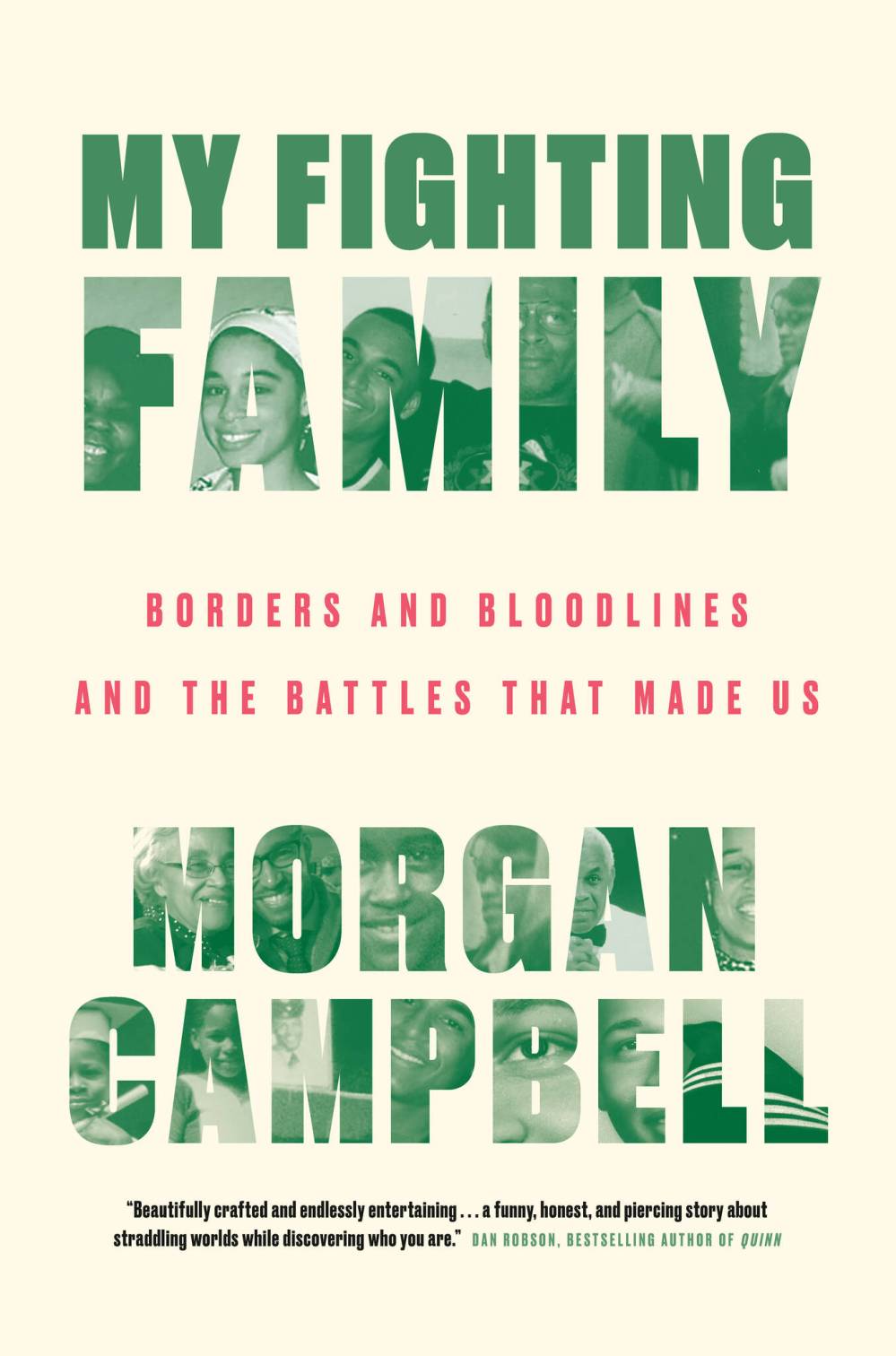
My Fighting Family: Borders and Bloodlines and the Battles that Made Us
“But it’s also ironic that my family and these other families had to leave the United States to try to find it.”
The key players in the conflicts that dominate Campbell’s memoir are his maternal grandfather, Claude Jones, and his Granny Mary, his father’s mother in Chicago. Each was ferociously stubborn and could hold epic grudges; the only thing they seemingly agreed upon is that their kids shouldn’t have married.
“Each of those people thought everything was about them. And that’s sort of what prompts them to turn little conflicts into big fights,” Campbell says. “Two other people might have been in a disagreement that had nothing to do with Granny Mary or with Grandpa, but if they got a whiff of it, suddenly it was about them. And once it’s about them, it’s 10 times bigger than it was the day before.”
Campbell had long considered writing his family’s story, but when the Star buyout offer came along, he knew it was finally time.
“I had to grow up some just to fully appreciate my parents and grandparents as human beings — fully formed, multifaceted characters,” Campbell says. “As a young person, it’s hard to even conceive of the idea that your parents had lives before you were born, identities that don’t involve you … as a middle-aged person, it’s much easier for me to make sense of all that now.”
With age and distance came the ability to look back at his griping grandparents with added insight and wisdom.
“It’s this process of learning to show empathy for people who are not always empathetic, to love people who aren’t always likable,” he explains.
“One of the points I tried to drive home in the book is the idea that each of us is the product of all these things our parents and grandparents did or didn’t do, the choices they made, the forces that acted on their lives that they couldn’t control.
“Like Granny Mary — my dad’s dad pulled out a gun; he shot at her in the house. He missed, but how different would everything have been if he had hit her? As individuals, we are the sum total of our choices. We’re also the sum total of other people’s choices … and also just luck.”
Campbell realizes that while his family experiences are his alone, others will find stories in My Fighting Family relatable relative to their own kin.
The Mississauga News
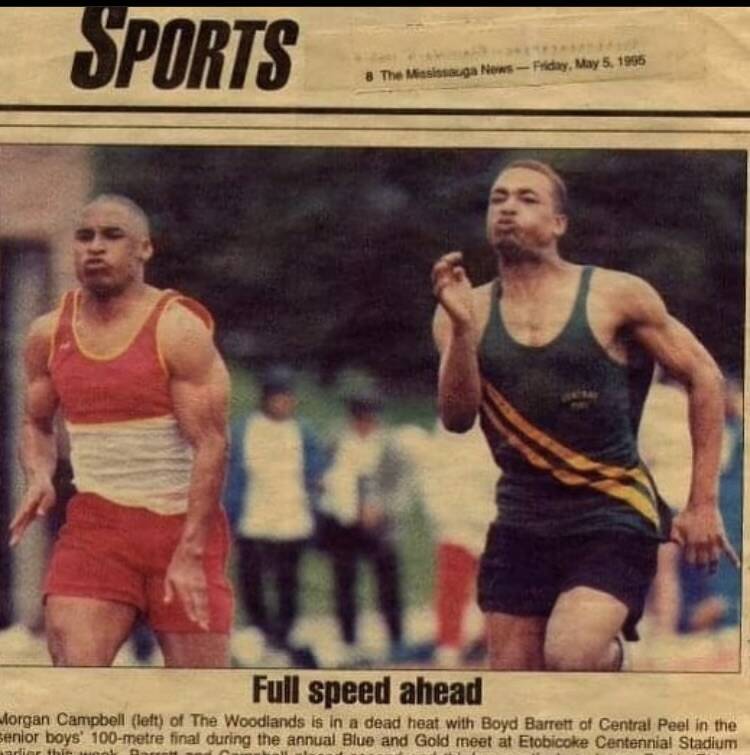
Morgan Campbell (left) in this 1995 newspaper photo, leads future Blue Bomber Boyd Barrett halfway through the senior boys’ 100-metre final in Etobicoke, Ont.
“So much of the feedback I’ve gotten from people is that, ‘Hey, your family’s not at all like my family, but your family is just like my family — we have the same stubbornness or unwillingness to forgive and big fights over stupid stuff,’” he says.
The feedback from Campbell’s family — including from his wife, retired Olympic hurdler Perdita Felicien — has been overwhelmingly positive, but he’s still waiting on one key review.
“My mom is in the process of reading it — she’s also a really, really harsh critic,” he says, laughing.
“In my mind if she gives me more than, like, two stars out of five, that’s a win.”
ben.sigurdson@freepress.mb.ca
@bensigurdson
Ben Sigurdson
Literary editor, drinks writer
Ben Sigurdson is the Free Press‘s literary editor and drinks writer. He graduated with a master of arts degree in English from the University of Manitoba in 2005, the same year he began writing Uncorked, the weekly Free Press drinks column. He joined the Free Press full time in 2013 as a copy editor before being appointed literary editor in 2014. Read more about Ben.
In addition to providing opinions and analysis on wine and drinks, Ben oversees a team of freelance book reviewers and produces content for the arts and life section, all of which is reviewed by the Free Press’s editing team before being posted online or published in print. It’s part of the Free Press‘s tradition, since 1872, of producing reliable independent journalism. Read more about Free Press’s history and mandate, and learn how our newsroom operates.
Our newsroom depends on a growing audience of readers to power our journalism. If you are not a paid reader, please consider becoming a subscriber.
Our newsroom depends on its audience of readers to power our journalism. Thank you for your support.
Ben Sigurdson
Literary editor, drinks writer
Ben Sigurdson is the Free Press‘s literary editor and drinks writer. He graduated with a master of arts degree in English from the University of Manitoba in 2005, the same year he began writing Uncorked, the weekly Free Press drinks column. He joined the Free Press full time in 2013 as a copy editor before being appointed literary editor in 2014. Read more about Ben.
In addition to providing opinions and analysis on wine and drinks, Ben oversees a team of freelance book reviewers and produces content for the arts and life section, all of which is reviewed by the Free Press’s editing team before being posted online or published in print. It’s part of the Free Press‘s tradition, since 1872, of producing reliable independent journalism. Read more about Free Press’s history and mandate, and learn how our newsroom operates.
Our newsroom depends on a growing audience of readers to power our journalism. If you are not a paid reader, please consider becoming a subscriber.
Our newsroom depends on its audience of readers to power our journalism. Thank you for your support.
Advertisement Advertise With Us
Advertisement Advertise With Us
History
Updated on Thursday, February 22, 2024 10:28 AM CST: Corrects spelling of Mississauga in image cutline