The buzz on climate change and insects
Be aware of the impact on native and invasive species

Advertisement
Read this article for free:
or
Already have an account? Log in here »
To continue reading, please subscribe:

Digital Subscription
One year of digital access for only $205*
- Enjoy unlimited reading on winnipegfreepress.com
- Read the E-Edition, our digital replica newspaper
- Access News Break, our award-winning app
- Play interactive puzzles
*First annual payment billed as $205.00 + GST for one year. This annual subscription will automatically renew at $233.00 + GST every 52 weeks (10% off the regular annual price of $259.35). Offer available to new and qualified returning subscribers only. Cancel any time.
To continue reading, please subscribe:
Add Free Press access to your Brandon Sun subscription for only an additional
$1 for the first 4 weeks*
- Enjoy unlimited reading on winnipegfreepress.com
- Read the E-Edition, our digital replica newspaper
- Access News Break, our award-winning app
- Play interactive puzzles
*Your next Brandon Sun subscription payment will increase by $1.00 and you will be charged $17.95 plus GST for four weeks. After four weeks, your payment will increase to $24.95 plus GST every four weeks.
Read unlimited articles for free today:
or
Already have an account? Log in here »
Hey there, time traveller!
This article was published 02/03/2024 (929 days ago), so information in it may no longer be current.
The usually predictable nature of Manitoba’s long, cold winters with a deep snowpack has stood our agriculture province in good stead. Extreme winter temperatures make our climate inhospitable for certain types of insect pests. A changing climate, though, with wildly fluctuating temperatures and repeated freezing and thawing can impact both native and invasive insect species.
“There can be a good side to cold winters especially for pest management purposes,” says John Gavloski, entomologist, Manitoba Agriculture. “In other parts of Canada where there have been a series of milder winters, we have seen certain pests expand their range. A good example is the mountain pine beetle in British Columbia.” A destructive insect pest, the mountain pine beetle gained a foothold in British Columbia’s pine forests in the late 1990s after several relatively warm winters.
In the past decade in Manitoba, invasive insects such as Cottony Ash Psyllid (CAP), Emerald Ash Borer (EAB), Spotted Wing Drosophila (SWD), the scarlet lily leaf beetle, and others have been found in several Manitoba communities. The Manitoba Regional Lily Society mounted a successful campaign to educate gardeners about how to monitor for the scarlet lily leaf beetle. In addition, the release of a parasitic wasp, Tetrastichus setifer, reduced beetle populations and today it has all but disappeared from many local gardens. That’s one example of a good news story.

Paul Harrison / Wikimedia Commons
Watch for and report any sightings of Japanese beetle, an invasive insect pest. Stomp on it, too.
Gavloski is part of a group of entomologists across Canada who are actively working on insect monitoring programs. “We call ourselves the Insect Surveillance Community of Practice. One of the projects we have tackled over the past year is to put together a two-page fact sheet on priority invasive and migratory insects that have the potential to establish in different regions across the country.” The list for the prairie region includes 12 insects to watch for and report to Manitoba Agriculture or the Canadian Food Inspection Agency (CFIA).
One of the insects listed is the Japanese beetle, an invasive plant pest that feeds heavily on the leaves, flowers, or fruit of more than 300 ornamental and agricultural plant species, including elm, maple, linden, grape vine, peach, apple, apricot, cherry, plum, rose, zinnia, corn, asparagus, soybean, blueberries, raspberries, and blackberries. Grubs feed on the root zones of irrigated turf. The Japanese beetle has never been found in Manitoba but does occur in various counties in North Dakota including Grand Forks. In previous surveys, it has been found in the county of Rolette, which borders Manitoba. There are established populations of Japanese beetle in parts of southern Ontario including the Niagara Peninsula and Hamilton-Wentworth region. The Japanese beetle is also well established in Minnesota.
“We have to face the reality that the Japanese beetle is kind of at our doorstep,” says Gavloski. “It has the potential to establish here and could be found here. It’s important that we know as early as possible what the beetle is, what it can do, and how to identify it. We are relaying this information so that we can engage the public’s assistance in identifying it so that we can respond appropriately. The Japanese beetle has such a broad host range that it could easily show up first in somebody’s garden or a community garden. Raising awareness of the fact that this is an invasive insect that has never been found in Manitoba but does occur in some neighbouring States is helpful.”
Adult Japanese beetles are about one centimetre in length. Their abdomens, thorax, and heads are metallic green, and their forewings are copper brown bordered with green. Monitoring for adult beetles by using specially designed traps is key. In 2021, Gavloski set up traps for Japanese beetle in a community garden in the Carman area and says that there were traps at a couple of other locations in Manitoba, but no Japanese beetles were found that year. “Some provinces use lots of traps to capture Japanese beetles,” says Gavloski. “In Manitoba, I’ve used traps to monitor for Japanese beetle on a very small scale. After a very mild winter, I would be very interested in setting up some traps closer to the border.”
The Japanese beetle can fly but is not known to be a migratory insect in the same way as other insects such as the diamondback moth which is readily carried by the wind. In 2017, in North Dakota, for example, Japanese beetle larvae and pupae were discovered in containers of plants that had been shipped from a Minnesota nursery.

Colleen Zacharias / Winnipeg Free Press
The rose is just one of 300 plant species that adult Japanese beetles feed on.
It’s important to not focus on just one potentially invasive insect, says Gavloski. Download the poster that illustrates the priority invasive and migratory insects to watch for in the prairie region at https://prairiepest.ca/2023/week-11/#post_14556 . Use the QT code on the poster to report all observations. The insect species listed include spotted lanternfly, yellow-spotted stink bug, brown marmorated stink bug, Western bean cutworm, spongy moth, fall armyworm, Asian long-horned beetle, Japanese beetle, emerald ash borer, pollen beetle, Northern giant hornet (formerly known as Asian giant hornet), and European cherry fruit fly. The list is enough to make all of us appreciate a good old-fashioned, bitterly cold Manitoba winter which can deter the spread of invasive insect species.

A changing climate can impact native insect species in different ways. Many beneficial insects survive by overwintering in soil under a deep, protective blanket of snow. Seasonal temperature fluctuations and minimal snow cover cause stress to insects and can affect their rate of development as well as survival. John Russell, an executive with the Red River Apiarists’ Association and a beekeeper who owns the John Russell Honey Company, says that milder winter temperatures can benefit insect species such as bees. “If there are warmer than normal temperatures, bees use fewer resources.”
But inconsistent and unpredictable weather can have a negative impact on bees. “Temperature fluctuations in January are not as detrimental as wild temperature fluctuations at the end of February when bees are gearing up for brood production as the days get longer. Longer days and warmer temperatures stimulate brood production but if the queen lays too many eggs, a sudden freeze can be very detrimental because a lot of energy and resources must go into covering a large patch of brood and keeping it warm.”
Could warmer than normal temperatures cause wild pollinating bees to emerge early in spring before nectar producing plants are available? “Most native species should not be fooled by a short period of warm weather as they typically use a combination of photoperiod and heat to break diapause (a hibernation-like state),” says Robert Currie, a professor in the entomology department at University of Manitoba. “Once diapause is broken a lot of species take time to complete development and eventually emerge as adults.”
colleenizacharias@gmail.com
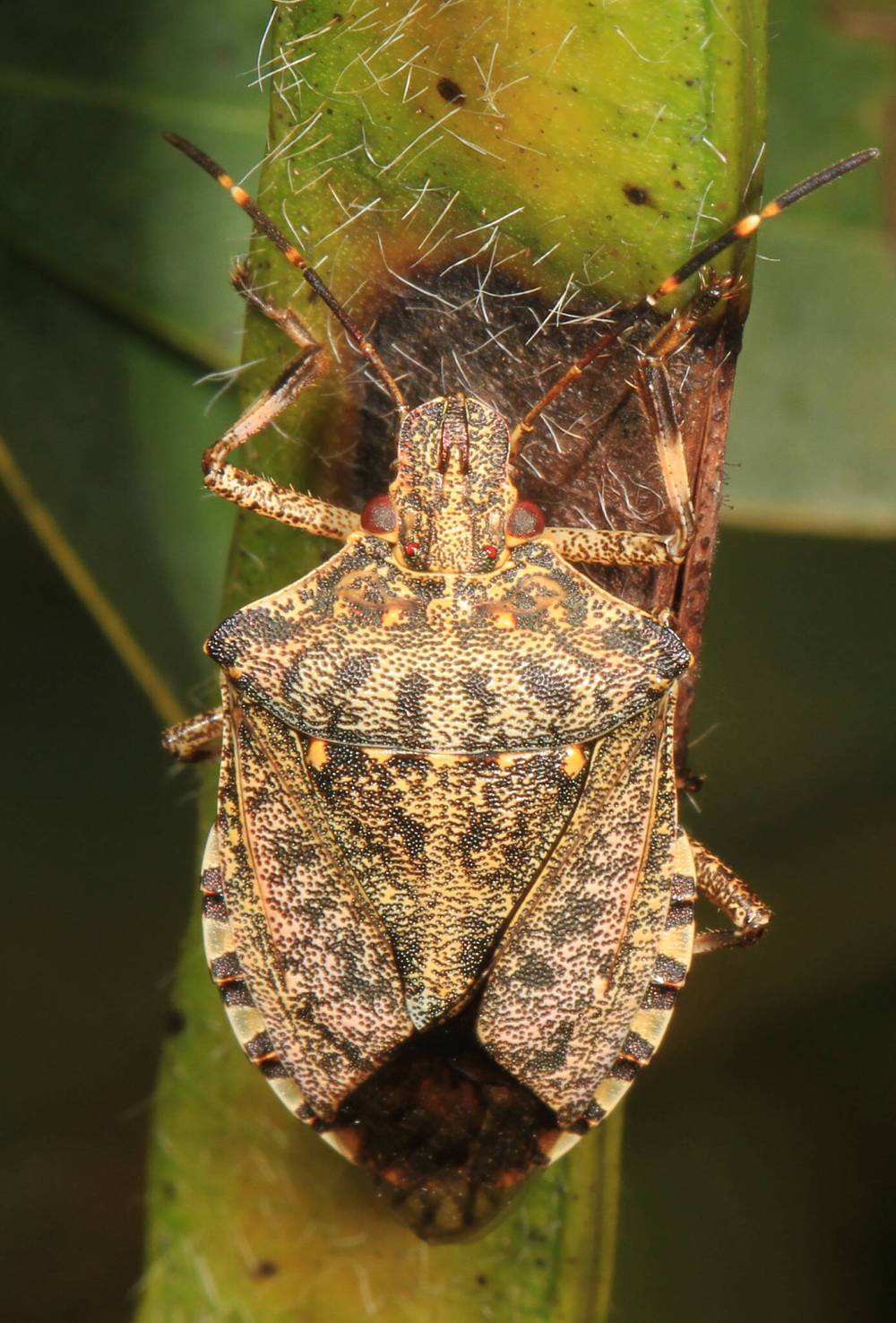
Judy Gallagher / Wikimedia Commons
Learn how to identify each one of the invasive insect species that have the potential to establish in Manitoba such as the brown marmorated stink bug.
For advice, ideas and tips to keep your outdoor and indoor plants growing, sign up to receive Winnipeg Gardener, a free monthly digital newsletter at: winnipegfreepress.com/newsletter/winnipeg-gardener

Wilfrid Scharbach
Climate change and fluctuating temperatures can place added stress on native species such as bees.
Colleen Zacharias
Gardening columnist
Colleen Zacharias writes about many aspects of gardening including trends, plant recommendations, and how-to information that is uniquely relevant to Prairie gardeners. She has written a column for the Free Press since 2010 and pens the monthly newsletter Winnipeg Gardener. Read more about Colleen.
Every piece of reporting Colleen produces is reviewed by an editing team before it is posted online or published in print — part of the Free Press‘s tradition, since 1872, of producing reliable independent journalism. Read more about Free Press’s history and mandate, and learn how our newsroom operates.
Our newsroom depends on a growing audience of readers to power our journalism. If you are not a paid reader, please consider becoming a subscriber.
Our newsroom depends on its audience of readers to power our journalism. Thank you for your support.
Colleen Zacharias
Gardening columnist
Colleen Zacharias writes about many aspects of gardening including trends, plant recommendations, and how-to information that is uniquely relevant to Prairie gardeners. She has written a column for the Free Press since 2010 and pens the monthly newsletter Winnipeg Gardener. Read more about Colleen.
Every piece of reporting Colleen produces is reviewed by an editing team before it is posted online or published in print — part of the Free Press‘s tradition, since 1872, of producing reliable independent journalism. Read more about Free Press’s history and mandate, and learn how our newsroom operates.
Our newsroom depends on a growing audience of readers to power our journalism. If you are not a paid reader, please consider becoming a subscriber.
Our newsroom depends on its audience of readers to power our journalism. Thank you for your support.
Related Articles
Fruit flies impact Manitoba berry crops

Advertisement Advertise With Us
Advertisement Advertise With Us