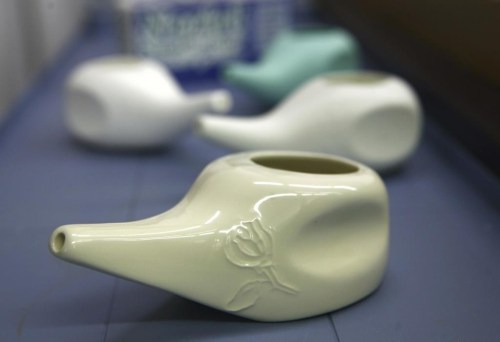
Another dangerous amoeba has been linked to neti pots and nasal rinsing. Here’s what to know
Advertisement
Read this article for free:
or
Already have an account? Log in here »
To continue reading, please subscribe:

Digital Subscription
One year of digital access for only $205*
- Enjoy unlimited reading on winnipegfreepress.com
- Read the E-Edition, our digital replica newspaper
- Access News Break, our award-winning app
- Play interactive puzzles
*First annual payment billed as $205.00 + GST for one year. This annual subscription will automatically renew at $233.00 + GST every 52 weeks (10% off the regular annual price of $259.35). Offer available to new and qualified returning subscribers only. Cancel any time.
To continue reading, please subscribe:
Add Free Press access to your Brandon Sun subscription for only an additional
$1 for the first 4 weeks*
- Enjoy unlimited reading on winnipegfreepress.com
- Read the E-Edition, our digital replica newspaper
- Access News Break, our award-winning app
- Play interactive puzzles
*Your next Brandon Sun subscription payment will increase by $1.00 and you will be charged $17.95 plus GST for four weeks. After four weeks, your payment will increase to $24.95 plus GST every four weeks.
Read unlimited articles for free today:
or
Already have an account? Log in here »
Hey there, time traveller!
This article was published 13/03/2024 (947 days ago), so information in it may no longer be current.
NEW YORK (AP) — For years, scientists have known people who use neti pots can become infected with a brain-eating amoeba if they use the wrong kind of water. On Wednesday, researchers linked a second kind of deadly amoeba to nasal rinsing.
The Centers for Disease Control and Prevention published a report that for the first time connects Acanthamoeba infections to neti pots and other nasal rinsing devices.
Officials also renewed their warning that extremely rare, but potentially deadly, consequences can come from flushing nasal passages with common tap water.
“We published this study because we want people to be aware of this risk,” said the CDC’s Dr. Julia Haston.
What are neti pots?
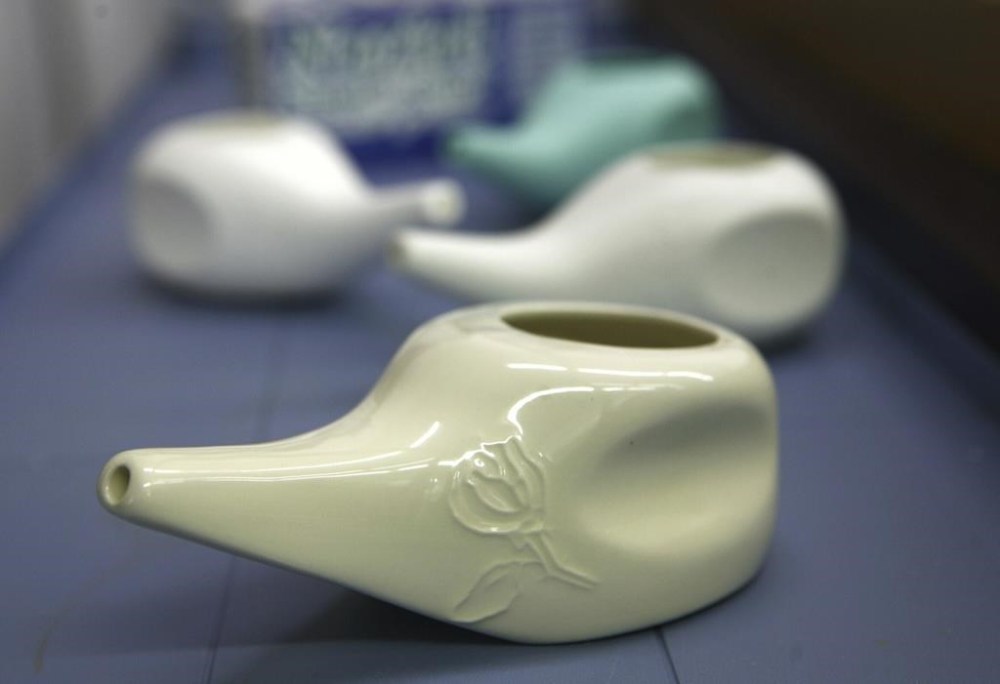
Neti pots are one of the better known tools of nasal rinsing. They look like small teapots with long spouts, and usually are made of ceramic or plastic.
Users fill them with a saline solution, then pour the liquid in one nostril. It comes out the other, draining the nasal passage of allergens and other bothersome contaminants.
Neti pot use in the U.S. has boomed in the last couple of decades, driven in part by the increasing prevalence of allergies and other respiratory diseases, market researchers say.
There also are other methods of rinsing nasal passages, including specially shaped cups and squeezable plastic bottles.
Why you shouldn’t use untreated tap water in neti pots
Tap water in the U.S. is treated to meet safe drinking standards, but low levels of microscopic organisms can still be found in it. It’s usually not a problem when people drink or cook with the water, but it can pose more of a danger when tap water is used for other purposes — like in humidifiers or for nasal irrigation.
CDC officials, citing a 2021 survey, say about one-third of U.S. adults incorrectly think tap water was free of bacteria and other microorganisms. Nearly two-thirds say tap water could be safely used for rinsing their sinuses.
The CDC recommends using boiled, sterile or distilled water.
If tap water is used, it must be boiled for a minimum of one minute — or three minutes at higher elevations — before it is cooled and used, officials say.
Rare illnesses and nasal rinsing
More than a decade ago, health officials linked U.S. deaths from a brain-eating amoeba — named Naegleria fowleri — to nasal rinsing. More recently, they started to note nasal rinsing as a common theme in illnesses caused by another microscopic parasite, Acanthamoeba.
Acanthamoeba causes different kinds of illness but is still dangerous, with a 85% fatality rate in reported cases.
“These infections are very serious and even life threatening,” said Haston who was lead author of the report published in the journal Emerging Infectious Diseases.
The new study focused on 10 patients who fell ill between 1994 and 2022, three of whom died. Researchers say they can’t be sure how the patients were infected, but they noted several commonalities: All had weakened immune systems and practiced nasal rinsing.
Seven patients reported nasal rinsing for relief of chronic sinus infections, and at least two of them used neti pots. Two other patients did nasal rinsing as part of a cleansing ritual that is part of Indian tradition.
What is Acanthamoeba?
This amoeba can be found naturally all over the environment — in lakes, rivers, seawater and soil.
It can cause diseases of the skin and sinuses, and can infect the brain, where it can cause a deadly form of inflammation. The microorganism also has been connected to non-fatal, but sight-threatening, eye infections, sometimes through contaminated contact lens solution.
U.S. health officials have identified about 180 infections from the single-cell organism since the first one was diagnosed in 1956.

In the vast majority of cases, researcher don’t know exactly how people became infected. But in reviewing cases in recent decades, CDC researchers increasingly received information that a number of the cases had done nasal rinsing, Haston said.
Research also has indicated it’s common in tap water. A study done in Ohio in the 1990s found more than half of tap water samples studied contained the amoeba and similar microorganisms.
“It’s very likely that we’re all exposed to Acanthamoeba all the time,” she said.
___
The Associated Press Health and Science Department receives support from the Howard Hughes Medical Institute’s Science and Educational Media Group. The AP is solely responsible for all content.