10 years after the deadliest US landslide, climate change is increasing the danger
Advertisement
Read this article for free:
or
Already have an account? Log in here »
To continue reading, please subscribe:

Digital Subscription
One year of digital access for only $205*
- Enjoy unlimited reading on winnipegfreepress.com
- Read the E-Edition, our digital replica newspaper
- Access News Break, our award-winning app
- Play interactive puzzles
*First annual payment billed as $205.00 + GST for one year. This annual subscription will automatically renew at $233.00 + GST every 52 weeks (10% off the regular annual price of $259.35). Offer available to new and qualified returning subscribers only. Cancel any time.
To continue reading, please subscribe:
Add Free Press access to your Brandon Sun subscription for only an additional
$1 for the first 4 weeks*
- Enjoy unlimited reading on winnipegfreepress.com
- Read the E-Edition, our digital replica newspaper
- Access News Break, our award-winning app
- Play interactive puzzles
*Your next Brandon Sun subscription payment will increase by $1.00 and you will be charged $17.95 plus GST for four weeks. After four weeks, your payment will increase to $24.95 plus GST every four weeks.
Read unlimited articles for free today:
or
Already have an account? Log in here »
Hey there, time traveller!
This article was published 19/03/2024 (897 days ago), so information in it may no longer be current.
OSO, Wash. (AP) — After the mountainside collapsed, obliterating a neighborhood and 43 lives in the worst landslide disaster in U.S. history, Jessica Pzsonka made a promise -– to herself, to her bereft parents and to her late sister, who was buried along with two young sons, her husband and in-laws.
Pszonka would see a permanent memorial created where relatives and visitors could feel her sister’s presence and reflect on the serenity that drew the family to Oso, as well as the forces that left an immense scar in the forested Cascade Mountain foothills along the north fork of the Stillaguamish River, 55 miles (89 km) northeast of Seattle.
Ten years later, that memorial is complete, and Pszonka is leaving: She put her home up for sale and is moving, with her parents, to Texas.
“I need to get them out of here,” she said. “They cannot snap out of it. It’s like it happened yesterday, every day, when they drive by the school that the kids would have gone to.”
The trauma that engulfed Oso, a rural community of a couple hundred residents, on March 22, 2014, was a national wake-up call about the dangers of landslides. Washington state began hiring more staff and conducting more mapping to get a better handle on the risk, and it tightened guidelines on logging landslide-prone slopes amid concerns that clearcutting near the top of the scar might have helped cause the disaster.
Congress in 2020 adopted the National Landslides Preparedness Act to create a national strategy to identify, understand and protect against landslides — legislation pushed by lawmakers from Washington state, including Democratic Rep. Suzan DelBene.
“It was really hard for anyone to imagine how enormous the impact was — that you really had to be there to see that this side of a mountain collapsed into the valley and up the other side, wiping out an entire community,” DelBene said. “I personally wanted to do anything I could to make sure that a natural disaster like this did not become another national tragedy.”
Nevertheless, landslides are likely to afflict more and more people as climate change intensifies storms and wildfires, destabilizing soil. Predicting slides remains difficult, though some research projects have helped establish under what conditions certain types might occur.
In the years since Oso, post-wildfire landslides have become alarmingly frequent in California, where mudslides killed 23 people and destroyed hundreds of homes in Montecito in 2018.
More than 500 mudslides were recorded in Los Angeles alone after torrential downpours early this year; another destroyed a home last week.
Areas that have not burned have also suffered, such as the mountainous temperate rainforest of southeast Alaska, which has seen three deadly landslides on saturated slopes since 2015. The most recent killed six people in Wrangell last November.
Landslides occur throughout the U.S., including in the Southeast after hurricanes. But Brian Collins, a research civil engineer with the U.S. Geological Survey who helped study the Oso slide, noted that in the “steeper terrain of the Western U.S. and Alaska, they do tend to be and — as we’re seeing — there have been … certainly a number of devastating landslides in the past 10 years.”
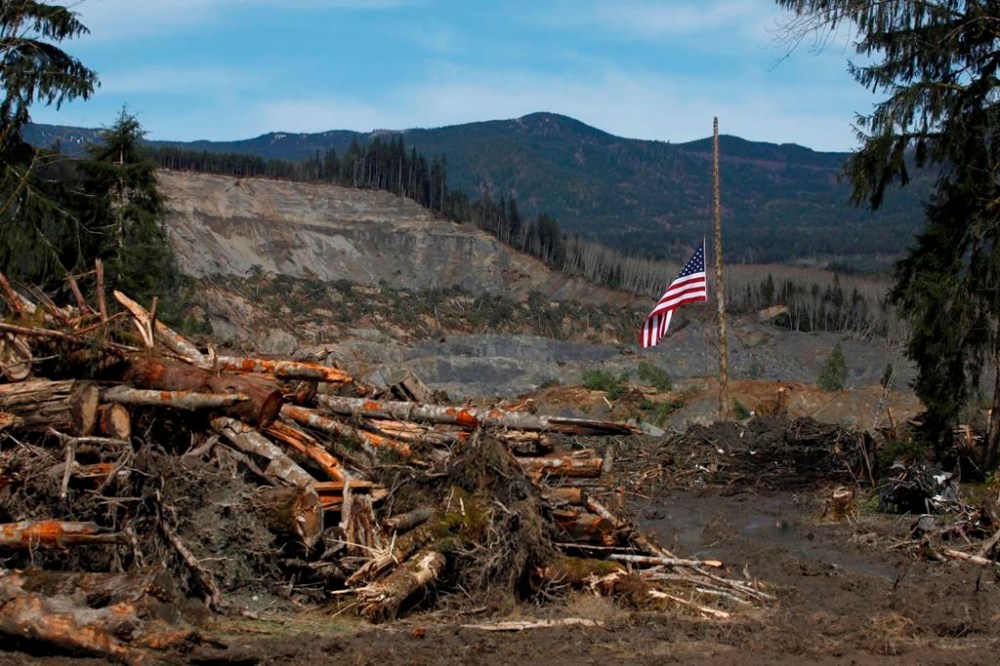
None more so than Oso. It was 10:37 on a sunny Saturday morning following weeks of heavy rain when the hillside gave way in a scraping, crashing roar — some residents thought it was the Navy jets that often fly overhead. Some 19 million tons of sand and ancient glacial deposits — enough to cover 700 football fields 10 feet (3 meters) deep — raced across the river at an average speed of 40 mph (64 kph), hydroplaning on the saturated valley floor “kind of like an air hockey table,” Collins said.
The tsunami of sodden earth and pulverized timber slammed into Steelhead Haven, a subdivision of 35 homes. The highway running alongside was buried 20 feet (6.1 meters) deep.
There had been a history of landslides on the slope, including massive prehistoric slides. One in 2006 dammed the river, and before that, technical reports had warned about a potential “large catastrophic failure” and “significant risk to human lives and private property.” Officials considered buying up homes in the area to keep people out.
But even those reports did not suggest anything could happen on the order of what did occur. Residents said they had no idea of the danger; homes continued being built even after the 2006 slide. Washington state and the company that logged above the slope paid more than $70 million to settle lawsuits by the 2014 slide’s victims and their families.
It was the deadliest landslide in U.S. history, according to the National Science Foundation-backed geotechnical team that reviewed it. Nine people survived — including a mother and baby who were reunited in a hospital two weeks later.
Tim Ward lost his wife of 37 years, Brandy, and four of his five dogs. He described regaining consciousness 500 yards (457 meters) from where his house once stood, in a hole 15 feet (4.6 meters) deep, with an opening at the top the size of a kitchen saucer. Rescuers eventually pulled him out.
Many of the victims — retirees, grandparents, military veterans, office workers, young families — were simply at home on a weekend. Others just happened to be there: three contractors working on a house. Someone installing a satellite TV dish. A plumber servicing a hot-water tank.
Summer Raffo, 36, was driving on State Route 530 on her way to shoe a horse for a client. Seconds earlier or later, she would have been fine. Instead, the slide buried her, ripping the roof off her blue Subaru.
Raffo’s older brother, Dayn Brunner, was a tribal police officer at the time. His mother called him that day and said: “You’re her brother. You need to go find her.” He and his teenage sons went past police barricades and spent five days digging through the muck. When searchers finally found Raffo’s car, they called Brunner over to lift her body out. Her hands were still on the wheel. The speedometer read 60 mph (97 kmh).
In an extraordinary effort, teams that included 900 responders from near and far plus volunteers — firefighters and police, military members and local loggers — helped find every victim, often slogging through what they came to call “the pile” as rain fell. They would silence their chainsaws and other machinery whenever they discovered bodies. The last victim turned up that July, about three months after the official search ended.
Brunner, Pszonka and other family members spent years working on the memorial — holding fundraisers, lobbying lawmakers for money and attending planning committee meetings. They wanted to honor not just the lives lost, but the community response.
“We could be standing here and talking about that they never recovered my one nephew, who is one of the last ones” to be found, Pszonka said. “To those firefighters and search and rescue people and rescue dogs and all the people that promised that they would stay until every person was found, I will be forever grateful.”
Pszonka’s sister and her husband, Katie and Shane Ruthven, had a thriving glass-repair business. The boys, Hunter and Wyatt, ages 6 and 4, loved football. Pszonka and her parents got tattoos to help remember them by. But holidays, birthdays — any days — aren’t the same. So they’re leaving to get a fresh start, she said.
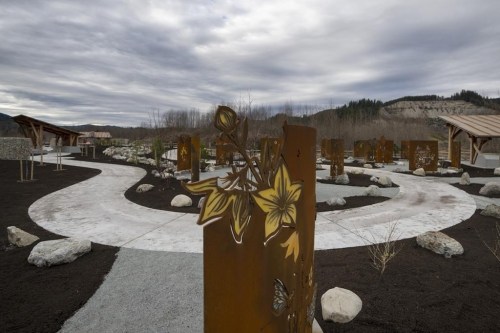
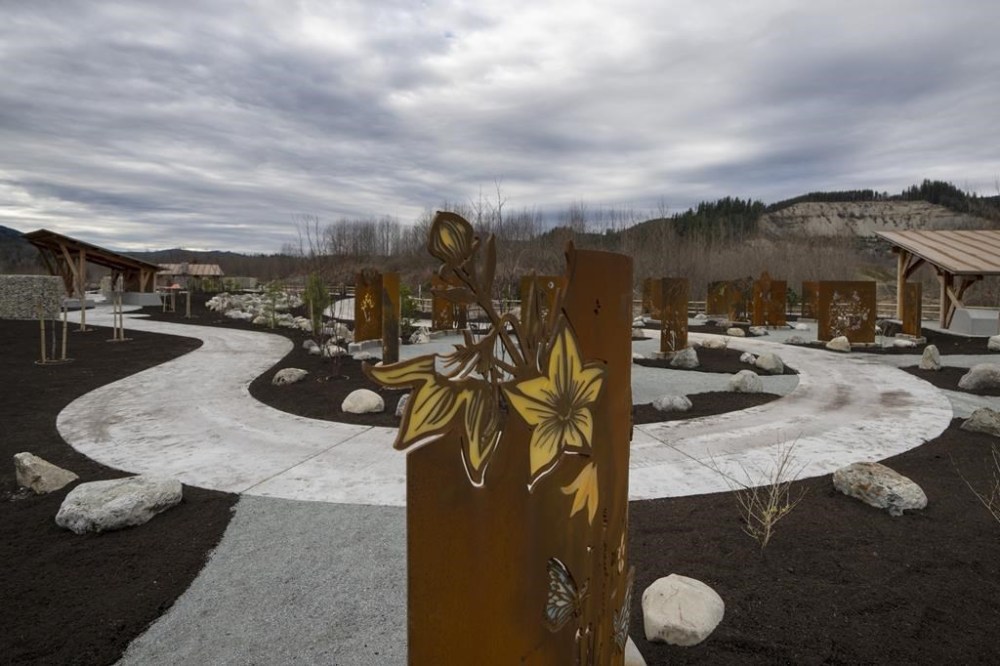
The $3.8 million memorial features large, curved metal panels by Seattle artist Tsovinar Muradyan for each family, with cut-out designs filled with colorful epoxy — butterflies for Pszonka’s nephews. Raffo’s includes a portrait of her along with her favorite horse.
Raffo was quiet and reserved, funny, dependable and an incredibly hard worker, Brunner said.
“Ever since Day 3, when the reality set in, I knew that I’m going to explain to everybody how special my sister was to me, to my mom, to my entire family, and let them know who the person she was,” Brunner said. “And doing this memorial is doing that for me.”
___
Bohrer reported from Juneau, Alaska.