Manitoba’s legacy still rising in Italy

Advertisement
Read this article for free:
or
Already have an account? Log in here »
To continue reading, please subscribe:

Digital Subscription
One year of digital access for only $205*
- Enjoy unlimited reading on winnipegfreepress.com
- Read the E-Edition, our digital replica newspaper
- Access News Break, our award-winning app
- Play interactive puzzles
*First annual payment billed as $205.00 + GST for one year. This annual subscription will automatically renew at $233.00 + GST every 52 weeks (10% off the regular annual price of $259.35). Offer available to new and qualified returning subscribers only. Cancel any time.
To continue reading, please subscribe:
Add Free Press access to your Brandon Sun subscription for only an additional
$1 for the first 4 weeks*
- Enjoy unlimited reading on winnipegfreepress.com
- Read the E-Edition, our digital replica newspaper
- Access News Break, our award-winning app
- Play interactive puzzles
*Your next Brandon Sun subscription payment will increase by $1.00 and you will be charged $17.95 plus GST for four weeks. After four weeks, your payment will increase to $24.95 plus GST every four weeks.
Read unlimited articles for free today:
or
Already have an account? Log in here »
Hey there, time traveller!
This article was published 20/03/2024 (912 days ago), so information in it may no longer be current.
It’s human nature to want to make connections; to find the familiar among the unfamiliar, to discover patterns and regularity amid chaos.
We want to discover common elements that link us to the larger world, perhaps to make us feel less insignificant or closer to home.
And so it was that while viewing the Elliott Erwitt exhibition currently featured at Teatro Margherita in Bari, Italy, the partially obscured words “Manitoba biscotti” on a store sign in one photograph caught my eye.

Pam Frampton photo
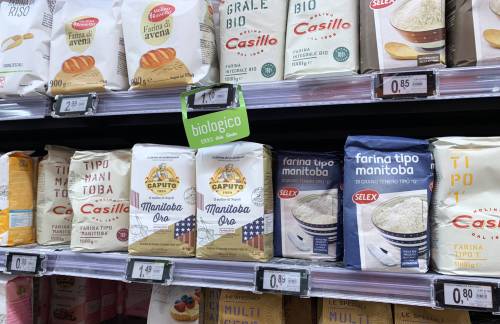
The author found Manitoba flour prominently displayed on supermarket shelves in Bari and Lecce, Italy.
Erwitt died last year at age 95. An artist with a ripe sense of humour and flair for the absurd, he was born in Paris to immigrant parents and spent a decade in Italy before moving with his family to the United States.
Marilyn Monroe and dogs are favourite subjects in his iconic black-and-white photographs.
But the photo that stopped me in my tracks at the art exhibit contained neither of those. Rather it was a photo taken in Milan in 1949 that showed two men in coveralls with an armless, high-heeled nude mannequin with a woman’s form, either taking it out of the back of a truck or hoisting it aboard.
They are parked outside a bakery — a pasticceria — called Manitoba Biscotti.
Intrigued by the Manitoba mention, I was curious to know how those particular cookies crumbled.
Online sleuthing turned up vintage posters from the 1940s and ’50s for Manitoba Biscotti, which promised “ogni boccone vale un milione” — every bite is worth a million.
I didn’t doubt the claim, but why “Manitoba” particularly?
Further research turned up the term “Manitoba flour,” which I learned was so named for the Manitoba grain exports that were part of a U.S.-driven food aid and economic restructuring program in Western Europe after the Second World War.
The Marshall Plan, as the initiative was called, was a multi-pronged strategy which had among its goals the boosting of economies weakened by the war, the finding of hungry markets for American grain surpluses and other exports, and the thwarting of communism and the building of political alliances.
The Marshall Plan had a lasting impact, and in 1953 U.S. Secretary of State George C. Marshall won the Nobel Peace Prize for his work.
Canadian grain from Manitoba made its way to Western Europe as part of the plan, and Italians became enamoured with the excellent flour it produced.

Pam Frampton photo
Snapshot of a detail from Elliott Erwitt’s Milan, Italy, part of the Elliott Erwitt: Icons exhibit on now in Bari, Italy. The original photograph was taken by Erwitt in 1949.
Manitoba flour, I have learned, achieves impressive measures on the Chopin alveograph, a device developed in the 1920s by Marcel Chopin that determines the strength and elasticity of dough.
Italian food manufacturing supplier Molini Spigadoro hails its qualities on its website: “The main characteristic of Manitoba flour is its strength, which, together with a high protein content and significant water absorption, makes it suitable for more complex recipes, especially for preparing leavened cakes,” it states.
“Due to its strength and elasticity, Manitoba flour is excellent for making Italian pandoro, and sweet and savoury panettone, croissants, doughnuts and rum baba. It can also be used to make specialities like focaccia, pizza with long leavening times and certain types of bread, such as delicious baguette or chapati.”
Over the years, “Manitoba flour” has become synonymous with a particularly high-calibre product.
Italian Pizza Stories magazine rhapsodizes about it online, calling it “the best performing flour on the market.”
“Due to genetic characteristics and adaptation to the Canadian climate,” it says, “this wheat has evolved to qualify as the highest protein and therefore gluten-rich soft wheat we can find on the market.”
I went looking for it on the shelves of grocery stores in the Italian cities of Bari and Lecce and, sure enough, at least three brands of Manitoba flour were prominently displayed. Whether the “Manitoba” on the label refers to where the wheat came from or merely the style of flour it contains, I couldn’t determine from all the labels — one declared it was made from 100 per cent Italian wheat — but it was comforting to see a Canadian reference so far from home.
It’s evident that despite past trade disputes over wheat between Italy and Canada, an affinity for the Manitoba style of flour lives on.
***
The tenacity of good pizza dough.

Pam Frampton photo
Detail from a vintage poster for a Milan pasticceria of the 1940s.
Chopin alveographs.
The popularity of a Milanese pasticceria in the 1940s.

How Manitoba flour helped stem the tide of communism in Europe.
The fascinating connections between these things.
All this and more I have learned about the strength of Manitoba wheat — and a facet of our own country’s history — thanks to a chance encounter with a retrospective exhibition of an American photographer’s work in a theatre in southern Italy.
Small world, indeed.
Pam Frampton is a freelance writer and editor who lives in St. John’s. Email pamelajframpton@gmail.com X: pam_frampton
Pam Frampton is a columnist for the Free Press. She has worked in print media since 1990 and has been offering up her opinions for more than 20 years. Read more about Pam.
Pam’s columns are built on facts, but offer her personal views through arguments and analysis. Every column Pam produces is reviewed by an editing team before it is posted online or published in print — part of the Free Press‘s tradition, since 1872, of producing reliable independent journalism. Read more about Free Press’s history and mandate, and learn how our newsroom operates.
Our newsroom depends on a growing audience of readers to power our journalism. If you are not a paid reader, please consider becoming a subscriber.
Our newsroom depends on its audience of readers to power our journalism. Thank you for your support.
Pam Frampton is a columnist for the Free Press. She has worked in print media since 1990 and has been offering up her opinions for more than 20 years. Read more about Pam.
Pam’s columns are built on facts, but offer her personal views through arguments and analysis. Every column Pam produces is reviewed by an editing team before it is posted online or published in print — part of the Free Press‘s tradition, since 1872, of producing reliable independent journalism. Read more about Free Press’s history and mandate, and learn how our newsroom operates.
Our newsroom depends on a growing audience of readers to power our journalism. If you are not a paid reader, please consider becoming a subscriber.
Our newsroom depends on its audience of readers to power our journalism. Thank you for your support.
Advertisement Advertise With Us
Advertisement Advertise With Us