Sask. potash revenue a wayward windfall

Advertisement

Advertise with us

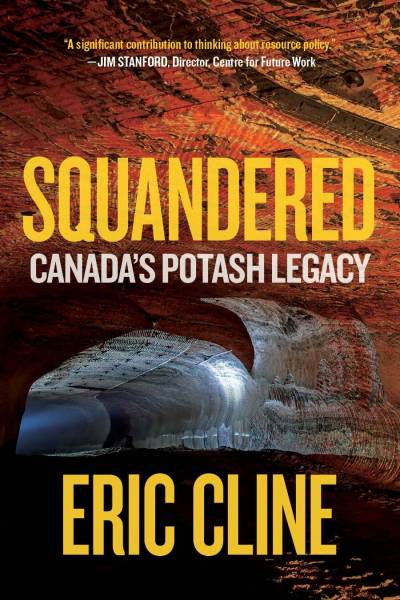
Eric Cline tells us that Saskatchewan’s potash deposits are rich and vast but buried very deep underground, with layers of water between them and the surface.

Read this article for free:


or

Already have an account? Log in here »

To continue reading, please subscribe:

Subscribe and receive a limited-edition Free Press branded hat or tote.

Digital Subscription

One year of digital access for only $205*

  • Enjoy unlimited reading on winnipegfreepress.com
  • Read the E-Edition, our digital replica newspaper
  • Access News Break, our award-winning app
  • Play interactive puzzles

*First annual payment billed as $205.00 + GST for one year. This annual subscription will automatically renew at $233.00 + GST every 52 weeks (10% off the regular annual price of $259.35). Offer available to new and qualified returning subscribers only. Cancel any time.

To continue reading, please subscribe:

Add Free Press access to your Brandon Sun subscription for only an additional

$1 for the first 4 weeks*

  • Enjoy unlimited reading on winnipegfreepress.com
  • Read the E-Edition, our digital replica newspaper
  • Access News Break, our award-winning app
  • Play interactive puzzles
Start now

*Your next Brandon Sun subscription payment will increase by $1.00 and you will be charged $17.95 plus GST for four weeks. After four weeks, your payment will increase to $24.95 plus GST every four weeks.

Hey there, time traveller!
This article was published 23/03/2024 (878 days ago), so information in it may no longer be current.

Eric Cline tells us that Saskatchewan’s potash deposits are rich and vast but buried very deep underground, with layers of water between them and the surface.

Cline — who was in the Saskatchewan NDP government from 1991 to 2007, mostly in senior cabinet positions including industry and resources and was, afterwards, employed as a corporate executive in the private mining sector for 11 years — might be describing his own book. Buried under layers of dull, repetitive prose lies an important account of how various Saskatchewan governments betrayed the public trust in favour of corporate profits.

In Canada, private landowners do not own undersurface minerals. They are held by the provincial governments in trust for the actual owners: the people of the respective provinces.

Squandered

Squandered

In Saskatchewan, the potash mining companies own the mines and mills which extract and refine the ore, but the potash in the ground is owned by the province. The province permits companies to extract the potash in return for royalties and taxes. When the mines are owned by the private sector, the responsibility of government should be to ensure their people receive fair compensation for their resources while allowing the companies to receive a fair return on their investments.

Notwithstanding the reference to Canada in the subtitle, Cline’s book is an unapologetic polemic aimed at the people of Saskatchewan. His purpose is to convince them that changes are needed in the province’s taxation regime to ensure government is not gratuitously giving revenue away to the private sector that could be used to mitigate the social ills that plague the province. As a result, he takes for granted a familiarity with Saskatchewan’s political economy that may be outside the experience of the general reader.

In 1975, nine multinational corporations were operating potash mines in Saskatchewan. After these companies refused to cooperate when Allan Blakeney’s NDP government attempted to negotiate a taxation regime more favourable to the province, Blakeney expropriated four mining companies to form a new crown corporation, the Potash Corporation of Saskatchewan (PCS). At one stroke, PCS became the largest potash mining company in the world, controlling 40 per cent of Saskatchewan’s potash.

Despite the traditional instability of mineral prices, over its lifetime PCS generated revenue for the provincial government well beyond what the expropriated mines would have generated had they remained in the private sector.

In 1989, at a time when potash prices were low, the Progressive Conservative government that replaced the NDP sold PCS to private investors for $630 million. From then on, whatever profits PCS made would generally accrue not to the Saskatchewan government, but to investors living outside the province — and, indeed, outside Canada. Cline quotes one economist’s estimate that between 1989 and 2011 alone, the loss to the people of Saskatchewan in foregone revenue could have been as much as $36 billion.

In 2010, the Australian mining giant BHP Billiton attempted a hostile takeover of PCS, offering $39 billion. The Saskatchewan and federal governments blocked the sale under the federal Investment Canada Act, opening the way for a takeover, for about half the BHP offer, by Calgary-based fertilizer company Agrium. The merged companies were renamed Nutrien. The Potash Corporation of Saskatchewan was no more.

A resource that should be used to maximize benefit for the people of the province through revenue, jobs and economic development had been effectively turned over to the world’s largest fertilizer company to be used to maximize corporate advantage to the detriment of the province’s interests.

In 2022, the potash industry in Saskatchewan, boosted by the consequences of Russia’s invasion of Ukraine, earned profits of $12 billion. Government revenue from potash was $3 billion. The government seemed content to see 85 per cent of the proceeds from the people’s resource flowing to investment funds outside the province.

Cline is not against companies making profits. He simply wants a major share of those profits to go to the owners of the potash.

Winnipegger John K. Collins finds it touching that so many people trust that corporations have their interests at heart.

Report Error Submit a Tip

More Stories

Steinbach homeowners sue city over flooding

Erik Pindera 3 minute read Preview

Steinbach homeowners sue city over flooding

Erik Pindera 3 minute read 4:58 PM CDT

Several Steinbach residents have filed a lawsuit against the southeastern Manitoba city over flooding in their homes they argue was the result of the government’s poor design and maintenance of the sewage system.

The lawsuit was filed on behalf of the homeowners — nine couples and four individuals — in the Court of King’s Bench last week.

The court papers claim the amount of rainfall that entered Steinbach’s sewers in the northeast part of the city, where the homeowners reside, was “significantly increased” during two heavy rainfalls in 2024 and 2025 as a result of the city’s alleged negligence or nuisance.

The lawsuit alleges a slew of issues with the city’s sewer system contributed to sewage backups and flooding of the plaintiffs’ homes during the heavy rains.

Read
4:58 PM CDT

Pair of banks abandoning Brandon’s downtown

Abiola Odutola 2 minute read Preview

Pair of banks abandoning Brandon’s downtown

Abiola Odutola 2 minute read 2:01 AM CDT

Two of Canada’s major banks are set to relocate from their longstanding downtown Brandon locations in October.

Read
2:01 AM CDT

Free fix is in: repair café aims to keep items out of landfills

Tiago Resko 3 minute read Preview

Free fix is in: repair café aims to keep items out of landfills

Tiago Resko 3 minute read Updated: Yesterday at 12:09 PM CDT

Stephen Kirk wants to give people a chance to fix items they’re not ready to let go of.

The Spence Neighbourhood Association staffer took notice when repair cafés started popping up around the world, and he decided to bring the idea to Winnipeg.

The café invites people to bring broken items like bikes, clothes and small kitchen appliances to the association’s headquarters to get free repairs by a team of skilled volunteers.

“Certainly in our neighbourhood, a lot of people’s motivation is economic, they would rather fix it than have to buy a new one,” said Kirk, the environmental and open spaces coordinator for the Spence Neighbourhood Association.

Read
Updated: Yesterday at 12:09 PM CDT

Ignore gossip, be good till girlfriend’s back

Maureen Scurfield 5 minute read 2:00 AM CDT

DEAR MISS LONELYHEARTS: I am lonely to the bone. My girlfriend has been away working for the summer, and I promised I wouldn’t cheat on her. But now I have heard through the grapevine she’s seeing a guy who works at her kids’ camp.

I think the source can be trusted, because she’s a friend who cares about me, almost like a sister. Actually I think she kind of wants me herself, but never seems to cross that line. Should I believe her “inside information” when she might be wanting to go out with me herself?

My girlfriend won’t be back until the very end of August and the messages and phone calls back and forth have been less and less frequent. Maybe she’s just busy or getting rested up to see me — or maybe she’s seeing someone else. I’m feeling jealous and I hate it! Maybe I should see somebody else too. Please advise ASAP.

— Lonely and Suspicious, Transcona

Two-time cancer survivor trades blows with angry Lake Winnipeg in epic 12-hour fundraising swim

Zoe Pierce 3 minute read Preview

Two-time cancer survivor trades blows with angry Lake Winnipeg in epic 12-hour fundraising swim

Zoe Pierce 3 minute read Updated: Yesterday at 2:46 PM CDT

After 12 hours of wind, waves and a painful shoulder, Jonathon Fenton has finished what he started, making it across Lake Winnipeg.

The 62-year-old two-time cancer survivor completed the roughly 26-kilometre swim Sunday, a year after shoulder problems forced him to stop 16 kilometres into his first attempt.

The swim was the second year of Fenton’s Jonny’s Big Swim fundraiser, which supports the Alberta Cancer Foundation, CancerCare Manitoba Foundation and Health Sciences Centre Foundation.

He raised roughly $48,000 this year, bringing the two-year total to about $90,000.

Read
Updated: Yesterday at 2:46 PM CDT

Hayden Panettiere, who starred in ‘Heroes’ and ‘Nashville,’ dies at 36

Hannah Schoenbaum, The Associated Press 6 minute read Preview

Hayden Panettiere, who starred in ‘Heroes’ and ‘Nashville,’ dies at 36

Hannah Schoenbaum, The Associated Press 6 minute read Updated: Yesterday at 12:26 PM CDT

Hayden Panettiere, a onetime child star who soared to fame in the TV shows “Heroes” and “Nashville” while enduring struggles with alcohol addiction and depression, has died. She was 36.

Police said Panettiere was found unresponsive in an apartment in Greenville, South Carolina, shortly before 2 p.m. Sunday. Lifesaving measures were performed but she was pronounced dead at the scene.

No cause of death has been determined and Panettiere's death remains under investigation. An autopsy found no signs of trauma and police said officers saw no signs of foul play.

The television and film performer, who would have turned 37 on Friday, had been open about her private battles and wrote at length about them in the memoir, “This Is Me,” which came out in May. She described lifelong scars from her early fame, and acknowledged being addicted to alcohol and enduring postpartum depression after the birth of her daughter, Kaya, with Ukrainian boxer Wladimir Klitschko in 2014.

Read
Updated: Yesterday at 12:26 PM CDT