Blind people can hear and feel April’s total solar eclipse with new technology

Advertisement

Advertise with us

WASHINGTON (AP) — While eclipse watchers look to the skies, people who are blind or visually impaired will be able to hear and feel the celestial event.

Read this article for free:


or

Already have an account? Log in here »

To continue reading, please subscribe:

Subscribe and receive a limited-edition Free Press branded hat or tote.

Digital Subscription

One year of digital access for only $205*

  • Enjoy unlimited reading on winnipegfreepress.com
  • Read the E-Edition, our digital replica newspaper
  • Access News Break, our award-winning app
  • Play interactive puzzles

*First annual payment billed as $205.00 + GST for one year. This annual subscription will automatically renew at $233.00 + GST every 52 weeks (10% off the regular annual price of $259.35). Offer available to new and qualified returning subscribers only. Cancel any time.

To continue reading, please subscribe:

Add Free Press access to your Brandon Sun subscription for only an additional

$1 for the first 4 weeks*

  • Enjoy unlimited reading on winnipegfreepress.com
  • Read the E-Edition, our digital replica newspaper
  • Access News Break, our award-winning app
  • Play interactive puzzles
Start now

*Your next Brandon Sun subscription payment will increase by $1.00 and you will be charged $17.95 plus GST for four weeks. After four weeks, your payment will increase to $24.95 plus GST every four weeks.

Hey there, time traveller!
This article was published 29/03/2024 (901 days ago), so information in it may no longer be current.

WASHINGTON (AP) — While eclipse watchers look to the skies, people who are blind or visually impaired will be able to hear and feel the celestial event.

Sound and touch devices will be available at public gatherings on April 8, when a total solar eclipse crosses North America, the moon blotting out the sun for a few minutes.

“Eclipses are very beautiful things, and everyone should be able to experience it once in their lifetime,” said Yuki Hatch, a high school senior in Austin, Texas.
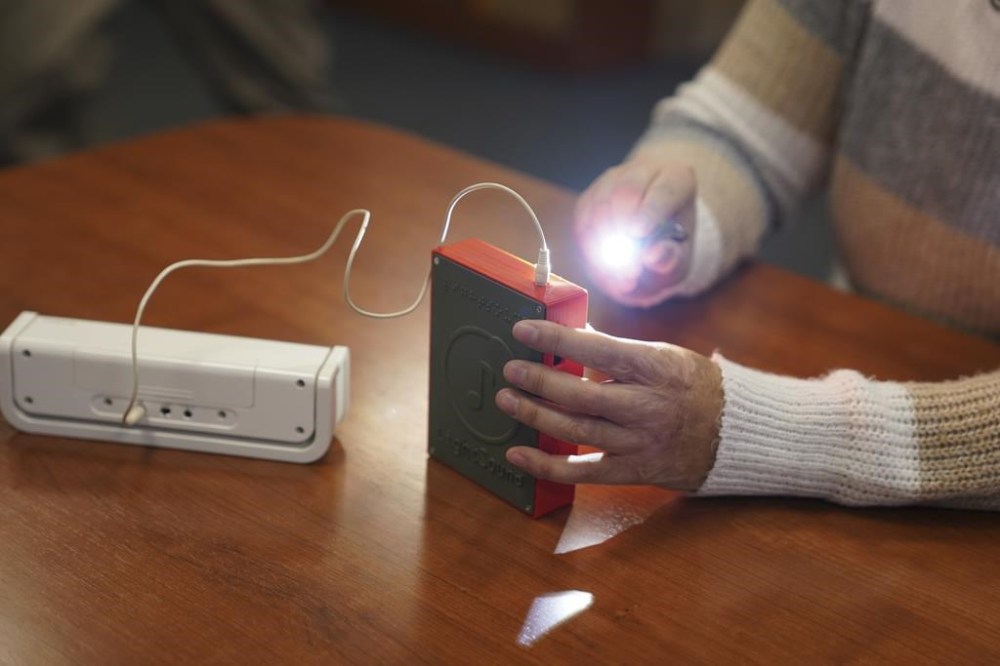
Minh Ha, assistive technology manager at the Perkins School for the Blind uses a flashlight to try a LightSound device, attached to an external speaker, for the first time at the school's library in Watertown, Mass., on March 2, 2024. Wanda Díaz-Merced, an astronomer who is blind, a co-creator of the device, says, “The sky belongs to everyone. And if this event is available to the rest of the world, it has to be available for the blind, too. ... I want students to be able to hear the eclipse, to hear the stars.
Minh Ha, assistive technology manager at the Perkins School for the Blind uses a flashlight to try a LightSound device, attached to an external speaker, for the first time at the school's library in Watertown, Mass., on March 2, 2024. Wanda Díaz-Merced, an astronomer who is blind, a co-creator of the device, says, “The sky belongs to everyone. And if this event is available to the rest of the world, it has to be available for the blind, too. ... I want students to be able to hear the eclipse, to hear the stars." (AP Photo/Mary Conlon)

Hatch is a visually impaired student and a space enthusiast who hopes to one day become a computer scientist for NASA. On eclipse day, she and her classmates at the Texas School for the Blind and Visually Impaired plan to sit outside in the school’s grassy quad and listen to a small device called a LightSound box that translates changing light into sounds.

When the sun is bright, there will be high, delicate flute notes. As the moon begins to cover the sun, the mid-range notes are those of a clarinet. Darkness is rendered by a low clicking sound.

“I’m looking forward to being able to actually hear the eclipse instead of seeing it,” said Hatch.

The LightSound device is the result of a collaboration between Wanda Díaz-Merced, an astronomer who is blind, and Harvard astronomer Allyson Bieryla. Díaz-Merced regularly translates her data into audio to analyze patterns for her research.

A prototype was first used during the 2017 total solar eclipse that crossed the U.S., and the handheld device has been used at other eclipses.

This year, they are working with other institutions with the goal of distributing at least 750 devices to locations hosting eclipse events in Mexico, the U.S., and Canada. They held workshops at universities and museums to construct the devices, and provide DIY instructions on the group’s website.

“The sky belongs to everyone. And if this event is available to the rest of the world, it has to be available for the blind, too,” said Díaz-Merced. “I want students to be able to hear the eclipse, to hear the stars.”

The Perkins Library — associated with the Perkins School for the Blind in Watertown, Massachusetts — plans to broadcast the changing tones of the LightSound device over Zoom for members to listen online and by telephone, said outreach manager Erin Fragola.

In addition to students, many of the library’s senior patrons have age-related vision loss, he said.

“We try to find ways to make things more accessible for everyone,” he said.

Others will experience the solar event through the sense of touch, with the Cadence tablet from Indiana’s Tactile Engineering. The tablet is about the size of a cellphone with rows of dots that pop up and down. It can be used for a variety of purposes: reading Braille, feeling graphics and movie clips, playing video games.

For the eclipse, “A student can put their hand over the device and feel the moon slowly move over the sun,” said Tactile Engineering’s Wunji Lau.

The Indiana School for the Blind and Visually Impaired started incorporating the tablet into its curriculum last year. Some of the school’s students experienced last October’s “ring of fire” eclipse with the tablet.

Sophomore Jazmine Nelson is looking forward to joining the crowd expected at NASA’s big eclipse-watching event at the Indianapolis Motor Speedway, where the tablet will be available.

With the tablet, “You can feel like you’re a part of something,” she said.

Added her classmate Minerva Pineda-Allen, a junior. “This is a very rare opportunity, I might not get this opportunity again.”

___

The Associated Press Health and Science Department receives support from the Howard Hughes Medical Institute’s Science and Educational Media Group. The AP is solely responsible for all content.

Report Error Submit a Tip

More Stories

A clear example of doing things right

Editorial 4 minute read Preview

A clear example of doing things right

Editorial 4 minute read Updated: Yesterday at 7:05 AM CDT

This week’s re-opening of a temporary emergency department in the flood-damaged Dauphin Regional Health Centre was described by government officials as a “monumental team effort.” It was certainly that, but the story about how the ER was restored so quickly is so much more.

Read
Updated: Yesterday at 7:05 AM CDT

Manitoba’s police watchdog is investigating after a man was found dead eight days after officers were unable to locate him following a 911 call from Canupawakpa Dakota First Nation in 2024.

The Independent Investigation Unit said the call came in just after midnight on Nov. 22, 2024, with a disturbance audible in the background. GPS coordinates traced it to the First Nation, 305 kilometres west of Winnipeg, prompting Manitoba First Nations Police Service officers to search the area.

Officers could not find the caller, whom they believed to be a local man. Eight days later, on Nov. 30, MFNPS conducted another search and found a man dead.

The death was initially referred to RCMP Major Crime Services as suspicious. The RCMP later returned the case to MFNPS for possible referral to the IIU because of concerns about the eight-day delay in locating the man. MFNPS notified the IIU on Sept. 15, 2026 — nearly two years after the incident.

Puzzles Palace

1 minute read Monday, Jul. 27, 2026

To solve our puzzles, please subscribe with this special offer: |

Manitoba mineral production set to triple, premier says

Carol Sanders 5 minute read Preview

Manitoba mineral production set to triple, premier says

Carol Sanders 5 minute read Updated: Yesterday at 5:19 PM CDT

Premier Wab Kinew said Tuesday Manitoba plans to triple mineral production in the next five years “to unlock a new era of wealth creation and growth.”

“We’re going to make sure that opportunity is spread throughout the province,” he told a news conference at the Canada investment summit in Toronto.

The province is working with industry and Indigenous governments to send a message to investors that “we’re going to do mining right in Manitoba,” the premier said.

For too long, Manitoba has lagged behind neighbouring provinces, Kinew said.

Read
Updated: Yesterday at 5:19 PM CDT

Seven years sought for serial harasser

Dean Pritchard 5 minute read Preview

Seven years sought for serial harasser

Dean Pritchard 5 minute read Yesterday at 2:01 AM CDT

Alexander Beaton finished serving a two-year jail sentence for criminally harassing six women and didn’t last two days in the community before he was back at it, sending unwanted obscene messages and videos to a dozen women.

Now prosecutors are seeking a seven-year prison sentence for the 30-year-old Winnipeg man, whose latest string of victims includes a police officer who investigated his earlier crimes.

“He essentially continued (offending) unabated,” Crown attorney Brett Rach told provincial court Judge Malcolm McDonald at a sentencing hearing Friday. “It caused more than a nuisance to these victims — it caused them to fear for their safety.”

Beaton pleaded guilty to 14 charges of criminal harassment, sending indecent communications and breaching court orders for a campaign of harassment waged between 2015 and 2025.

Read
Yesterday at 2:01 AM CDT

Winnipeg, economic diversity and risks from AI

Al Vigier 5 minute read 2:00 AM CDT

I run a company that builds software to read documents and fill out forms. When I look at Winnipeg, I see a lot of potential customers. I also think the city should be asking some fairly uncomfortable questions about what companies like mine are selling.

Winnipeg has spent decades building an economy that does not depend on any one industry. Insurance, agriculture, transportation, aerospace, manufacturing, government, health care. That mix has served it well. A bad year for one employer does not necessarily become a bad year for the whole city.

But there is another way to look at that economy: what people actually do when they arrive at work.

Great-West Lifeco, Wawanesa, IGM Financial and Manitoba Public Insurance are all headquartered in Winnipeg. There are provincial departments, Shared Health and businesses handling the freight moving through CentrePort. Their purposes are different. A surprising amount of their paperwork follows the same routine.