

Putting yourself in others’ shoes
Advertisement
Read this article for free:
or
Already have an account? Log in here »
To continue reading, please subscribe:

Digital Subscription
One year of digital access for only $205*
- Enjoy unlimited reading on winnipegfreepress.com
- Read the E-Edition, our digital replica newspaper
- Access News Break, our award-winning app
- Play interactive puzzles
*First annual payment billed as $205.00 + GST for one year. This annual subscription will automatically renew at $233.00 + GST every 52 weeks (10% off the regular annual price of $259.35). Offer available to new and qualified returning subscribers only. Cancel any time.
To continue reading, please subscribe:
Add Free Press access to your Brandon Sun subscription for only an additional
$1 for the first 4 weeks*
- Enjoy unlimited reading on winnipegfreepress.com
- Read the E-Edition, our digital replica newspaper
- Access News Break, our award-winning app
- Play interactive puzzles
*Your next Brandon Sun subscription payment will increase by $1.00 and you will be charged $17.95 plus GST for four weeks. After four weeks, your payment will increase to $24.95 plus GST every four weeks.
Read unlimited articles for free today:
or
Already have an account? Log in here »
Hey there, time traveller!
This article was published 30/03/2024 (883 days ago), so information in it may no longer be current.
What if it were someone you know?
You have that friend. We all have that friend, at some point in our lives.
Someone who pushes the limits — someone who sometimes makes you push the limits, too, sometimes pushing them further that you like, when you look back on it later. They’re great — they’re fun. They make you laugh. They make everybody laugh. But there’s a dark part, too.
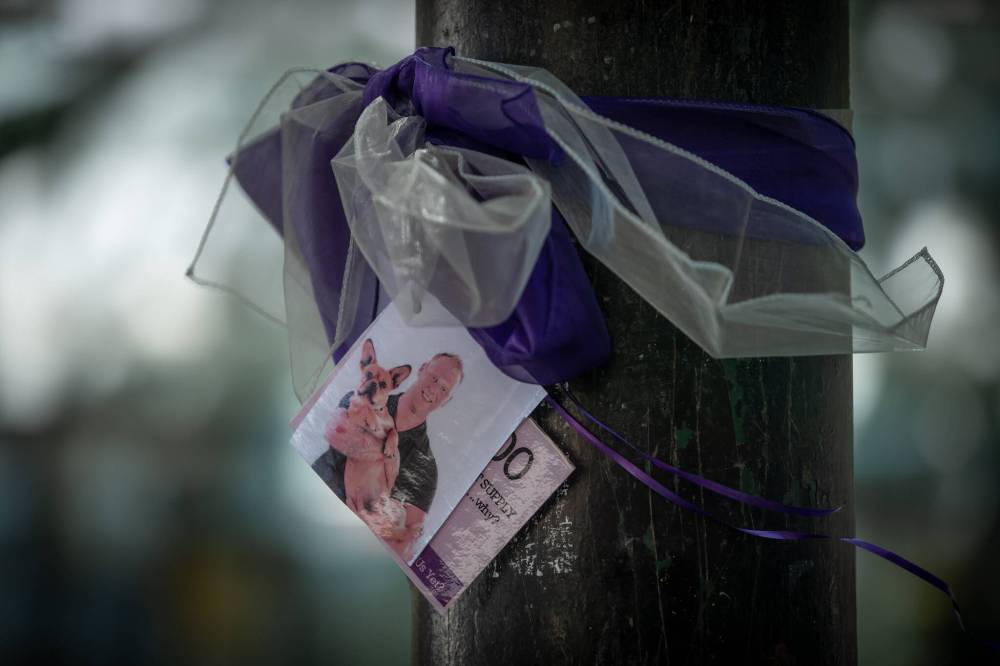
THE CANADIAN PRESS FILES
A photo of a person who died due to an illicit drug overdose is tied to a tree with a purple ribbon.
They just do everything, well, harder. They work hard and regularly take chances that you know you wouldn’t. They live just a little too large, all the time.
Maybe, as you grow older, you don’t see them as much as you used to — you’ve moved in a different direction, your life gets complicated with kids and responsibilities. You can’t afford the time recovering from the night before, no matter how much fun the adventure can be at the time. Through the grapevine, you hear they’ve fallen into a darker place.
One day, you find out they’ve died of an overdose.
You’d like to say you’re surprised, but, somehow, you’re not. You didn’t see it coming, not exactly, but you’re experienced enough to know how to read the map and see the dangerous intersections.
But then, the next day, another friend dies of the same thing.
Then, one day later, an uncle of yours dies, the uncle who liked to sit on a chair in the dim of his garage on summer evenings with the garage door open, watching the lane.
And then it goes on like that, every day, day after day, for weeks on end.
You’d want answers, and you’d want solutions.
Actually, you’d demand answers and you’d demand solutions.
We’re in that spot now in Manitoba. Except you don’t know everyone who’s dying and perhaps that lets you gloss over what’s actually happening. Scores of people are dying. They’re just not always people you know, often people on the margins of society.
Someone dies of a drug overdose in this province more frequently than every single day of the year now. Early data from this province’s chief medical officer says that there were 445 drug-related deaths in the province last year, a higher total than both 2022 (418) and 2021 (432). There were a staggering 54 deaths in December alone, closing in on two people a day.
They’re dying of fentanyl overdoses, of methamphetamine, of combinations of several drugs being sold under the street name “Down.” Sometimes, people taking a drug mix don’t even know what it is they’ve been given.
Outreach workers say that we’re in the midst of a crisis and that, in a crisis, you have to find effective tools to save lives, whatever those tools are. Just the way needle exchanges supply products to try and stop the spread of disease, we should also be trying to find a way to stop the spread of dangerously adulterated drugs — whether that means drug testing services, safe consumption sites or even the distribution of safe supply drugs.
The simplest thing to point out is that what we’re doing now isn’t solving the problem.
Wab Kinew’s government has instructed Addictions Minister Bernadette Smith to create those kinds of supports.
But since those instructions were announced, hundreds of people have died.
Hundreds.
Think back to the top of this editorial.

It’s different when you know someone.
So maybe we should treat this crisis like it’s happening to people we know.
Because sometimes, it is.
And even if it isn’t, we could scrape up enough compassion somewhere to put ourselves in the shoes of their friends and families.
For those who are gone and not forgotten.