Uber legacy: Class-action lawsuit by taxi drivers against Quebec begins
Advertisement
Read this article for free:
or
Already have an account? Log in here »
To continue reading, please subscribe:

Digital Subscription
One year of digital access for only $205*
- Enjoy unlimited reading on winnipegfreepress.com
- Read the E-Edition, our digital replica newspaper
- Access News Break, our award-winning app
- Play interactive puzzles
*First annual payment billed as $205.00 + GST for one year. This annual subscription will automatically renew at $233.00 + GST every 52 weeks (10% off the regular annual price of $259.35). Offer available to new and qualified returning subscribers only. Cancel any time.
To continue reading, please subscribe:
Add Free Press access to your Brandon Sun subscription for only an additional
$1 for the first 4 weeks*
- Enjoy unlimited reading on winnipegfreepress.com
- Read the E-Edition, our digital replica newspaper
- Access News Break, our award-winning app
- Play interactive puzzles
*Your next Brandon Sun subscription payment will increase by $1.00 and you will be charged $17.95 plus GST for four weeks. After four weeks, your payment will increase to $24.95 plus GST every four weeks.
Read unlimited articles for free today:
or
Already have an account? Log in here »
Hey there, time traveller!
This article was published 02/04/2024 (904 days ago), so information in it may no longer be current.
MONTREAL – Driving a taxi was not how Jean-Pierre Derival planned to spend his golden years. But this week, as the 80-year-old prepared to testify at a trial against the Quebec government’s management of the taxi industry, he was behind the wheel of his cab.
His goal, he said, was to use his taxi owner’s permit as a source of income in retirement. Then, in 2013, ride-hailing company Uber entered the Quebec market, and his permit, along with cab permits across the province, slowly began losing their value. And in 2019, the province passed a law to abolish the permit system altogether, crushing Derival’s retirement dreams.
He’s now part of a class-action lawsuit against the government on the grounds that the province’s handling of Uber’s entry into the market and Quebec’s taxi reform law allowed Quebec to expropriate his property — his permit — without adequately compensating him.
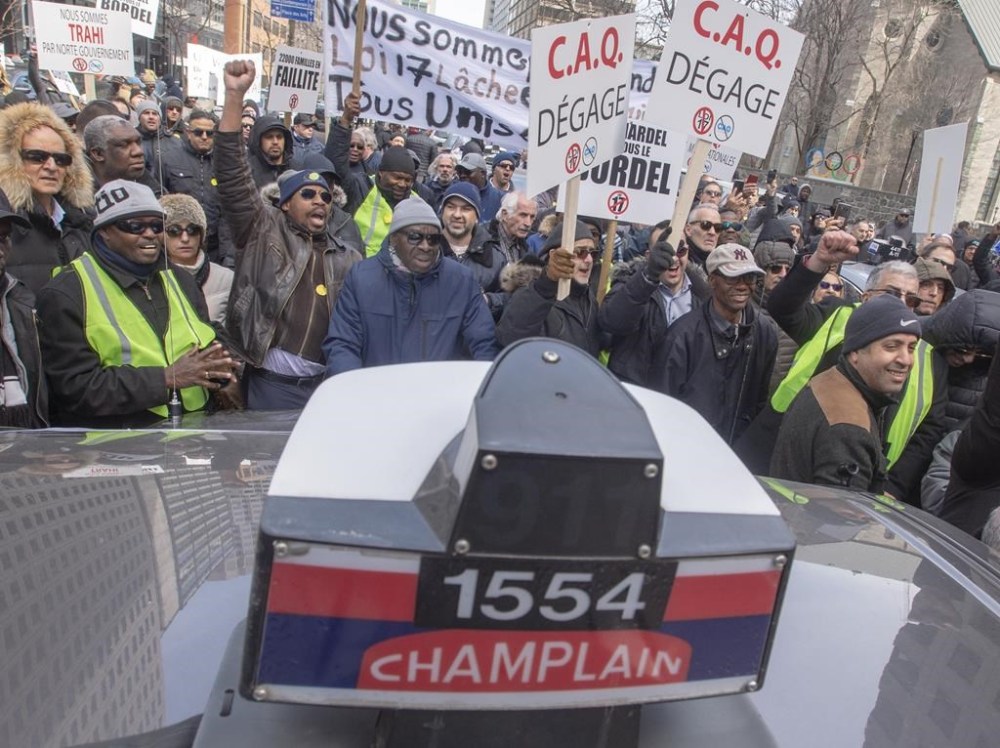
“It’s unfair, your honour, to deprive the members (of the class action) of their life’s work, it’s an injustice that I find shocking, and ultimately, it’s illegal,” Bruce Johnston, a lawyer representing the cab drivers, said in his opening arguments as the month-long trial began at the Montreal courthouse Tuesday.
Before the 2019 taxi reform, each cab in the province required a permit. The provincial government limited the number of permits in each region, but allowed them to be resold, creating a secondary market and leading their value to rise to more than $200,000 in the Montreal area. Permit holders often rented them out, allowing others to drive their cabs for a fee.
Buying a permit gave people access to a supply-controlled market created by the government, Johnston told the court, but also opened other doors, because permits could be used as collateral for loans, such as mortgages.
“It was their business, it was their pension fund,” he said. “For many of them, the decision to buy a taxi permit was the biggest financial decision of their lives, for which they worked and made sacrifices for decades. It was the cornerstone of their financial planning.”
When Quebec abolished the permit system, it gave holders a total of $800 million in compensation, but Johnston said that figure fell far below the market value of the permits before Uber’s 2013 arrival, which he estimated at around $1.2 billion.
Derival bought his permit in 1976 for $10,500; he took out loans from a bank and a friend to buy it. That permit, he said, offered him employment but also something he could pass on to his children.
“At least if I died, my children could use it,” he told the court, after describing the series of labour-intensive, low-paying jobs he had held after immigrating from Haiti in 1971.
The compensation he received from the government — a total of $75,000 — was less than the total income stream he had expected in retirement by renting his permit.
Max Pierre, another former permit holder who also immigrated from Haiti, told the court on Tuesday buying a taxi permit was the only way to find work that paid more than minimum wage. In 1991, he bought a permit for $37,955 — it came with a car, a taxi dome light and meter. He would later buy another permit near the peak of the market for $210,000.
To buy the first permit, he said, “I gave up a lot,” adding that he got help from his sister.
In 2017, he said, he was able to rent his permit and his taxi to another driver for $500 a week, but with the end of the permit system, which went into effect in 2020, and the COVID-19 pandemic, no one was interested in driving for him, and as a result he sold his car.
“What the government did was an abuse of power,” he told the court.
Éric Cantin, a lawyer for the Quebec government, argued that the province had the right to make the choices it did.
People can think Uber’s arrival in Quebec was a bad thing, that Uber is a bad corporate citizen, and that the old taxi monopoly should have been maintained, Cantin told the court, but the government, he added, made political choices about how it wanted to regulate the industry.
For years after Uber entered the market, it operated without a licence. But in 2016, Quebec launched a pilot project allowing the San Fransisco-based ride-hailing company to operate legally. That project was challenged in court, but its legality was upheld, Cantin said, adding that the 2019 taxi industry reform — which provided compensation for permit holders — was never challenged in court.

“A law can’t be indirectly challenged because you’re not satisfied with the money you’ve received,” he said.
While Cantin said taxi driving is difficult and Uber made it harder, the decision to abolish the permit system cannot be described as an expropriation because the government never created its own taxi service and taxi drivers can continue to drive taxis.
The class action, which was authorized in 2018, seeks at least$400 million for members — the difference between the estimated 2014 market value of the approximately 7,500 permits and the compensation package Quebec gave to permit holders. The lawsuit is also seeking $1,000 in punitive damages for each member of the group.
A separate class-action lawsuit on behalf of Quebec taxi drivers who say they lost revenue as a result of Uber’s arrival in Quebec has also been authorized, but a trial date has not yet been set.
This report by The Canadian Press was first published April 2, 2024.