

Illuminating path, creating opportunities for communication
Advertisement
Read this article for free:
or
Already have an account? Log in here »
To continue reading, please subscribe:

Digital Subscription
One year of digital access for only $205*
- Enjoy unlimited reading on winnipegfreepress.com
- Read the E-Edition, our digital replica newspaper
- Access News Break, our award-winning app
- Play interactive puzzles
*First annual payment billed as $205.00 + GST for one year. This annual subscription will automatically renew at $233.00 + GST every 52 weeks (10% off the regular annual price of $259.35). Offer available to new and qualified returning subscribers only. Cancel any time.
To continue reading, please subscribe:
Add Free Press access to your Brandon Sun subscription for only an additional
$1 for the first 4 weeks*
- Enjoy unlimited reading on winnipegfreepress.com
- Read the E-Edition, our digital replica newspaper
- Access News Break, our award-winning app
- Play interactive puzzles
*Your next Brandon Sun subscription payment will increase by $1.00 and you will be charged $17.95 plus GST for four weeks. After four weeks, your payment will increase to $24.95 plus GST every four weeks.
Read unlimited articles for free today:
or
Already have an account? Log in here »
Hey there, time traveller!
This article was published 04/04/2024 (898 days ago), so information in it may no longer be current.
When it comes to cross-cultural community relations, there’s no magic formula for success.
As Canadians, we pat ourselves on the back when it comes to the success of multiculturalism and acceptance of newcomers.
In Manitoba, the dramatic increase in immigration over recent decades has been heralded as an actual economic boon for the province. The province has very publicly welcomed a recent influx of conflict migrants from Ukraine.
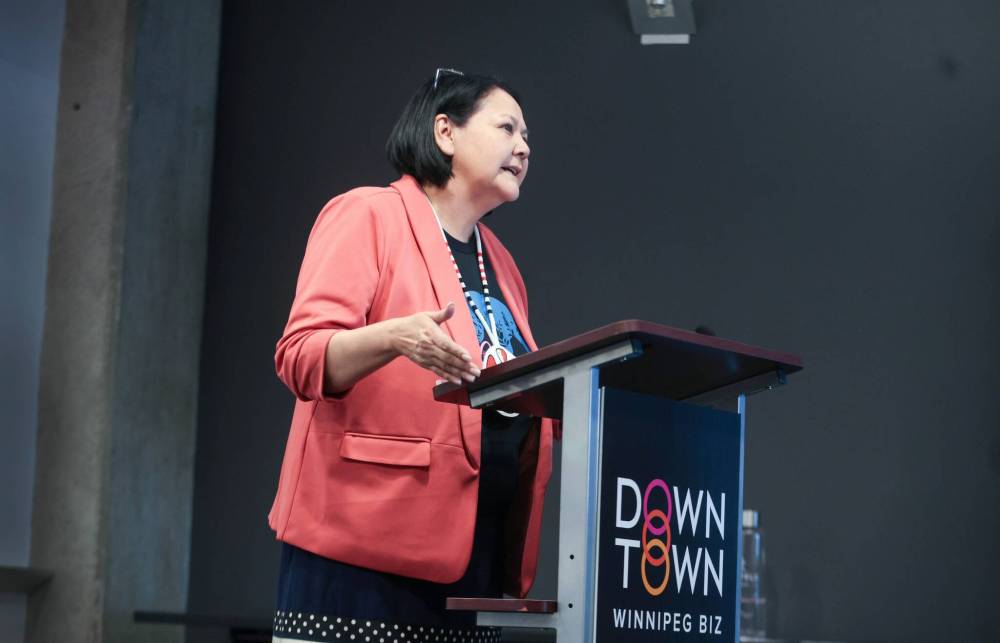
Ruth Bonneville / Free Press
Assembly of Manitoba Chiefs Grand Chief Cathy Merrick talks about building understanding and cultural cohesion in the heart of the city Thursday at a Downtown Winnipeg Business Improvement Zone event at the Alt Hotel.
There is plenty of NIMBY-ism regarding individuals’ preferences when it comes to interactions with people from other cultures but, at a broader community level, we are an accepting bunch.
In the context of that track record, reconciliation with the historic injustices that have befallen Indigenous people has become a community-wide project no one would publicly opt out of.
The process of reconciliation being pursued in Manitoba is often referred to as a journey, one that’s undertaken by both Indigenous and non-Indigenous people. But setting off on a physical journey typically means you know where you’re heading and have some sense of the route to be taken.
While it’s safe to say there is a sincere commitment to reconciliation in Manitoba, trying to figure out which path to take is no easy matter. Many would likely very much appreciate a clear road map, were one handy.
What we do instead is look for and create opportunities to keep talking to each other.
Community organizations are becoming more experienced at facilitating that sort of situation.
On Thursday, the Downtown Winnipeg Business Improvement Zone hosted a standing room-only event for its members at the Alt Hotel, with an opportunity to hear Assembly of Manitoba Chiefs Grand Chief Cathy Merrick talk about building understanding and cultural cohesion in the heart of the city — an issue widely understood to be in a particularly vulnerable state these days.
Merrick’s remarks didn’t include many surprising historic revelations or cultural details non-Indigenous Winnipeggers were not aware of, but her remarks hit home.
She clearly articulated Indigenous people come to Winnipeg for medical appointments because there are no such medical facilities in their home communities, not because of a preference. She noted how young children are when they have to leave their families to attend schools because there is no high schools in many First Nations communities.
She used the word “racism” in noting the challenges Indigenous people have in renting apartments or finding jobs, even when they have the money and educational credentials.
However, Merrick was not despondent in her remarks. She was also hilarious.
Her admiration for First Nations youth and their increasing educational successes and hope about the impact they can have on the future was powerful.
“Education is the new buffalo,” she said in reference to the increasing numbers of Indigenous students graduating from post-secondary schools and how important a resource that will be for their home communities.
Robin Hardman, general manager of McCOR Management, a commercial property manager with a staff of about 40 in Winnipeg, said she could have heard a pin drop at Merrick’s presentation and was surprised when she noticed an hour had gone by.
She said hearing Merrick made her realize her staff — who encounter struggling and homeless Indigenous individuals every day — would benefit from hearing more about the cultural realities of Indigenous people in the province.
“Hearing what Cathy had to say… it’s challenging for both sides,” Hardman said. “We’re not always sensitive to the history.
“I’m a parent,” she said. “I can’t imagine sending 13- and 14-year-olds off to live with someone else (to attend high school). What’s going to happen to them?”
Merrick commented on how a non-Indigenous acquaintance of hers was surprised to learn about multi-generational Indigenous families getting together for celebrations. “She said, ‘I didn’t know you did that.’”

At the end of her presentation, Kate Fenske, CEO of Downtown BIZ, said everyone is at different places in their personal reconciliation journey.
Asking Merrick for advice, she said: “Sometimes, we’re not necessarily sure where we should go next. Some are even trying to figure out the first step.”
Merrick said the important thing is to be inclusive. Earlier, she encouraged people to support Indigenous-led businesses.
She might also have said to keep listening to people like her and others who know how to illuminate a path.
martin.cash@freepress.mb.ca