
Austria likely to be largely ice-free within 45 years as glaciers recede quickly, experts say

Advertisement

Advertise with us

VIENNA (AP) — Austrian glaciers receded last year at a rapid pace and the Alpine country is likely to be largely ice-free in 40 to 45 years as the process continues, experts said Friday.

Read this article for free:


or

Already have an account? Log in here »

To continue reading, please subscribe:

Subscribe and receive a limited-edition Free Press branded hat or tote.

Digital Subscription

One year of digital access for only $205*

  • Enjoy unlimited reading on winnipegfreepress.com
  • Read the E-Edition, our digital replica newspaper
  • Access News Break, our award-winning app
  • Play interactive puzzles

*First annual payment billed as $205.00 + GST for one year. This annual subscription will automatically renew at $233.00 + GST every 52 weeks (10% off the regular annual price of $259.35). Offer available to new and qualified returning subscribers only. Cancel any time.

To continue reading, please subscribe:

Add Free Press access to your Brandon Sun subscription for only an additional

$1 for the first 4 weeks*

  • Enjoy unlimited reading on winnipegfreepress.com
  • Read the E-Edition, our digital replica newspaper
  • Access News Break, our award-winning app
  • Play interactive puzzles
Start now

*Your next Brandon Sun subscription payment will increase by $1.00 and you will be charged $17.95 plus GST for four weeks. After four weeks, your payment will increase to $24.95 plus GST every four weeks.

Hey there, time traveller!
This article was published 05/04/2024 (915 days ago), so information in it may no longer be current.

VIENNA (AP) — Austrian glaciers receded last year at a rapid pace and the Alpine country is likely to be largely ice-free in 40 to 45 years as the process continues, experts said Friday.

The Austrian Alpine Club said that, of the 93 glaciers its volunteers measured and observed, all but one receded in 2022-2023.

The 79 glaciers measured both last year and the previous year were an average 23.9 meters (78 feet) shorter than a year earlier, it said in an annual report. That was the third-highest figure of shrinkage in both the club’s 133 years of measurements and in the past seven years. The retreat of 14 other glaciers was observed less precisely, for example by comparing photos.
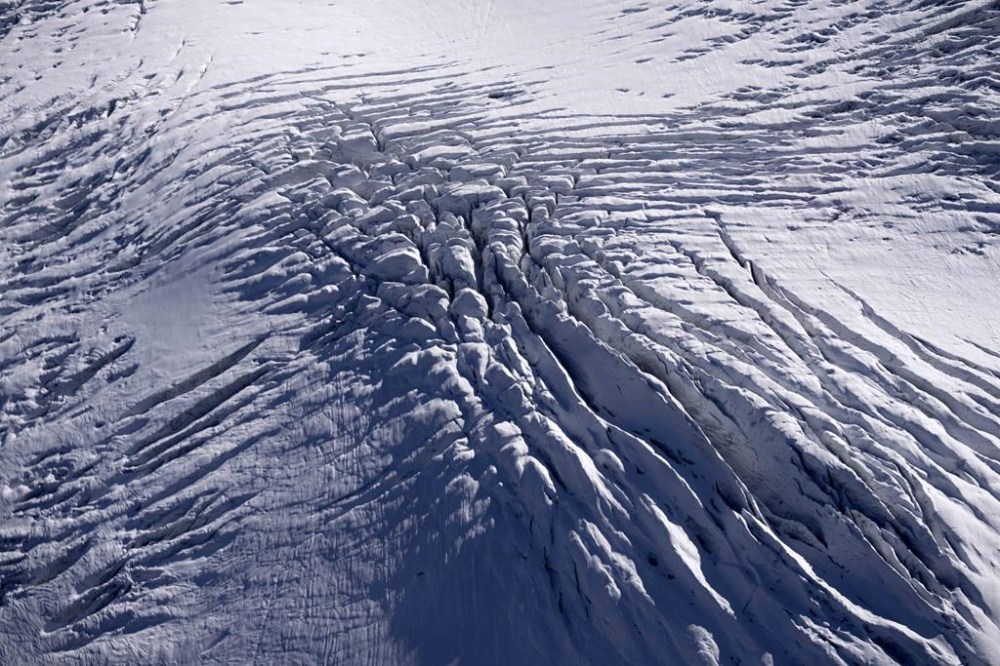
FILE - The Sulzenauferner Glacier is visible near Innsbruck, Austria, on Sept. 25, 2023. Austrian glaciers receded last year at a rapid pace, and the Alpine country is likely to be largely ice-free in 40 to 45 years as the process continues, experts said Friday April 5, 2024. (AP Photo/Matthias Schrader, File)

The biggest retreat was that of Austria’s biggest glacier — the Pasterze, in the Glockner mountain group in the southern province of Carinthia — which shrank by 203.5 meters (668 feet), a record for that glacier.

Gerhard Lieb, the co-leader of the club’s glacier measurement service, said Austria’s glaciers can no longer be saved and their disappearance in the coming decades is “unstoppable.”

The process of forming snow reserves at the upper ends of glaciers so that they can stabilize takes decades, “and the time is up,” he added. “That means nothing can be done anymore.”

“There might be some remnants in shadowed locations — maybe at the Glockner glacier on the north-east side, some areas in the Oetztal valley,” said the service’s other co-leader, Andreas Kellerer-Pirklbauer. “But de facto, in 40 to 45 years all of Austria will be pretty much ice-free.”

The experts, both of whom work at the University of Graz’s geography institute, said that the continued existence of Austria’s glaciers is down entirely to ice reserves from the past.

Kellerer-Pirklbauer said that “a late but very long and warm melting period in 2023” was the main culprit in the latest numbers.

Last year’s average figure for glacier retreat fell short of the record set in 2021-2022 of 28.7 meters (94.2 feet). But no glacier receded by more than 100 meters that year, and two did in the latest report: Alongside the Pasterze, Tyrol province’s Rettenbachferner glacier was 127 meters (416.7 feet) shorter. Only one glacier, the Baerenkopfkees in the Glockner group, was unchanged in length last year.

Glaciers are masses of ice that form as snow and ice compact over centuries and then flow slowly over land. Their melting is one of the most notable indications of human-caused climate change, with glaciers around the world rapidly retreating.

Experts in neighboring Switzerland said in September that that country saw 4% of its total glacier volume disappear in 2023, the second-biggest decline in a single year on top of a 6% drop in 2022.


Report Error Submit a Tip

More Stories

AI governance: Canada’s next structural test

Anne Thompson 4 minute read 2:00 AM CDT

Artificial intelligence is accelerating faster than the governance structures meant to contain it. Canada now faces a structural test — whether our institutions can protect autonomy, dignity, and continuity in an era when decision-making is increasingly mediated by systems we did not design, cannot fully audit, and do not yet constitutionally constrain.

This is not a technological problem. It is a governance problem.

AI systems influence how information flows, how institutions behave, and how decisions are made. They shape the conditions under which harm becomes predictable. They amplify both the strengths and weaknesses of the systems into which they are deployed. And they do all of this at a scale and speed that outpaces traditional regulatory tools.

Canada’s current approach to AI governance relies heavily on policy, guidelines, and sector-specific regulation. These are important, but they are not sufficient. What is missing is structural clarity — a constitutional-grade framework that defines authority, responsibility, accountability, and the minimum conditions under which AI systems may operate without undermining human dignity or institutional credibility.

Whistleblower pharmacist fined for misconduct after complaint

Nicole Buffie 5 minute read Preview

Whistleblower pharmacist fined for misconduct after complaint

Nicole Buffie 5 minute read Yesterday at 4:57 PM CDT

A Manitoba pharmacist who made complaints against a colleague that led to sanctions against him has now also been fined due to her own conduct.

Read
Yesterday at 4:57 PM CDT

Uber bans city driver facing sexual assault charge

Matthew Frank 2 minute read 12:43 PM CDT

A Winnipeg Uber driver has been permanently banned from the platform after police charged the man for allegedly sexually assaulting a passenger last month.

A woman reported that she used the ride service on Sept. 27 and the 27-year-old driver sexually assaulted her once the vehicle reached its destination in the Weston neighbourhood, the Winnipeg Police Service said in a news release.

Police said the woman was able to escape and get to safe place. The driver was arrested on Sept. 28 at an apartment complex on Kennedy Street. He was later released with conditions.

An Uber spokesperson said the driver is permanently banned, and the company is assisting police with the investigation.

MPI lowers speed limit on tech upgrade with ‘IT roadmap’ following Project Nova debacle

Carol Sanders 5 minute read Preview

MPI lowers speed limit on tech upgrade with ‘IT roadmap’ following Project Nova debacle

Carol Sanders 5 minute read Monday, Oct. 5, 2026

Manitoba Public Insurance is now using an “IT road map” and phasing in new technology and systems after pulling the plug last year on its failed $164-million overhaul known as Project Nova, its annual report says.

Read
Monday, Oct. 5, 2026

This week’s silly geopolitical spat

Gwynne Dyer 4 minute read 2:01 AM CDT

“I would not like to call this an incident. Let’s say it’s a diplomatic misunderstanding,” said Ukrainian Foreign Affairs Minister Andrii Sybiha. But the South Korean president definitely sees it as a serious incident, and he has already gone public with it.

“If (Ukraine’s) refusal to acknowledge the facts and issue a public apology continues, we will take additional measures,” President Lee Jae-myung wrote on X. He probably means cutting the non-military aid South Korea gives to Ukraine. (There is no military aid, since the constitution bans Seoul from providing arms to a country actively involved in a war).

What monstrous misdeed did the Ukrainian government commit to deserve such harsh words from a country that is generally sympathetic to Ukraine’s struggle against its giant neighbour? Have the South Koreans discovered Ukrainian spies in the Blue House?

No, it’s what we professionals call a “spat.”

Puzzles Palace

1 minute read Monday, Jul. 27, 2026

To solve our puzzles, please subscribe with this special offer: |