A deft diagnosis
Psychologist offers glimpse into her sociopathic mind in polished new memoir
Advertisement
Read this article for free:
or
Already have an account? Log in here »
To continue reading, please subscribe:

Digital Subscription
One year of digital access for only $205*
- Enjoy unlimited reading on winnipegfreepress.com
- Read the E-Edition, our digital replica newspaper
- Access News Break, our award-winning app
- Play interactive puzzles
*First annual payment billed as $205.00 + GST for one year. This annual subscription will automatically renew at $233.00 + GST every 52 weeks (10% off the regular annual price of $259.35). Offer available to new and qualified returning subscribers only. Cancel any time.
To continue reading, please subscribe:
Add Free Press access to your Brandon Sun subscription for only an additional
$1 for the first 4 weeks*
- Enjoy unlimited reading on winnipegfreepress.com
- Read the E-Edition, our digital replica newspaper
- Access News Break, our award-winning app
- Play interactive puzzles
*Your next Brandon Sun subscription payment will increase by $1.00 and you will be charged $17.95 plus GST for four weeks. After four weeks, your payment will increase to $24.95 plus GST every four weeks.
Read unlimited articles for free today:
or
Already have an account? Log in here »
Hey there, time traveller!
This article was published 06/04/2024 (841 days ago), so information in it may no longer be current.
Canadian readers looking at the pretty blonde child gazing blankly from the cover of this page-turner of a memoir can be forgiven for thinking of Karla Homolka.
But Toronto serial killer Paul Bernardo’s soulless accomplice is the last person that Sociopath’s author, California psychologist Patric Gagne, would want comparison with.
The main point Gagne conveys is that people like herself, those who have been clinically diagnosed with “antisocial personality disorder” (sociopathy in the common parlance), are not intrinsically evil or without conscience.

Kristia Knowles photo
Patric Gagne’s memoir is superbly written and edited, and reads like a psychological thriller.
Despite their inability to process normal social emotions such as empathy, guilt, shame and in some cases even love, many sociopaths are aware of their inadequacies and want to overcome them.
The worst part is her loneliness, she tells her father in her 20s. “I want to connect. I want friends.… It’s like I’m starving, but food makes me sick.”
From her early childhood in San Francisco, Gagne writes, she knew she was different, or as a schoolmate tells her, “weird.” She stole small items from neighbours and family members, feeling no remorse.
She sneaked into neighbours’ houses when they weren’t home. In elementary school, after her parents divorced and her mother took her and her younger sister to Florida, she stabbed a classmate in the side of the head with a sharp pencil.
Gagne comes from affluence, it should be stated, and she was not malignantly parented. She thinks her condition is nature, not nurture.
Attending UCLA, she is drawn to the study of psychology, where she finds labels for her feelings — or more specifically, her lack of them. She begins to understand why the “pressure” that builds up in her brain can only be relieved by committing “premeditated transgressions.”
After a long detour working for her father as a talent manager in the Los Angeles music industry — where, she notes, sociopaths are a dime a dozen — she returns to graduate school to become a clinical psychologist.
She interweaves discussions of her academic research and reconstructions of conversations with her profs and therapist with tales of her crimes, such as stealing cars and breaking into homes.
There is a titillation factor to Gagne’s confessions, but apart from the boyfriend she meets at camp at age 14 — and whom she marries much later — she spends her 20s living like a nun.
Mind you, she also swears like a sailor and the text’s volume of profanity can be off-putting.
Otherwise, Sociopath is superbly written and edited. It reads like a psychological thriller, as aspects of Gagne’s story — including a blackmailing attempt (she’s the victim) and her relationship with a famous musician — come together in the final chapters.
But this slickness works against credibility. Real life is not as packaged as Gagne portrays hers.
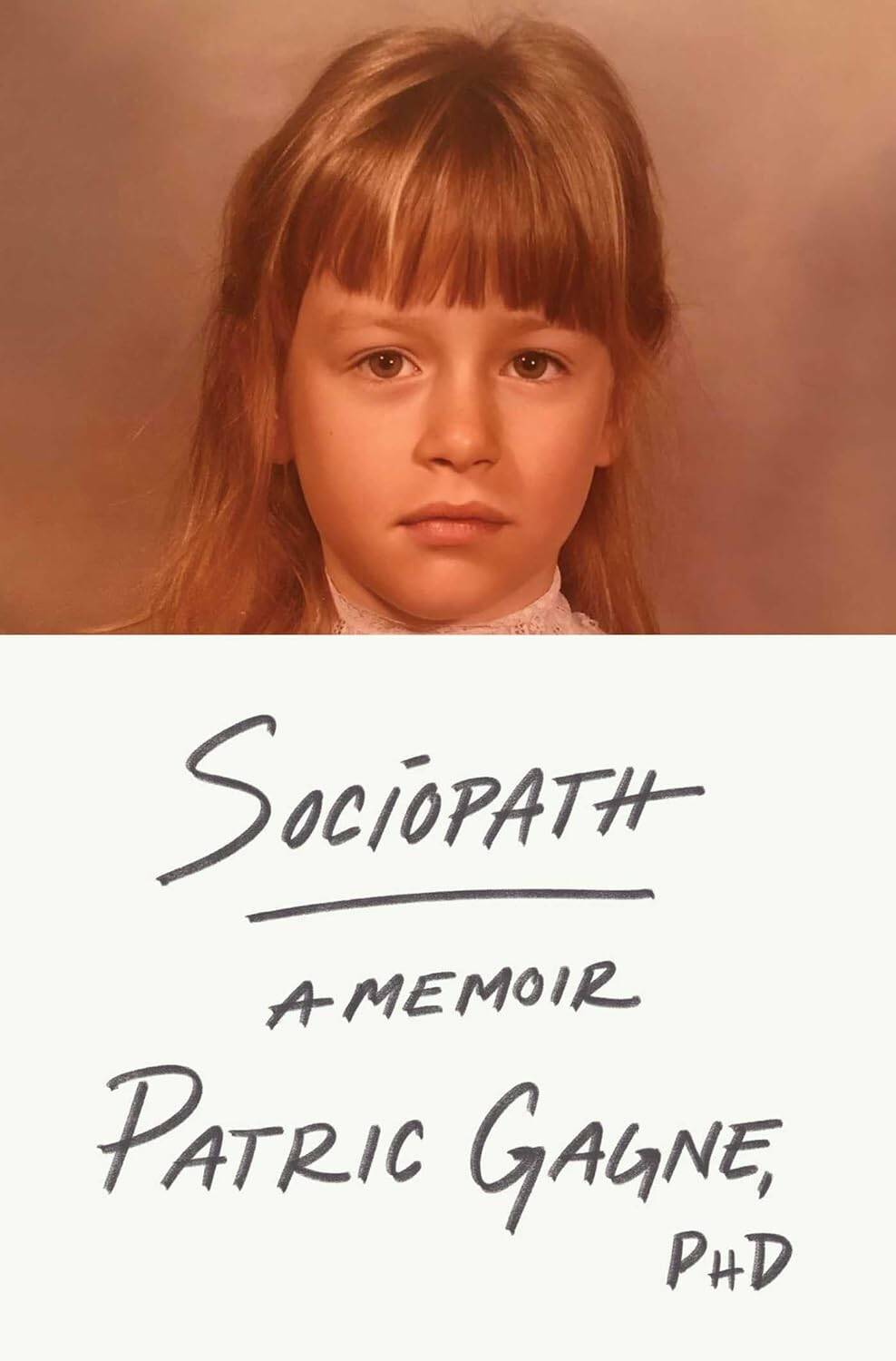
Sociopath
She is suspiciously vague about dates and ages, including her own. All we have is the odd pop-culture reference as a clue to when incidents occur.
Her mother vanishes from the story without comment and Gagne (who would be close to 50 now) has changed the name of everyone else around her. One wonders if “Patric Gagne” is itself not a pseudonym.
Memoirs, of course, are always shaped. No one recalls conversations verbatim decades after they took place.

But the polished surface here calls to mind a novel such as Bret Easton Ellis’ American Psycho or, worse, the intentional deception of James Frey’s notorious 2003 faux memoir A Million Little Pieces.
In 2013, another American woman, M.E. Thomas, published a similar memoir, Confessions of a Sociopath, which seemed more believable, despite its author’s annoying grandiosity.
Gagne’s book aims for sincerity. Yet despite its compulsive readability, there is something about it that does not ring true.
Maybe that’s what you get from a sociopath.
Morley Walker is a retired Free Press editor and writer.