Scientists are grasping at straws while trying to protect infant corals from hungry fish
Advertisement
Read this article for free:
or
Already have an account? Log in here »
To continue reading, please subscribe:

Digital Subscription
One year of digital access for only $205*
- Enjoy unlimited reading on winnipegfreepress.com
- Read the E-Edition, our digital replica newspaper
- Access News Break, our award-winning app
- Play interactive puzzles
*First annual payment billed as $205.00 + GST for one year. This annual subscription will automatically renew at $233.00 + GST every 52 weeks (10% off the regular annual price of $259.35). Offer available to new and qualified returning subscribers only. Cancel any time.
To continue reading, please subscribe:
Add Free Press access to your Brandon Sun subscription for only an additional
$1 for the first 4 weeks*
- Enjoy unlimited reading on winnipegfreepress.com
- Read the E-Edition, our digital replica newspaper
- Access News Break, our award-winning app
- Play interactive puzzles
*Your next Brandon Sun subscription payment will increase by $1.00 and you will be charged $17.95 plus GST for four weeks. After four weeks, your payment will increase to $24.95 plus GST every four weeks.
Read unlimited articles for free today:
or
Already have an account? Log in here »
Hey there, time traveller!
This article was published 10/04/2024 (900 days ago), so information in it may no longer be current.
FORT LAUDERDALE, Fla. (AP) — South Florida researchers trying to prevent predatory fish from devouring laboratory-grown coral are grasping at biodegradable straws in an effort to restore what some call the rainforest of the sea.
Scientists around the world have been working for years to address the decline of coral reef populations. Just last summer, reef rescue groups in South Florida and the Florida Keys were trying to save coral from rising ocean temperatures. Besides working to keep existing coral alive, researchers have also been growing new coral in labs and then placing them in the ocean.
But protecting the underwater ecosystem that maintains upwards of 25% of all marine species is not easy. Even more challenging is making sure that coral grown in a laboratory and placed into the ocean doesn’t become expensive fish food.
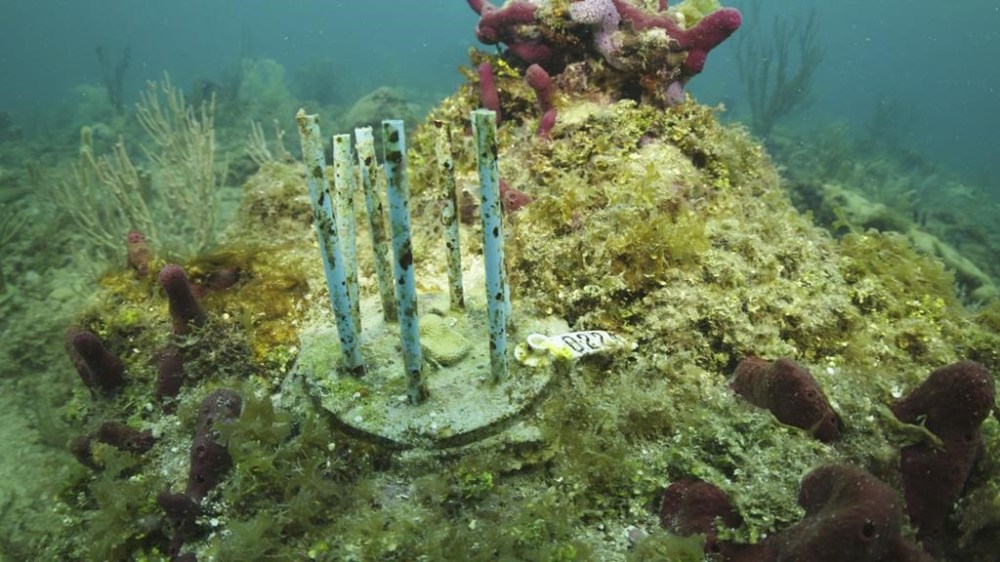
Marine researcher Kyle Pisano said one problem is that predators like parrot fish attempt to bite and destroy the newly transplanted coral in areas like South Florida, leaving them with less than a 40% survival rate. With projects calling for thousands of coral to be planted over the next year and tens of thousands of coral to be planted over the next decade, the losses add up when coral pieces can cost more than $100 each.
Pisano and his partner, Kirk Dotson, have developed the Coral Fort, claiming the small biodegradable cage that’s made in part with drinking straws boosts the survival rate of transplanted coral to over 90%.
“Parrot fish on the reef really, really enjoy biting a newly transplanted coral,” Pisano said. “They treat it kind of like popcorn.”
Fortunately the fish eventually lose interest in the coral as it matures, but scientists need to protect the coral in the meantime. Stainless steel and PVC pipe barriers have been set up around transplanted coral in the past, but those barriers needed to be cleaned of algae growth and eventually removed.
Pisano had the idea of creating a protective barrier that would eventually dissolve, eliminating the need to maintain or remove it. He began conducting offshore experiments with biodegradable coral cages as part of a master’s degree program at Nova Southeastern University. He used a substance called polyhydroxyalkanoate, a biopolymer derived from the fermentation of canola oil. PHA biodegrades in ocean, leaving only water and carbon dioxide. His findings were published last year.
The coral cage consists of a limestone disc surrounded by eight vertical phade brand drinking straws, made by Atlanta-based WinCup Inc. The device doesn’t have a top, Pisano said, because the juvenile coral needs sunlight and the parrot fish don’t generally want to position themselves facing downward to eat.
Dotson, a retired aerospace engineer, met Pisano through his professor at Nova Southeastern, and the two formed Reef Fortify Inc. to further develop and market the patent-pending Coral Fort. The first batch of cages were priced at $12 each, but Pisano and Dotson believe that could change as production scales up.
Early prototypes of the cage made from phade’s standard drinking straws were able to protect the coral for about two months before dissolving in the ocean, but that wasn’t quite long enough to outlast the interest of parrot fish. When Pisano and Dotson reached out to phade for help, the company assured them that it could make virtually any custom shape from its biodegradable PHA material.
“But it’s turning out that the boba straws, straight out of the box, work just fine,” Dotson said.
Boba straws are wider and thicker than normal drinking straws. They’re used for a tea-based drink that includes tapioca balls at the bottom of the cup. For Pisano and Dotson, that extra thickness means the straws last just long enough to protect the growing coral before harmlessly disappearing.
Reef Fortify is hoping to work with reef restoration projects all over the world. The Coral Forts already already being used by researchers at Nova Southeastern and the University of Miami, as well as Hawaii’s Division of Aquatic Resources.
Rich Karp, a coral researcher at the University of Miami, said they’ve been using the Coral Forts for about a month. He pointed out that doing any work underwater takes a great deal of time and effort, so having a protective cage that dissolves when it’s no longer needed basically cuts their work in half.
“Simply caging corals and then removing the cages later, that’s two times the amount of work, two times the amount of bottom time,” Karp said. “And it’s not really scalable.”
Experts say coral reefs are a significant part of the oceanic ecosystem. They occupy less than 1% of the ocean worldwide but provide food and shelter to nearly 25 percent of sea life. Coral reefs also help to protect humans and their homes along the coastline from storm surges during hurricanes.