Swept away Folk artist works to keep craft of traditional broom making alive

Amina Haswell wouldn’t have given a broom a second glance in the past. Like many, she never paid much attention to the household item often tucked away in the corner and mostly ignored until a mess occurs.

Read this article for free:

or

Already have an account? Log in here »

To continue reading, please subscribe:

Digital Subscription

One year of digital access for only $1.44 a week*

  • Enjoy unlimited reading on winnipegfreepress.com
  • Read the E-Edition, our digital replica newspaper
  • Access News Break, our award-winning app
  • Play interactive puzzles

*Billed as $5.77 plus GST every four weeks. After 52 weeks, price increases to the regular rate of $19.95 plus GST every four weeks. Offer available to new and qualified returning subscribers only. Cancel any time.

To continue reading, please subscribe:

Add Free Press access to your Brandon Sun subscription for only an additional

$1 for the first 4 weeks*

  • Enjoy unlimited reading on winnipegfreepress.com
  • Read the E-Edition, our digital replica newspaper
  • Access News Break, our award-winning app
  • Play interactive puzzles
Start now

*Your next Brandon Sun subscription payment will increase by $1.00 and you will be charged $17.95 plus GST for four weeks. After four weeks, your payment will increase to $24.95 plus GST every four weeks.

Hey there, time traveller!
This article was published 12/04/2024 (817 days ago), so information in it may no longer be current.

Amina Haswell wouldn’t have given a broom a second glance in the past. Like many, she never paid much attention to the household item often tucked away in the corner and mostly ignored until a mess occurs.

THE CREATORS

The Creators is a series that examines the “aha” moment behind ideas, images and inspiration, and the people behind them.

One day during a break on a work trip to Vancouver she saw throngs of people streaming in and out of a traditional broom shop.

Her interest piqued, Haswell, 45, joined the crowd and ended up buying a couple of brooms, marvelling at the handiwork.

She couldn’t get the Shaker-style brooms out of her mind and vowed to learn to make brooms and open a shop herself.

Photos by Ruth Bonneville / Free Press
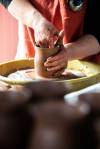
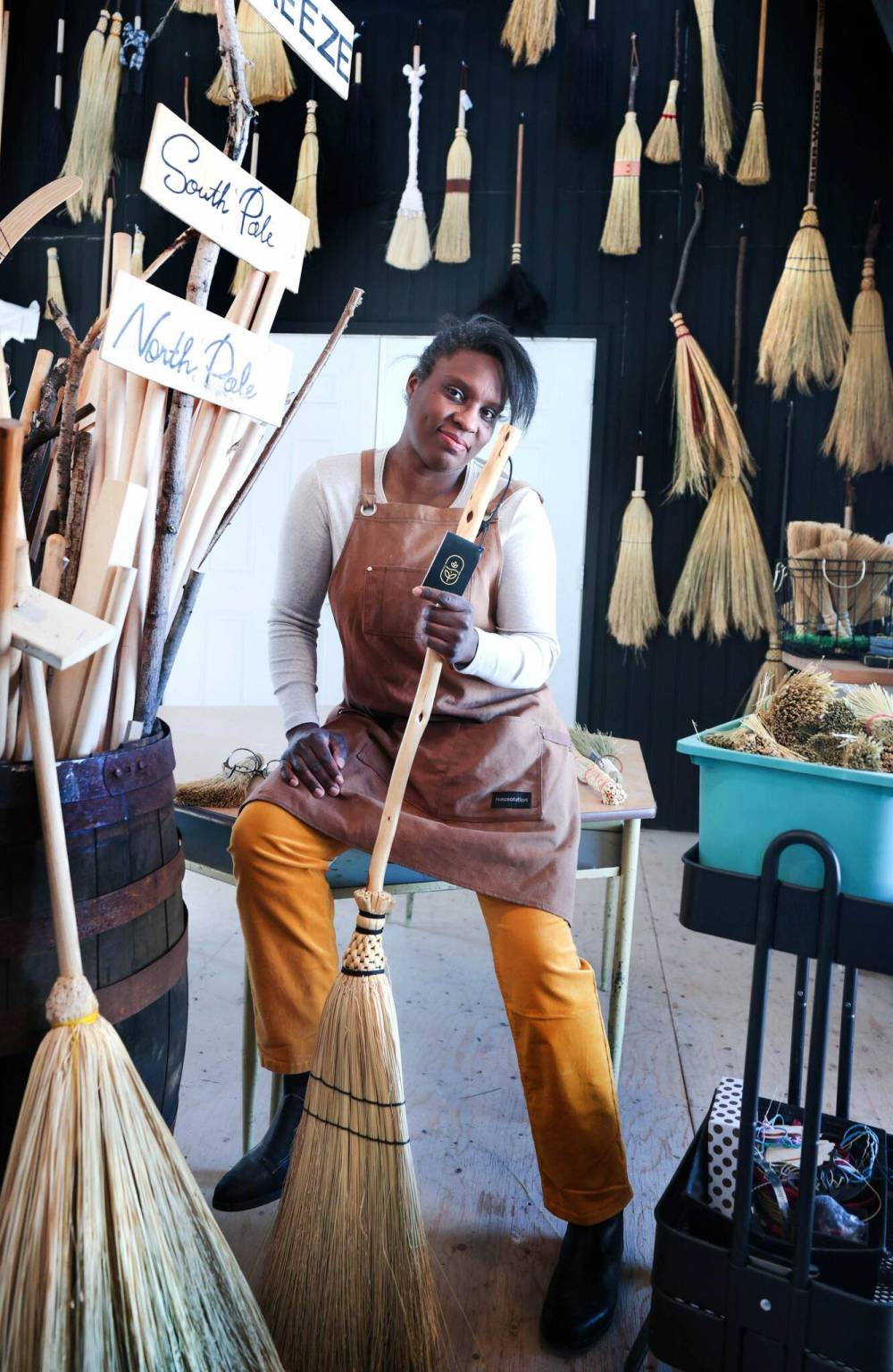
                                Prairie Breeze Folk Arts Studio owner Amina Haswell makes traditional, artisan-style brooms in her Balmoral workshop.
Photos by Ruth Bonneville / Free Press

Prairie Breeze Folk Arts Studio owner Amina Haswell makes traditional, artisan-style brooms in her Balmoral workshop.

She took the plunge when on maternity leave for her second child, taking courses at two folk schools — Driftless Folk School in Wisconsin and John C. Campbell Folk School in North Carolina — where she mastered the art of broom-making.

Today, Haswell makes her own brooms and brushes in her Balmoral studio, Prairie Breeze Folk Arts Studio, which she established in 2019.

“I make traditional artisan brooms. The focus is to keep this long-lost art of broom making alive so I try and keep it as close to the traditional techniques as possible,” she explains.

“Average brooms last anywhere from 18 months to two-and-a-half years. Our brooms can last anywhere from 15 to 50 years; handed down from generation to generation. My whole premise is that I want people to get back to using things that have a long life span.”

Every broom in her shop is handmade using natural fibres. They come in a number of styles: Appalachian; Shaker; Edo-Japanese; Indonesian fan broom; and Japanese brush.

Some are for everyday use both indoors and outdoors, while others are matrimonial, made specifically for the symbolic wedding tradition of jumping the broom.

Ruth Bonneville / Free Press
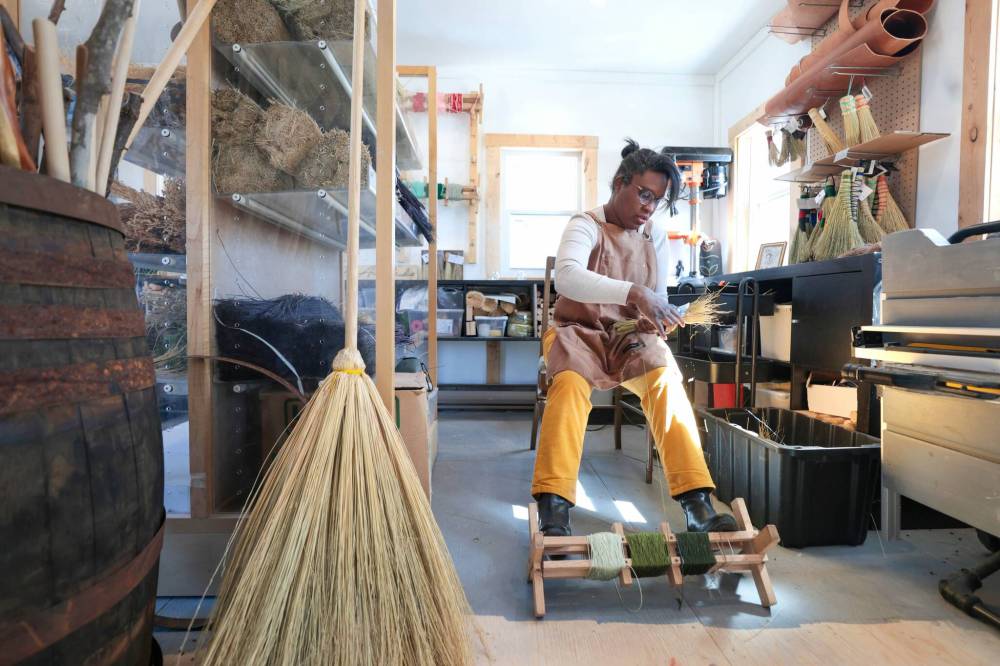
                                Haswell markets her brooms and brushes online and in-person.
Ruth Bonneville / Free Press

Haswell markets her brooms and brushes online and in-person.

For kitchen brooms, Haswell uses corn or sorghum vulgare, a flexible and extremely durable fibre, to make the sweep, while fancier ones, such as wedding brooms, have a sweep made from sisal, a smooth fibre with a silky texture.

“It’s very different to the broom corn. Sisal comes from the agave plant, and we also use it for our body brushes and dusting brushes,” she explains.

Handles are made in two styles — rustic natural-harvested and finished — using two different types of wood.

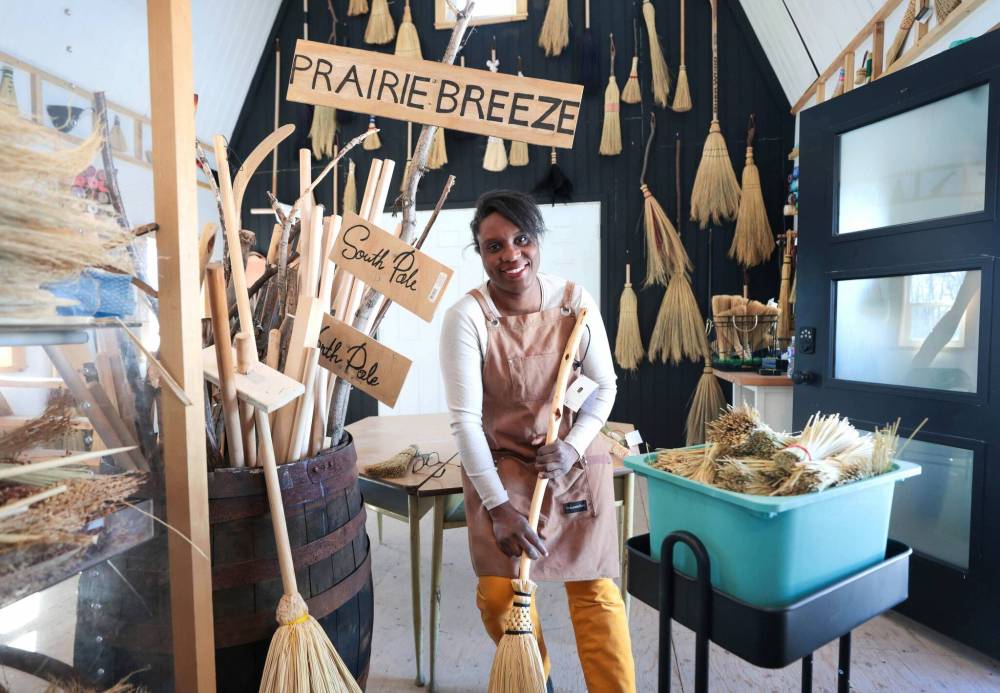
Amina Haswell, owner of Prairie Breeze, in Balmoral, Man. (Ruth Bonneville / Free Press)

Amina Haswell, owner of Prairie Breeze, in Balmoral, Man. (Ruth Bonneville / Free Press)

For rustic everyday brooms, Haswell harvests sticks from her six-acre property in the summer and autumn, debarking and smoothing them down before drying them indoors for up to six months. The sticks have to be completely free of moisture before they can be used as handles.

“If it’s not dry then the broom part will fall off the handle as the wood expands and contracts. The sticks have to be kept in an environment away from the elements. This takes time. It would only take a day if I were to use a kiln but I’m doing everything the old way,” she says.

Maple hardwood, sourced from a mill in Quebec, is used for the finished handles.

Haswell sets aside three days a week to make her brooms, working eight hours daily to create around 21 brooms in a day. It’s a staggered process that goes through four or five stages, depending on the type of broom. She often takes on an apprentice during her peak season in spring and summer.
For Haswell, the broom is a great unifier.

“Almost every house has a broom and a dustpan, whatever its size,” she says. “Whether the home is a shanty hut in a favela in Brazil or a castle in Scotland.”

And just because an item is functional doesn’t mean it has to be ugly.

“I believe in beauty and function. My brooms are artistically driven and Earth-conscious. I am tying natural fibres with something that is artistic and functional that is connected to a home or a personal space,” she says.

av.kitching@freepress.mb.ca

AV Kitching

AV Kitching
Reporter

AV Kitching is an arts and life writer at the Free Press. She has been a journalist for more than two decades and has worked across three continents writing about people, travel, food, and fashion. Read more about AV.

Every piece of reporting AV produces is reviewed by an editing team before it is posted online or published in print — part of the Free Press‘s tradition, since 1872, of producing reliable independent journalism. Read more about Free Press’s history and mandate, and learn how our newsroom operates.

Our newsroom depends on a growing audience of readers to power our journalism. If you are not a paid reader, please consider becoming a subscriber.

Our newsroom depends on its audience of readers to power our journalism. Thank you for your support.

Report Error Submit a Tip

More Stories

Brotherly bond boosts local Amazing Race competitors

Grace Penner 7 minute read Preview

Brotherly bond boosts local Amazing Race competitors

Grace Penner 7 minute read Yesterday at 2:01 AM CDT

Sacha has a feeling and Sébastien has a plan — together they’ll work it out.

Read
Yesterday at 2:01 AM CDT

Poor drainage also blamed for flooded fields

Nicole Buffie 5 minute read Preview

Poor drainage also blamed for flooded fields

Nicole Buffie 5 minute read Monday, Jul. 6, 2026

RURAL MUNICIPALITY OF ROCKWOOD — Looking out at his fields Monday afternoon, Curtis Campbell likened his normally green and lush land to retention ponds.

Out of the 3,000 acres of canola and cereal grains he usually farms, he only has about 300 acres left of salvageable crops after a June 9 storm dumped 255 mm of rain in the area. The 37-year-old farmer guesses it will be another month before floodwaters recede.

Even once the water is gone, Campbell estimates he’ll have losses of $600,000 — that’s with crop insurance — and his fields won’t return to normal for another four or five years because of nutrient loss and erosion.

“I won’t make an income for three years,” Campbell said.

Read
Monday, Jul. 6, 2026

What can you do with $200 million?

Ed Lohrenz 5 minute read Preview

What can you do with $200 million?

Ed Lohrenz 5 minute read 2:00 AM CDT

Let’s see if I’ve got this right. In the article Carbon capture project gains support (June 30). Julia-Simone Rutgers writes that the direct carbon capture facility proposed by Deep Sky for construction in southwestern Manitoba will cost $200 million to build.

The company claims the facility will scrub 30,000 tonnes of carbon dioxide from the atmosphere each year and inject it 1,000 metres into the ground. To do this, it will need to draw up to 15,000 megawatts of power from the Manitoba Hydro grid for the first stage of the project. The project will be financed by selling carbon credits.

To put this into perspective, the Canadian industrial carbon price is set at $130 per tonne. At that price, Deep Sky will have to sell more than 1.5 million tonnes of carbon just to cover the upfront cost of building the plant. That’s over 51 years’ worth of carbon credits. And that doesn’t even cover the everyday operating costs, such as the electricity needed to run the plant.

Some studies suggest it requires about 2,000-2,500 kilowatt hours to electricity to capture one tonne of CO2 and inject it into the ground. To capture 30,000 tonnes, that’s about 60 million kWh. Even if Manitoba Hydro sells it to the facility for only $0.035/kWh, that’s an additional $70 per tonne.

Read
2:00 AM CDT

‘Easy decision for me:’ longtime city councillor Chambers not seeking re-election

Joyanne Pursaga 4 minute read Preview

‘Easy decision for me:’ longtime city councillor Chambers not seeking re-election

Joyanne Pursaga 4 minute read Updated: Yesterday at 5:48 PM CDT

Coun. Markus Chambers has announced will not run for a third term on city council, instead stepping away to spend more time with his family.

On Tuesday, Chambers told reporters he won’t seek re-election in the St. Norbert-Seine River ward.

“This has actually been an easy decision for me. My family is growing. My son has announced that my wife and I will be grandparents in December. And other priorities … have emerged that require my undivided attention,” he said.

The councillor said health concerns played a key role in his decision, as his wife has battled cancer for two years.

Read
Updated: Yesterday at 5:48 PM CDT

Letters,

6 minute read 2:00 AM CDT

LRT is the answer

Re: Anything seems possible now (Editorial, July 4)

The Free Press editorial is absolutely correct, traffic “did not gridlock” at the intersection of Portage and Main.

I happen to be old enough that I can remember driving across Portage and Main both before and after the underground concourse was opened. It made no practical difference.

Imperialist crusades: 21st-century style

John R. Wiens 5 minute read Preview

Imperialist crusades: 21st-century style

John R. Wiens 5 minute read 2:00 AM CDT

In the 11th century and lasting into the 13th, the papacy launched a series of at least eight military campaigns we now refer to as the Crusades, or Holy Wars. They were an imperialistic call to arms for Christians to retake Jerusalem, which was at the time under Muslim rule.

Spiritual rewards for participation were implied, and other incentives offered, to dull the extra taxation demanded to fund the campaigns. Over time, the “crusades” morphed to become massacres of not only Muslims but also Jews and Christian dissidents — in other words, any enemies of the papacy. If today’s news sounds like déjà vu all over again, it probably should.

The stories keep repeating themselves in many forms. We now know that two 20th century world wars, global in scope, were caused by imperialistic ambitions, changes in the balance of international powers and corresponding arms races. The first was attributed to the assassination of the heir to the Austro-Hungarian throne by a Bosnian Serb, a kind of “regime change” initiative. The second resulted from rising tensions between Allied and Axis powers, triggered by the rise of European fascism and Japanese militarism. The human toll of both was unimaginable.

In the First World War, 15 to 22 million people, including soldiers and civilians, were killed and another 23 million were wounded. These numbers do not account for those otherwise affected — victims of chemical warfare whose compromised health shortened their lives; of the subsequent Spanish flu epidemic amplified by the displacement of peoples; others who died from other diseases caused by war conditions; and those who were malnourished or starved. Nor do they account for the ongoing trauma and resentments passed on intergenerationally to this day.

Read
2:00 AM CDT