

The courts and climate change
Advertisement
Read this article for free:
or
Already have an account? Log in here »
To continue reading, please subscribe:

Digital Subscription
One year of digital access for only $205*
- Enjoy unlimited reading on winnipegfreepress.com
- Read the E-Edition, our digital replica newspaper
- Access News Break, our award-winning app
- Play interactive puzzles
*First annual payment billed as $205.00 + GST for one year. This annual subscription will automatically renew at $233.00 + GST every 52 weeks (10% off the regular annual price of $259.35). Offer available to new and qualified returning subscribers only. Cancel any time.
To continue reading, please subscribe:
Add Free Press access to your Brandon Sun subscription for only an additional
$1 for the first 4 weeks*
- Enjoy unlimited reading on winnipegfreepress.com
- Read the E-Edition, our digital replica newspaper
- Access News Break, our award-winning app
- Play interactive puzzles
*Your next Brandon Sun subscription payment will increase by $1.00 and you will be charged $17.95 plus GST for four weeks. After four weeks, your payment will increase to $24.95 plus GST every four weeks.
Read unlimited articles for free today:
or
Already have an account? Log in here »
Hey there, time traveller!
This article was published 19/04/2024 (876 days ago), so information in it may no longer be current.
A group of Swiss women have hit upon a surefire way to get their government’s attention on climate change: take the issue to court — and win.
Last week, the European Court of Human Rights ruled in favour of the women, a group of 2,400 called the KlimaSeniorinnen who sued the government claiming its weak climate-change policies had put them at greater risk of death from heat waves, therefore violating their human rights. It was one of several such cases before the court, not all of which were successful. All the same, activists are hailing the effort as a success.
The verdict, according to coverage in The Guardian, paves the way for cases to be brought against all 46 members of the Council of Europe in national courts.
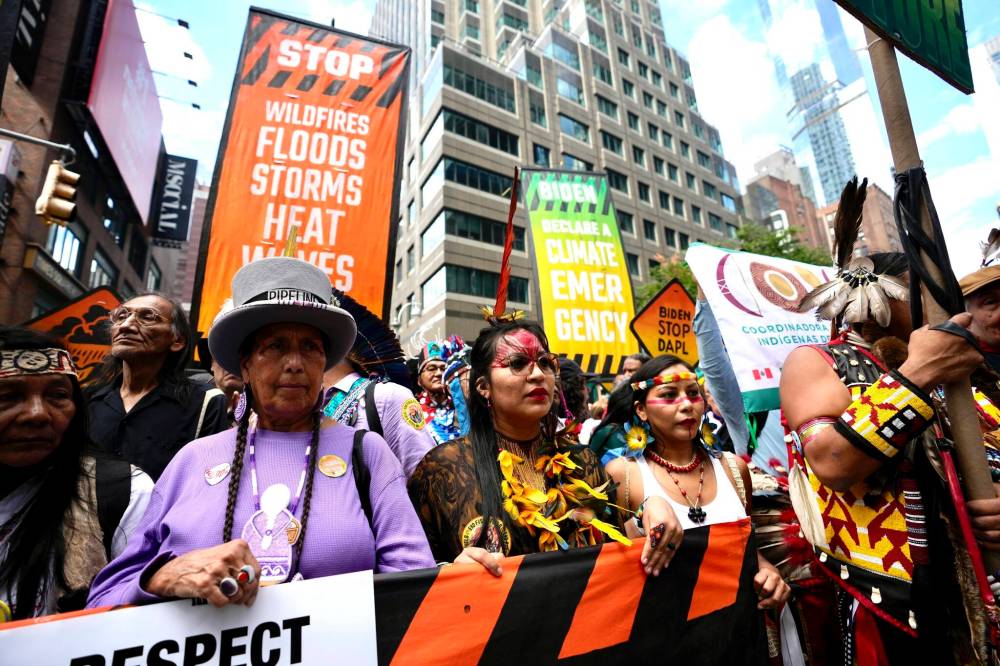
Bryan Woolston / THE ASSOCIATED PRESS FILES
Climate activists may take to the courts, instead of the streets.
It can be tiresome both to be forced to say, and forced to hear, sermons about how important tackling climate change is, to the point where many may be tempted to tune out discussion on the subject entirely. But the Swiss women were right to bring their case, and it can be argued they were left with little choice.
Experts have said that properly dealing with the problem could require no less than a total social transformation, including a huge mobilization and redirection of resources akin to a wartime effort. Instead, climate change action seems doomed to go down in failure as a tragedy of half-measures. Instead of massive investment toward pivoting away from a car culture, we keep public transportation anemic and make gestures toward getting more EVs on the road. We institute a carbon tax, only to rebate the money constantly instead of investing it toward cleaner tech — that is when governments of different stripes aren’t busy reducing it or fighting its institution to begin with.
And now we’re firmly in the “too little, too late” stage of climate change. The window is likely closed.
Well, there’s mitigation, one supposes. But life in the great outdoors isn’t going to get any easier any time soon. Our children will live in a more hostile world, with hotter summers and colder winters, more violent storms, severe droughts, and more acidic oceans, with all of those problems’ spinoff consequences.
So, now what?
Given that most people are ruled by some form of representative government or another, it’s fair enough for all of us to ask why our duly elected leaders didn’t take this issue seriously when they had the chance, and to hold them accountable for their failure.

That punishment can’t just come at the ballot box, however, because the failure to act is something which all governments of all stripes are guilty. Left-wing and right, liberal and conservative, all of them refused for their own reasons to press the issue in the way scientists deemed was necessary.
So now, some have turned to the courts. The ECHR’s ruling should be cause for concern for democratically elected governments, which so often claim to act in the best interests of their people. It wouldn’t come as a surprise if climate activists in Canada and elsewhere look to the KlimaSeniorinnen’s victory and see the possibility for a similar outcome at home.
If a court can rule that a national government is guilty of violating human rights because of a failure to act, it opens the door for serious consequences, be they monetary or otherwise, to follow inaction on a critical issue.
And of course, there’s the dramatic power of having the ruling come down officially, that because it did not act, a national government made life meaningfully harder for the people living in it.
What a terrible thing indeed.