Prehistoric lake sturgeon is not endangered, US says despite calls from conservationists

Advertisement

Advertise with us

MADISON, Wis. (AP) — Lake sturgeon don't need Endangered Species Act protections, federal wildlife officials announced Monday, saying that stocking programs have helped the prehistoric fish return to areas where they had vanished.

Read this article for free:


or

Already have an account? Log in here »

To continue reading, please subscribe:

Subscribe and receive a limited-edition Free Press branded hat or tote.

Digital Subscription

One year of digital access for only $205*

  • Enjoy unlimited reading on winnipegfreepress.com
  • Read the E-Edition, our digital replica newspaper
  • Access News Break, our award-winning app
  • Play interactive puzzles

*First annual payment billed as $205.00 + GST for one year. This annual subscription will automatically renew at $233.00 + GST every 52 weeks (10% off the regular annual price of $259.35). Offer available to new and qualified returning subscribers only. Cancel any time.

To continue reading, please subscribe:

Add Free Press access to your Brandon Sun subscription for only an additional

$1 for the first 4 weeks*

  • Enjoy unlimited reading on winnipegfreepress.com
  • Read the E-Edition, our digital replica newspaper
  • Access News Break, our award-winning app
  • Play interactive puzzles
Start now

*Your next Brandon Sun subscription payment will increase by $1.00 and you will be charged $17.95 plus GST for four weeks. After four weeks, your payment will increase to $24.95 plus GST every four weeks.

Hey there, time traveller!
This article was published 22/04/2024 (874 days ago), so information in it may no longer be current.

MADISON, Wis. (AP) — Lake sturgeon don’t need Endangered Species Act protections, federal wildlife officials announced Monday, saying that stocking programs have helped the prehistoric fish return to areas where they had vanished.

The decision ends the Arizona-based Center of Biological Diversity’s petition filed in May 2018 asking the U.S. Fish and Wildlife Service to list lake sturgeon as endangered or threatened. Such listings would make harvesting the fish illegal, but without them, popular sturgeon harvest seasons in states such as Wisconsin and Michigan can continue.

The center argued that overharvesting and deteriorating habitat have “severely depleted” the species. Dams block access to spawning and rearing habitat and water pollution and diversions have done “irreparable harm,” the center said.
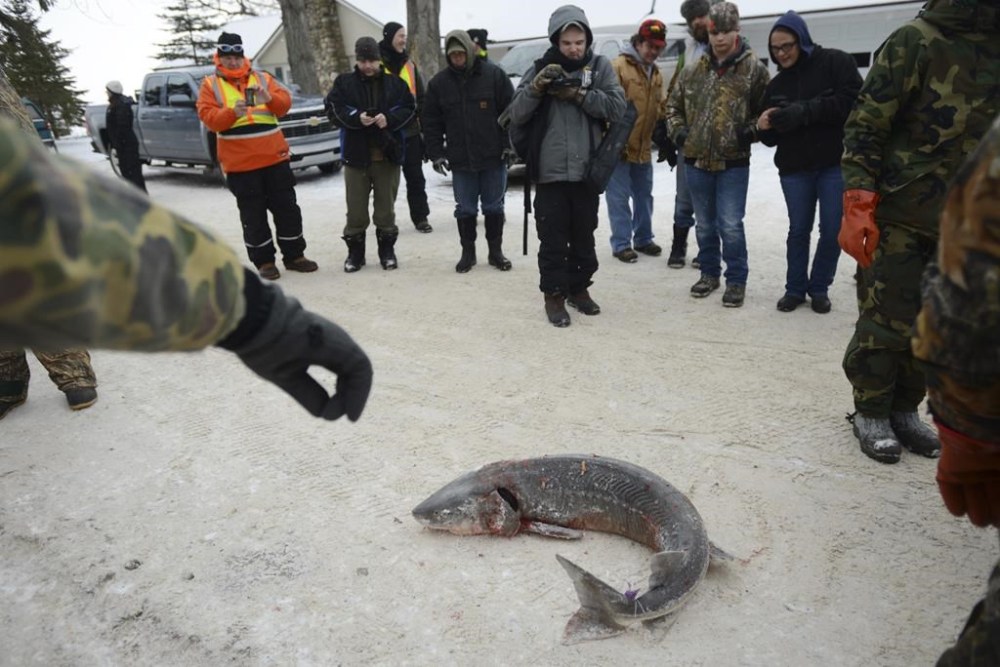
FILE - People gather to look at a lake sturgeon, before it is weighed, near Black Lake in Cheboygan County, Mich., Feb. 4, 2017. Lake sturgeon don't need Endangered Species Act protections, federal wildlife officials announced Monday, April 22, 2024, saying that stocking programs have helped the prehistoric fish return to areas where they had vanished. (Julia Nagy/Lansing State Journal via AP, File)

But stocking has helped grow adult lake sturgeon populations and increase spawning, agency officials said. Putting the creatures on the list would be like going to the emergency room, and the rebounding species doesn’t need that level of protection, said Chuck Traxler, the wildlife service’s Midwest deputy regional director.

“It doesn’t mean everything is good right now,” he said. “It means keep up the good work.”

Populations aren’t at historical highs, the agency acknowledged in a December assessment, but stocking returned them to the Red River of the North between Minnesota and North Dakota, the Tennessee and Cumberland rivers, portions of the Mississippi River and the Coosa River.

Dam removals and habitat restoration efforts also have helped, the agency has said, citing work in 2015 to retrofit a dam on Wisconsin’s Menominee River to allow spawning sturgeon to travel upstream and the removal of the Brecksville Dam on Ohio’s Cuyahoga River in 2020.

The agency also pointed to reef restoration work in the corridor connecting Lake Huron and Lake Erie that has created a place for sturgeon to lay eggs and noted that nine of 43 toxic spots along Great Lakes shorelines have been cleaned up.

The assessment also noted the adaptable species should be able to withstand warmer water due to climate change.

Lake sturgeon are ancient North American freshwater fish. They’re essentially living fossils, first appearing about 136 million years ago when dinosaurs ruled the planet. They resemble torpedoes, with dorsal ridges and snouts. They can grow up to 7 feet (2 meters) long and weigh up to 300 pounds (136 kilograms). Males typically live about 50 years. Females can live anywhere between 80 and 150 years.

They’re found in the upper and lower Mississippi River basin as well as the Great Lakes. Commercial anglers considered lake sturgeon a nuisance because they tore their nets, leading to widespread over-harvesting in the 1800s that continued into the 20th century.

Lake sturgeon can’t reproduce fast enough to replace the losses. It takes up to three decades before they reach spawning age, and even then they don’t spawn annually. And many don’t survive the trip back to their birth waters to spawn. The wildlife service has compared lake sturgeon losses to the mass destruction of the American buffalo.

Twenty states have outlawed sturgeon harvesting. Fourteen of those states have listed lake sturgeon as threatened or endangered. Volunteers and Wisconsin natural resources officials have been guarding spawning sturgeon from poachers on the Wolf River for 30 years.

Michigan, Minnesota and Wisconsin still hold hook-and-line lake sturgeon fishing seasons. Michigan and Wisconsin hold sturgeon spearing seasons each winter as well where anglers drill holes through lake ice and impale sturgeon as they swim past.

The Wisconsin natural resources department reported 432 sturgeon were taken in February, down from 1,405 in 2023. Warm weather and poor ice conditions led to the diminished return, according to the department. Michigan officials set the total harvest limit at just six sturgeon but ended up canceling due to warm weather and unsafe ice conditions.

Those states’ seasons are so tightly regulated that the harvests don’t impact the species overall, said Lori Nordstrom, the wildlife service’s Midwest assistant regional director of ecological services.

Michigan and Wisconsin, for example, allow an angler to take only one sturgeon per year. Minnesota anglers must release any sturgeon they catch in inland waters. Wisconsin regulations are designed to keep the harvest rate below 5%, with all tag fees going to the state’s sturgeon conservation program, according to the wildlife service.
Report Error Submit a Tip

More Stories

A life's story: ‘Ivor the Driver’ found his calling in the ranching life

Aaron Epp 7 minute read Preview

A life's story: ‘Ivor the Driver’ found his calling in the ranching life

Aaron Epp 7 minute read Updated: Yesterday at 9:59 AM CDT

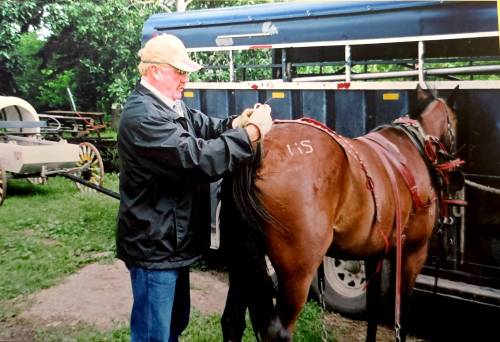
Ivor Asham’s family couldn’t have picked a better image to accompany his obituary. There he is, riding Flash, his beloved brown and white quarter horse, a black cowboy hat on his head and a drink in his hand.

Asham owned and operated Birds Hill Park Ranch for nearly 35 years, where he shared his lifelong passion for horses with thousands of visitors. He moved hay, harnessed horses and drove the wagons, introducing himself as “Ivor the Driver.”

Over the years, Asham built a reputation as the quintessential cowboy.

There’s a restaurant at the ranch filled with memorabilia that he collected over the years. Calgary Stampede posters, cowboy boot-shaped shot glasses, a child’s rocking horse, a wagon wheel and numerous photos of legendary actor John Wayne are just some of the items that line the walls.

Read
Updated: Yesterday at 9:59 AM CDT

Pokemon thieves clear out collectibles shop

Scott Billeck 5 minute read Preview

Pokemon thieves clear out collectibles shop

Scott Billeck 5 minute read Friday, Sep. 11, 2026

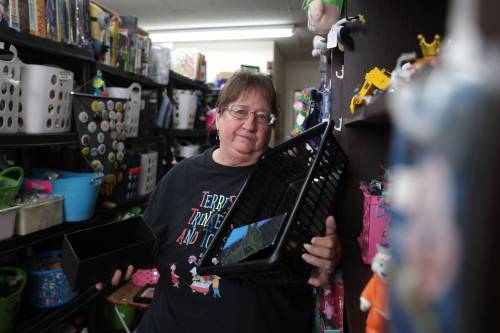
Terri Settle loved watching children walk into her collectibles shop to hunt for their favourite Pokemon cards.

After the latest break in stripped her shelves of much of the inventory, she’s not sure she’ll get to see it again.

Thieves broke into Terri’s Trinkets and Toys on Tuesday evening, punching through a grate and then the store’s bathroom wall to reach the storefront.

They made off with about $6,000 worth of merchandise, including all of the store’s Pokemon cards — about 7,000 of them — along with toys, Lego, jewelry, video games, a debit machine and personal laptop. They even took her vacuum cleaner.

Read
Friday, Sep. 11, 2026

Puzzles Palace

1 minute read Monday, Jul. 27, 2026

To solve our puzzles, please subscribe with this special offer: |

The port of Churchill — but done right

Editorial 4 minute read Preview

The port of Churchill — but done right

Editorial 4 minute read Yesterday at 2:00 AM CDT

The seagoing grain carrier wasn’t christened with a champagne bottle. There was no confetti or streamers. Nevertheless, the Aug. 31 event marking the first shipment of grain to be loaded at the Port of Churchill since 2020 was celebrated like the launch of a brand new vessel.

The presence of the federal minister of northern and arctic affairs, provincial cabinet ministers and leaders and elders from several northern First Nations signalled that the fast-tracked process of refurbishing and buffing up Manitoba’s deep-water seaport gem is gaining momentum.

For OneNorth, the partnership of 29 First Nations and 12 northern communities which owns the Port of Churchill and the Hudson Bay Railway (both operated by the Arctic Gateway Group) the event heralded a new beginning. It’s been eight years since OneNorth purchased the port and railroad, and six years since grain was moved by rail through Manitoba and then by ship to European markets. Two more grain shipments, plus shipments of potash and critical minerals, will continue through the fall.

When Prime Minister Mark Carney solicited the premiers to suggest “nation-building” projects following his election in 2025, Premier Wab Kinew pitched a Manitoba trade corridor that would move wheat, critical minerals, potash and energy (oil or liquid natural gas) through the Port of Churchill.

Read
Yesterday at 2:00 AM CDT

Retired sportscaster Scott Oake determined as fundraising for women's addictions treatment facility enters home stretch

Melissa Martin 4 minute read Preview

Retired sportscaster Scott Oake determined as fundraising for women's addictions treatment facility enters home stretch

Melissa Martin 4 minute read Thursday, Sep. 10, 2026

For now, the patch of land just east of the Victoria Hospital doesn’t look like much: just a field of rocks, mounded dirt, and concrete piles driven into the earth. Yet when Scott Oake looks over the site, he can already imagine how it will look in just over a year’s time, when the new Anne Oake Family Recovery Centre is expected to open.

It’s easier to picture this time around. In 2020, when the recently-retired CBC sportscaster and his late wife, Anne, were building their first labour of intermingled grief and love, the Bruce Oake Recovery Centre for men, it was hard for him to wrap his mind around how a raw construction site could transform into a welcoming addictions treatment facility.

When that centre opened in 2021, Oake found it looked “almost identical” to the architect’s renderings. So it’s easy to hope the Anne Oake Centre will be the same. It will be the first facility of its kind, its founders believe, not only in Canada but in North America: a place where 50 to 70 women can pursue sobriety while staying with their children.

“At Bruce Oake there’s a culture of love, and most of all a culture of hope,” Oake said, speaking at the site Thursday after a media conference to announce the final push of the centre’s fundraising campaign. “I can feel it every time I walk into that building. And I know it will be the same here.”

Read
Thursday, Sep. 10, 2026

Sunday-night auto aficionados work to steer away from unwelcome elements they say aren’t a part of their tradition

Zoe Pierce 12 minute read Preview

Sunday-night auto aficionados work to steer away from unwelcome elements they say aren’t a part of their tradition

Zoe Pierce 12 minute read Friday, Sep. 11, 2026

The red 1969 Dodge Coronet Super Bee out for a cruise on Portage Avenue draws admiring eyes from onlookers on a recent Sunday night, many of them seeing a specimen of the now-rare muscle car for the first time on a Winnipeg street. Or any other street, for that matter.

Longtime car enthusiast Bob Sudoma was behind the wheel, participating in the decades-old show-offy summer tradition.

The Sunday night cruise is built around a simple idea: proud car owners take their beloved vehicles for a spin to meet up with others of the same autophile ilk.

Less-fortunate appreciators, or just curious folks, also gather along the route to watch the highly-polished parade. Portage Avenue is one of cruise night’s best-known stretches.

Read
Friday, Sep. 11, 2026