

Jerry Seinfeld’s commitment to the bit
Advertisement
Read this article for free:
or
Already have an account? Log in here »
To continue reading, please subscribe:
Monthly Digital Subscription
$1 per week for 24 weeks*
- Enjoy unlimited reading on winnipegfreepress.com
- Read the E-Edition, our digital replica newspaper
- Access News Break, our award-winning app
- Play interactive puzzles
*Billed as $4.00 plus GST every four weeks. After 24 weeks, price increases to the regular rate of $19.95 plus GST every four weeks. Offer available to new and qualified returning subscribers only. Cancel any time.
Monthly Digital Subscription
$4.99/week*
- Enjoy unlimited reading on winnipegfreepress.com
- Read the E-Edition, our digital replica newspaper
- Access News Break, our award-winning app
- Play interactive puzzles
*Billed as $19.95 plus GST every four weeks. Cancel any time.
To continue reading, please subscribe:
Add Free Press access to your Brandon Sun subscription for only an additional
$1 for the first 4 weeks*
*Your next subscription payment will increase by $1.00 and you will be charged $16.99 plus GST for four weeks. After four weeks, your payment will increase to $23.99 plus GST every four weeks.
Read unlimited articles for free today:
or
Already have an account? Log in here »
Hey there, time traveller!
This article was published 26/04/2024 (722 days ago), so information in it may no longer be current.
NEW YORK (AP) — Jerry Seinfeld has been responsible for more movies than you think.
Yes, he co-wrote and lent his voice to 2007’s “Bee Movie.” But before that, “Seinfeld” — where going to the movies, with or without the aid of Moviefone, was nearly as regular a destination as the coffee shop — gave birth to dozens of (fake) films. “Rochelle, Rochelle.” “Prognosis Negative.” “Sack Lunch.”
But nearly three decades after Seinfeld was, in one episode, cajoled into bootlegging “Death Blow,” he has finally made his first film. Seinfeld directed, co-wrote and stars in “Unfrosted,” a star-studded comedy about the invention of the Pop-Tart premiering May 3 on Netflix.
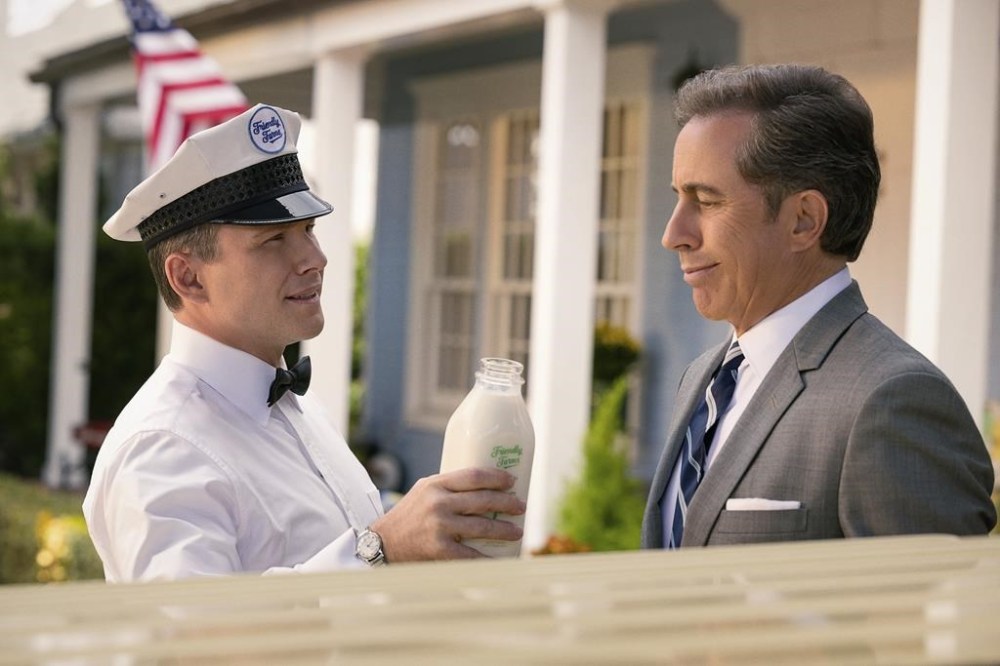
The film, which co-stars Melissa McCarthy, Jim Gaffigan, Hugh Grant and others, is an outlandish, “Mad Men”-inspired ‘60s-set satire in which Kellogg’s and Post Cereal are engaged in a cutthroat race to “upend America’s breakfast table.”
“When you see any scene of it you go, ‘What is that?’ And I was very happy about that,” Seinfeld said in a recent interview. “I like that you look at it and go, ‘I don’t know what this is.’”
For Seinfeld, who has resolutely stuck to stand-up since “Seinfeld” ended in 1998, it’s a rare post-sitcom project, joining a short and sporadic list including the short-lived reality series “The Marriage Ref” and the popular streaming show “Comedians in Cars Getting Coffee.”
“Unfrosted,” though, returns Seinfeld to one of his abiding passions. Remember all those cereal boxes in his apartment on “Seinfeld”? The Pop-Tart is a particular fascination, though. In his 2020 comedy special “23 Hours to Kill,” it formed an extended bit beginning with the childhood memory: “When they invented the Pop-Tart, the back of my head blew right off.”
For Seinfeld, the Pop-Tart has an almost mythical quality. A movie about Oreos or Milk Duds or even Junior Mints wouldn’t work, he says. But the Pop-Tart is different.
“A lot of it is the word. It’s a funny word,” says Seinfeld. “I heard Mattel is trying to do a Hot Wheels movie. That could work. Certain things really got us when we were kids, you know?”
In a wide-ranging interview, Seinfeld discussed subjects large and small.
AP: Is it true that your moments on the “Curb Your Enthusiasm” finale were improvised with Larry David?
SEINFELD: The idea occurred right in that moment. I said, “Hey, let’s talk about the finale right now.” We had been talking about it all day because it was their finale. We were just talking about series finales all day. And I was saying that “Mad Men” was my favorite and I thought “The Sopranos” one was great, and obviously ours was what it was.
AP: What does that mean? You’re happy with it or not?
SEINFELD: Well, I think what we said in that scene. We thought, “Yeah, that would have been better.” (Laughs) It’s very hard to remember. The emotional state I was in after nine years was a little ragged. Maybe we weren’t thinking quite clearly. The idea of doing that on his show — the math of it is really amazing. To do that, two people have to have two successful long-running sitcoms and they have to be playing themselves, with a 25-year separation. When I was driving home that night on the 10 in LA, my head was exploding because of the math of what just happened — to set something up in ’98 and pay it off in ’23. For a joke person like me, I felt like I landed on the moon.
AP: “Unfrosted” began with an old stand-up bit of yours. Is it surprising to you that you’ve made a movie about it?
SEINFELD: It was all (“Seinfeld” writer) Spike Feresten’s idea. I did not want to do it. I did not think it would work. What’s a movie about inventing the Pop-Tart? That’s not funny. And (“Seinfeld” writer) Andy Robin came up with the idea that it’s “The Right Stuff.” And I went, “Oh, that’s funny.”
AP: I think you have a line about “splitting the atom of breakfast” so this is also like a snack-size “Oppenheimer.”
SEINFELD: Yes, “Oppenheimer.” I think it’s a fun game if anyone wants to play — how many movies we stole from. Obviously, “The Godfather,” obviously “The Right Stuff.” At one point, I was going to say, “I’ll bury you under the ground, Eli,” from “There Will Be Blood.” And we weren’t even going to explain it. The character’s name wasn’t Eli.
AP: You once in an interview suggested you only say you love Pop-Tarts to make the joke work.
SEINFELD: I probably just said that to make that point. But I do love Pop-Tarts. I had one yesterday. We were doing a social media piece with Jimmy Fallon and Meghan Trainor. I took a bite and I went, “This is fantastic.” What I like about it is the man-made quality of it. I love great objects that fit in your hand in a nice way. A pack of cigarettes is one of the greatest things you can put in your hand. It just feels great. Dice feel great. I like a nice spoon. I like things. (Laughs)
AP: Were you aware of the recent trend of movies based on products?
SEINFELD: Yeah, but we were started long before that. I was a little disappointed that I suddenly became part of a trend but there was nothing we could do about it.
AP: Do you have any guesses as to why we’ve turned our focus to American consumerism? Your film is a big, silly satire of American consumerism.
SEINFELD: For me, I love men in suits talking about something stupid, like cereal and puffs and sprinkles.
AP: You’ve often spoken about your dedication to sharpening and sculpting a joke. Are you still driven by that?
SEINFELD: I started a bit the other night about your kitchen sponge on the sink looking up at you going: “I don’t know how much more you think I have. I was done two months ago.” Now it’s just growing and growing into a monologue of your kitchen sponge telling you, “Let me go! Let me die a rectangle, not in pieces.” When I lock on to something like that, I just want to see how far I can go with it, how long will they let me talk about this.
AP: You’re about to turn 70. Is that meaningful to you?
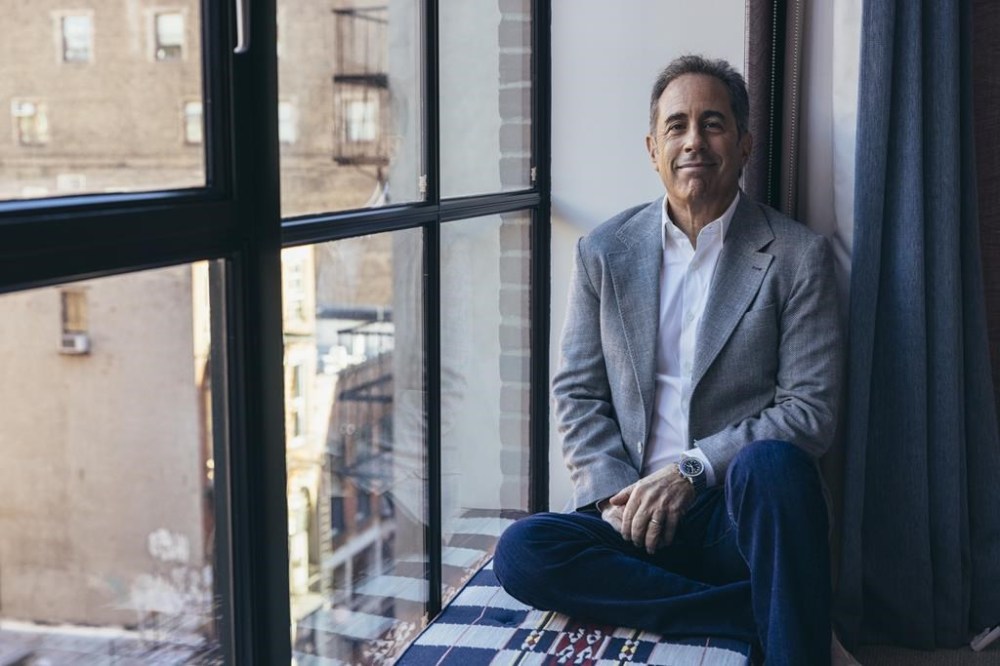
SEINFELD: No.
AP: Some entertainers turn inward when they reach their 70s, like Steven Spielberg did with “The Fabelmans.” But maybe this is a very personal movie for you.
SEINFELD: Very much. This is my “Fabelmans.” Because I’m not interested in my life. I’m interested in eating.
AP: Why have you always avoided topicality or politics in your comedy?
SEINFELD: I don’t have the fluency. Your comedic thing, whatever it is, it only works on certain things. My thing only works on these dumb things.
AP: Still, there is a kind of meaning in dedicating yourself to meaninglessness.
SEINFELD: I’ve discussed this at length with my friend Joel Hodgson (“Mystery Science 3000”) and he’s incredibly articulate on this subject, which is: The throw-away culture of our childhood was not throw-away to us. We deeply love these things and they were meaningful in their meaninglessness.
AP: You and Marc Maron had a great debate on his podcast as almost diametrically opposed comedians. He believes in baring his soul on stage and you pledge fidelity to the joke. I thought you were both right.
SEINFELD: My attitude, I think, was more talking to comedians. I think comedians, if they want to survive throughout their life doing this, they have to pay close attention to the laughs. No less value in what he’s doing, but I would worry about how long would this last for in your life. But, yeah, that’s a good point. We were both right, just different.
AP: You’ve said you want to do stand-up into your 80s and beyond.
SEINFELD: To the end. To the very end.
AP: You still feel that way?
SEINFELD: Yeah. The only hard part of my life is the other things. People do ask me about slowing down and I go, “The work part of my life is not stand-up. It’s all the other things.” Stand-up is an incredible, pure experience. Surfing is the great regret of my life that I never really got good at that. I did it for two weeks one time many years ago. But if you were a surfer, you would never stop doing it. That’s what stand-up is for me. Feeling that energy, that natural life-force energy under you and around you, I never get tired of that.
AP: Are you thinking about another stand-up special?
SEINFELD: No, I’m not. I’m not sure of it as a comedy form for me right now. I would love to think of something else, if I even wanted to do it — which I don’t right now. Like, “Comedians in Cars Getting Coffee,” the subtext of that is: I’m really sick of talk shows on TV. That’s why I did that. And let me show you why. We don’t want to see them sitting on a couch anymore. The people who are doing it aren’t having any fun doing it. That was my anti-talk show. So I would want to do an anti-stand-up special if I did one. I envy, sometimes, these little Italian artisans who don’t really care if anybody knows who they are or what they do. And stand-up can be like that. Any writing work is very lonely work. Stand-up, in a way, is kind of a private, lonely world. I’m going to Dayton, Ohio, on Friday. No one’s going to know what happened there. I’m very attracted to that. I’m more attracted to that than, “Hey everyone, I made a movie.” My way, if I had my choice, is that I would like to do this work very quietly and privately.
AP: It’s interesting you’d say that as someone who had one of the biggest TV shows ever. Maybe you had your fill of it.

SEINFELD: That’s possible. But it never felt like me. Larry and I, when we first started to do the show thought: This will be a really fun, little boutique thing that will just get our people that like this kind of quirky, off-beat thing, and that would be cool. What it became was never on our radar. Then, suddenly, you’re a big wave surfer. I think it was tougher on Larry than for me. Because you feel the pressure. I never minded the pressure.
AP: Have you experienced younger generations finding “Seinfeld” on Netflix?
SEINFELD: That age around 10 to 12, they seem to find it. They have no idea what it is at first. (Laughs) I think the credit all really goes to Jason (Alexander), Michael (Richards) and Julia (Louis-Dreyfus) — what they did with those characters, the color that they found in all of those characters. Larry and I, we were just doing these silly conversations, but they made it so accessible. They deserve the credit for the success of the show.
___
Follow AP Film Writer Jake Coyle on Twitter at: http://twitter.com/jakecoyleAP