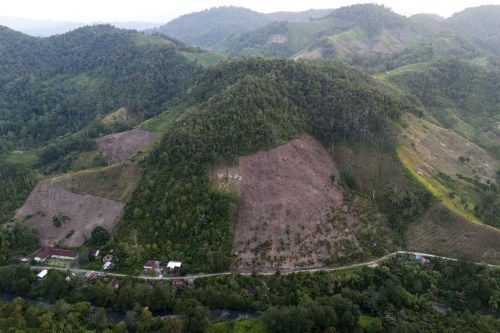
Deforestation in Indonesia spiked last year, but resources analyst sees better overall trend
Advertisement
Read this article for free:
or
Already have an account? Log in here »
To continue reading, please subscribe:

Digital Subscription
One year of digital access for only $205*
- Enjoy unlimited reading on winnipegfreepress.com
- Read the E-Edition, our digital replica newspaper
- Access News Break, our award-winning app
- Play interactive puzzles
*First annual payment billed as $205.00 + GST for one year. This annual subscription will automatically renew at $233.00 + GST every 52 weeks (10% off the regular annual price of $259.35). Offer available to new and qualified returning subscribers only. Cancel any time.
To continue reading, please subscribe:
Add Free Press access to your Brandon Sun subscription for only an additional
$1 for the first 4 weeks*
- Enjoy unlimited reading on winnipegfreepress.com
- Read the E-Edition, our digital replica newspaper
- Access News Break, our award-winning app
- Play interactive puzzles
*Your next Brandon Sun subscription payment will increase by $1.00 and you will be charged $17.95 plus GST for four weeks. After four weeks, your payment will increase to $24.95 plus GST every four weeks.
Read unlimited articles for free today:
or
Already have an account? Log in here »
Hey there, time traveller!
This article was published 28/04/2024 (895 days ago), so information in it may no longer be current.
JAKARTA, Indonesia (AP) — From trees felled in protected national parks to massive swaths of jungle razed for palm oil and paper plantations, Indonesia had a 27% uptick in primary forest loss in 2023 from the previous year, according to a World Resources Institute analysis of deforestation data. But the loss is still seen as historically low compared to the 2010s, it said.
“Deforestation has been declining from six or so years ago, when there were peak rates,” said Rod Taylor, global director of the forests program at WRI. “It’s good news and commendable for Indonesia.”
But others saw cause for concern in the uptick, and tied some of the more recent deforestation to the world’s appetite for mining Indonesia’s vast deposits of nickel, which is critical for the green energy transition.
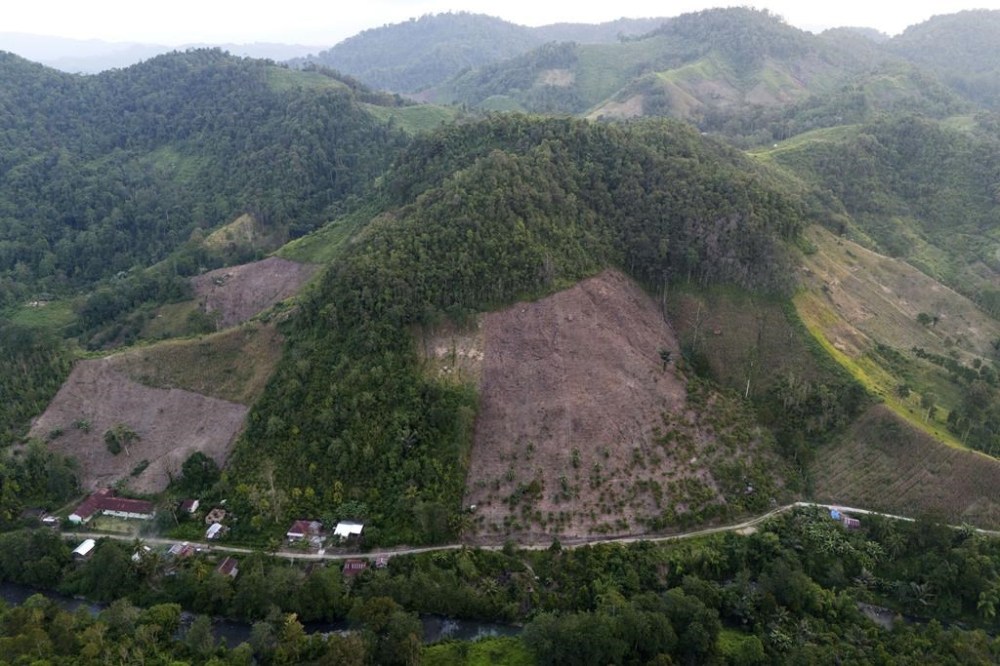
The latest data from the University of Maryland’s Global Land Analysis and Discovery laboratory was shared on Global Forest Watch — a platform run by WRI that provides data, technology and tools for monitoring the world’s forests.
A vast tropical archipelago stretching across the equator, Indonesia is home to the world’s third-largest rainforest, with a variety of endangered wildlife and plants, including orangutans, elephants and giant forest flowers. Some live nowhere else.
Since 1950, more than 74 million hectares (285,715 square miles) of Indonesian rainforest — an area twice the size of Germany — have been logged, burned or degraded for development of palm oil, paper and rubber plantations, nickel mining and other commodities, according to Global Forest Watch. Indonesia is the biggest producer of palm oil, one of the largest exporters of coal and a top producer of pulp for paper. It also exports oil and gas, rubber, tin and other resources.
Expansion of industrial plantations occurred in several locations adjacent to existing palm oil tree and pulp and paper plantations on the tropical islands of Kalimantan and West Papua, according to the analysis.
The Indonesian Ministry of Environment and Forestry said the expansion occurred in concessions granted before the current administration took office in 2014.
The Indonesian Ministry of Environment and Forestry did not respond to questions and a request for comment sent by The Associated Press.
Global Forest Watch’s data on Indonesia’s loss of primary forests — which are old-growth forests typically high in stored carbon and rich in biodiversity — are higher than the official Indonesian statistics. That’s because much of the primary forest loss in Indonesia, according to the analysis, is within areas that Indonesia classifies as secondary forest — areas that have regenerated through largely natural processes after human actions such as agriculture clearing or timber harvest. Secondary forests typically have reduced capacity for storing carbon than primary forests.
Deforestation linked to the mining industry occurred in Sumatra, Sulawesi, Mlauku and Kalimantan, according to the analysis.
Indonesia has the world’s largest reserves of nickel — a critical material for electric vehicles, solar panels and other goods needed for the green energy transition. And part of this deforestation can be directly linked to the expansion of Indonesia’s nickel industry, said Timer Manurung, director of Auriga Nusantara, a nongovernmental conservation organization based in Indonesia.
Manurung said it’s not clear exactly how much of Indonesia deforestation is due to mining. But he called it a “significant driver,” and said the government’s rapid development of the country’s mining and nickel industry — including more than 20 new smelters to process the nickel ore — is “repeating Indonesia’s oil palm and pulpwood mistakes” of increasing deforestation.
But Taylor noted that deforestation done on a massive scale seems to be shrinking, compared to the past.
In the 2010s there was gargantuan oil palm, timber and large-scale plantation expansion across Indonesia. Research in the Nature Climate Change journal found that the deforestation rate doubled to approximately 2 million hectares per year during 2004-2014.
In 2023, primary forest loss in patches greater than 100 hectares made up just 15% of the loss, according to the analysis.
Taylor attributes this lack of large-scale deforestation patches to the reputational risks that companies face if they are found to be razing trees. In recent decades nongovernmental organizations, consumers and governments — including the European Union — have pushed for companies to move away from deforestation practices.
In 2018 Indonesian President Joko Widodo put a three-year freeze on new permits for palm oil plantations. And the rate of deforestation slowed between 2021-2022, according to government data.

But small-scale primary forest loss was still prevalent throughout the country, including within several protected areas such as Tesso Nilo National Park and Rawa Singkil Wildlife Reserve on the island of Sumatra. Both areas are home to critically endangered animals such as tigers and elephants.
A wetter than usual El Nino — which usually leads to less rainfall and higher temperatures that can cause rapid spread of fires set to clear land for agriculture — contributed to a quieter than expected fire season, Taylor said. So did investments made by the Indonesian government in fire prevention capabilities, as well as efforts to suppress fire by local communities.
During Indonesia’s last El Nino in 2015-2016, fires intentionally started to clear land for agriculture rapidly spread, sending haze across Southeast Asia. Several Indonesian provinces declared states of emergencies, respiratory illnesses spiked and thousands of Indonesians had to flee their homes.
“The good news in Indonesia is that the fire prevention measures are much more sophisticated than they were in years past,” said Taylor. “It’s really making a difference.”
___ Associated Press climate and environmental coverage receives support from several private foundations. See more about AP’s climate initiative here. The AP is solely responsible for all content.