Cigarettes with health warnings could nudge smokers to butt out: researchers

Advertisement

Advertise with us

VANCOUVER - Cigarettes with health warnings printed directly on them are being sold in some parts of Canada, making it the first country to adopt the regulation aimed at encouraging people to kick the habit or keep them from taking it up in the first place.

Read this article for free:


or

Already have an account? Log in here »

To continue reading, please subscribe:

Subscribe and receive a limited-edition Free Press branded hat or tote.

Digital Subscription

One year of digital access for only $205*

  • Enjoy unlimited reading on winnipegfreepress.com
  • Read the E-Edition, our digital replica newspaper
  • Access News Break, our award-winning app
  • Play interactive puzzles

*First annual payment billed as $205.00 + GST for one year. This annual subscription will automatically renew at $233.00 + GST every 52 weeks (10% off the regular annual price of $259.35). Offer available to new and qualified returning subscribers only. Cancel any time.

To continue reading, please subscribe:

Add Free Press access to your Brandon Sun subscription for only an additional

$1 for the first 4 weeks*

  • Enjoy unlimited reading on winnipegfreepress.com
  • Read the E-Edition, our digital replica newspaper
  • Access News Break, our award-winning app
  • Play interactive puzzles
Start now

*Your next Brandon Sun subscription payment will increase by $1.00 and you will be charged $17.95 plus GST for four weeks. After four weeks, your payment will increase to $24.95 plus GST every four weeks.

Hey there, time traveller!
This article was published 29/04/2024 (897 days ago), so information in it may no longer be current.

VANCOUVER – Cigarettes with health warnings printed directly on them are being sold in some parts of Canada, making it the first country to adopt the regulation aimed at encouraging people to kick the habit or keep them from taking it up in the first place.

Manufacturers are required, by Tuesday, to ensure that warnings about harms such as cancer, impotence, leukemia and damage to organs are printed directly on individual cigarettes. Retailers must sell only packages with those cigarettes by July 31.

Six different warnings, in English and French, are printed in rotation on the paper around the filter of each cigarette. The wording ranges from “Tobacco smoke harms children” to “Poison in every puff.”
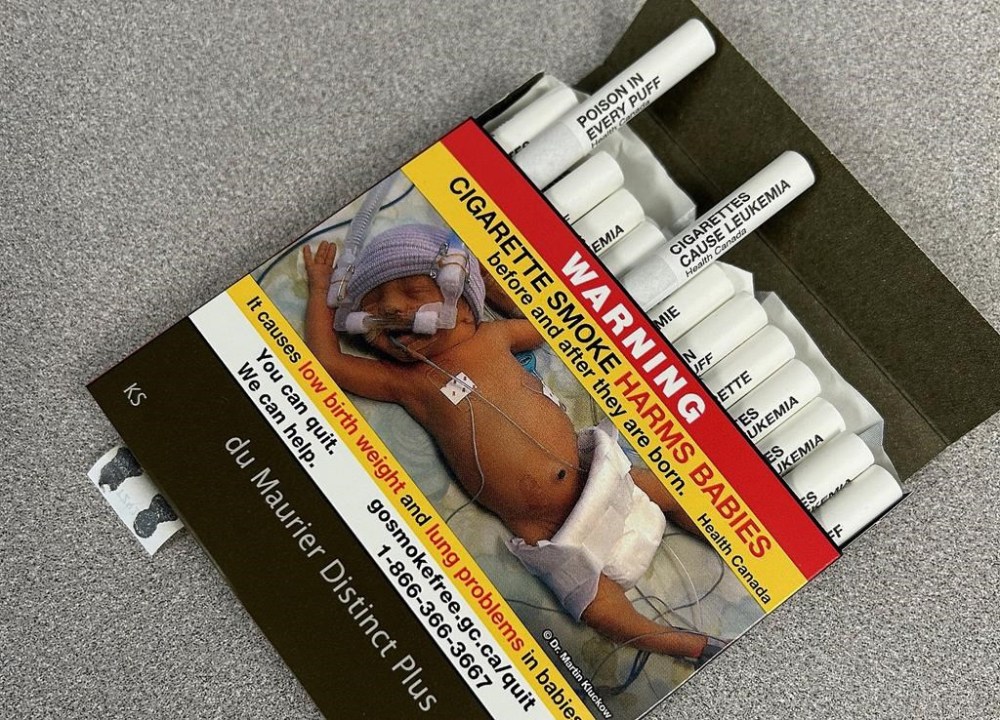
Canada has become the first country to sell cigarettes with health warnings printed directly on them to help people butt out or think twice about starting to smoke. A pack of cigarettes bearing exterior warning label and warnings on the filter tips of each individual cigarette is seen in Vancouver, B.C., Friday, April 26, 2024. THE CANADIAN PRES/Camille Bains

“It’s an innovation that’s unprecedented, and it’s going to reduce smoking,” Canadian Cancer Society senior policy analyst Rob Cunningham said in an interview. Manufacturers print their brand names on cigarettes sold in most countries, he added.

Canadian Regulations dating back to 1989 required text warnings to be printed on packages. Canada stepped up efforts even further and became a world leader in 2001 when 16 rotated graphic pictorial warnings started covering half of the front and back of packages. As of 2012, the photo warnings have covered 75 per cent of a pack and eight messages have been printed on the inside flap.

Now, 138 countries sell cigarettes in packages that show graphic images of health consequences, Cunningham said, noting Australia has proposed a law that would emulate Canada’s new approach and print warnings on each cigarettes.

The messages on individual smokes repeat some of the warnings that have previously appeared on packages. But some cigarettes will feature a new caution about the link between smoking and leukemia.

Cunningham said he recently bought some of the new packages at stores in Ottawa, Toronto and Gatineau, Que., and he provided samples to The Canadian Press.

He said it will now be impossible to ignore the health harms of smoking when someone holds a cigarette, even if they have become desensitized to the graphic warnings. One shows a brain damaged by stroke and another has a photo of a hospitalized baby hooked up to a breathing apparatus due to harms from smoking during pregnancy.

More than one million people in Canada have died from tobacco-related illness including cancer, heart disease and emphysema since 2000, according to the Canadian Institute for Substance Use Research and the Canadian Centre on Substance Use and Addiction.

Sathio Zed of Vancouver said peer pressure pushed him to start smoking four years ago at age 20 and he tried unsuccessfully to quit six months ago by using nicotine gum.

“I want to quit but I have to be mentally strong, no distractions. The job I’m doing is stressful so I smoke during breaks,” Zed said as he finished a cigarette on a downtown street.

He shrugged when he looked at the words “Poison in every puff” printed on a cigarette shown to him.

“I know it’s harmful,” said Zed, adding he worries about his health if he remains addicted to nicotine.

“Nicotine is dopamine,” he said of the buzz he gets from smoking.

Tracy Brunskill said she smoked between the ages of 14 and 29 before starting to vape eight years ago, though she is concerned about the unknown long-term impact of that choice.

Brunskill was surprised to see the warnings printed on individual cigarettes and said she’s “1,000 per cent” sure that she would not have started smoking if she’d seen them as a teen.

Dr. Peter Selby, head of the Nicotine Dependence Clinic at Toronto’s Centre for Addiction and Mental Health, said the warnings on each cigarette could start more conversations about the harms of a “public health nuisance” that is particularly dangerous for young smokers, adding their brains are not fully developed until at least age 25.

“My hope is that it will nudge some people to rethink their smoking addiction,” he said. “Health-care costs are the most immediate societal cost but there are productivity costs and losses due to the No. 1 cause of fires in homes in Canada — that’s cigarettes.

Nicotine is so addictive that smokers typically have their first cigarette within 30 minutes of waking up, and many who have become ill wish they had never taken up the habit, he said.

“These are people who’ve tried 10, 20, 30 times to quit. They’ve got cancer, they’ve got heart disease, lung disease.”

An estimated 10 per cent of people in Canada smoke, and the goal is to cut that figure to less than five per cent by 2035.

Geoffrey Fong, a psychology and public health sciences professor at the University of Waterloo in Ontario, said warnings get people’s attention.

A 2019 study he co-authored in the journal Tobacco Control showed the 2012 graphic warnings on cigarette packages were effective in increasing people’s knowledge about health risks.

He said about 2,000 smokers were surveyed in 2010 about whether they knew that bladder cancer and blindness were associated with smoking. They were surveyed again 17 months after the pictorial warnings appeared on packages showing links to those harms.

Researchers found that 27 per cent of respondents knew smoking could cause bladder cancer before seeing the warnings, and that number rose to 43 per cent in the second phase of the survey, he said.

Thirteen per cent of people knew blindness was linked to smoking before the warnings were printed on packages. That number nearly tripled to 36 per cent after the warnings appeared, said Fong, founder and chief principle investigator of the International Tobacco Control Policy Evaluation Project, which has done research in 31 countries to assess various policies listed in the World Health Organization’s tobacco control treaty.

“Warnings are fantastic in informing people about the specific harms of smoking,” he said. “Everyone kind of knows that smoking is bad for you but they don’t know how bad, or the extraordinary array of diseases that smoking causes.”

This report by The Canadian Press was first published April 29, 2024.

Canadian Press health coverage receives support through a partnership with the Canadian Medical Association. CP is solely responsible for this content.


Report Error Submit a Tip

More Stories

Hydro’s unpredictable fortunes

Editorial 4 minute read Preview

Hydro’s unpredictable fortunes

Editorial 4 minute read 2:00 AM CDT

Hope for rain. Or snow. Or both.

There’s a truism buried deep in a financial outlook in Manitoba Hydro’s 2025-26 annual report, released in late September: “Manitoba Hydro’s net income is highly dependent on several uncontrollable factors.”

Those factors include the risk of drought reducing hydroelectric production and sales (a situation that means the utility will have to purchase more power, especially in winter), the rate of inflation, the actual cost of purchased electricity and increased interest rates that would mean Hydro will have to spend more servicing its $26.55 billion debt.

The report outlines that several of those factors came together during the utility’s last full fiscal year — along with huge costs to replace equipment damaged in a long, dry summer of forest fires.

Read
2:00 AM CDT

Collaros turns back the clock in crucial win over Stamps

Taylor Allen 7 minute read Preview

Collaros turns back the clock in crucial win over Stamps

Taylor Allen 7 minute read Sunday, Oct. 11, 2026

It was around this time seven years ago that the Winnipeg Blue Bombers officially became Zach Collaros’s team.

Making his first start in blue and gold after being acquired via trade, Collaros ran backwards to escape a collapsing pocket before rolling to his right and firing a perfect pass to Darvin Adams in the back corner of the south end zone during a home game against the Calgary Stampeders.

The play marked the beginning of the Collaros era in Winnipeg.

And a similar play Saturday night, once again against the Stampeders, served as a reminder that the 38-year-old pivot isn’t done just yet.

Read
Sunday, Oct. 11, 2026

Woman accused of pulling handgun on taxi driver

1 minute read Yesterday at 10:39 AM CDT

A 45-year-old woman accused of pulling a handgun on a Winnipeg taxi driver is facing multiple firearms-related charges.

It happened Sunday afternoon, at about 2:30 p.m., near the intersection of Concordia Avenue and Louelda Street. Officers learned a woman got into a cab in the Munroe East neighbourhood and pulled out a handgun, asking the driver to take her to a specific location, the Winnipeg Police Service stated in a news release.

The taxi driver activated the taxi's emergency beacon, exited the vehicle, and contacted police.

The woman got into the driver's seat of the taxi, but the keys had been removed, and she fled on foot. A suspect was arrested shortly afterward in the 1000 block of Concordia Avenue. Police seized a .22-calibre handgun during the arrest.

Comparing the Iran and Vietnam Wars

Peter McKenna 5 minute read Preview

Comparing the Iran and Vietnam Wars

Peter McKenna 5 minute read 2:00 AM CDT

The other day I asked my students in U.S. foreign policy to think about the relevance of the Vietnam War in relation to the ongoing war in Iran. More specifically, I wanted them to identify the similarities and differences between the two wars.

What is immediately striking is how domestic politics played such a seminal role in both conflicts. While American public opinion was generally in favour of U.S. military involvement in Vietnam in the early years, things started to turn very sour after U.S. soldiers started arriving stateside in flag-draped coffins and body bags. As for Iran, just about every single poll and TV newscast since the first few weeks of the war have illustrated an overwhelming public repudiation of President Trump’s military adventurism.

The electoral implications were also quite apparent for the two wars. The U.S.-Iran War is clearly having a positive effect on the Democratic Party’s electability, as it looks set to capture both the House of Representatives and the Senate in the Nov. 3 midterm elections. Democratic President Lyndon Johnson, reading the political tea leaves from the Vietnam fallout, opted not to contest the 1968 U.S. presidential election.

Equally interesting, the U.S. press had a crucial, and mostly negative, impact on both the Vietnam and Iran conflicts. Who could forget Gen. William Westmoreland — the commander of U.S. forces in Vietnam (1964-1968) — maintaining that it was the media’s fault the U.S. lost the war in Vietnam. While I take issue with his thesis, I do believe the news coverage and visuals of the first televised war served to raise serious concerns about why the U.S. was at war in Southeast Asia.

Read
2:00 AM CDT

RJ Mitte, ‘Breaking Bad’ actor and disability rights champion, dies at 34

Andrew Dalton, The Associated Press 3 minute read Preview

RJ Mitte, ‘Breaking Bad’ actor and disability rights champion, dies at 34

Andrew Dalton, The Associated Press 3 minute read Updated: Yesterday at 10:23 PM CDT

LOS ANGELES (AP) — Actor and disability rights advocate RJ Mitte, who brought a lifetime of experience with cerebral palsy to fictional family struggles in an essential role on “Breaking Bad,” died Monday at age 34, authorities and his representatives said.

Cameron County Justice of the Peace Cyndi Hinojosa told The Associated Press she declared Mitte dead at about 1:30 p.m. at what she believed was his home in Brownsville, Texas. She said she was unable to provide a cause, but an autopsy will be performed.

Mitte played Walter White Jr., the son of Bryan Cranston's chemistry teacher-turned-meth dealer Walter White on nearly every episode of the five seasons of the AMC show, which recently ranked as the best of the 21st century in a New York Times poll.

Cranston said he is in “deep despair” for the loss of his “sweet son.”

Read
Updated: Yesterday at 10:23 PM CDT

A question of public utility

Tom Pearson 5 minute read 2:00 AM CDT

The editorial page of the Free Press often provides perspectives that are thought-provoking and sometimes contradictory. “Keeping the lights on,” (Oct. 5) by Hal Turner and “Wasteful operations should be held accountable,” (Oct. 6) by Barry Prentice are both thought-provoking. They are not contradictory because they cover two quite different topics. Where they differ is in their delivery and the quality of the underlying facts.

Mr. Turner provides what is, in my view, the most cogent rationale for gas-fuelled generation that I have read. He highlights the essential aspect of power supply to Manitobans. He supports the argument for natural gas generation with succinct, relatable facts and anecdotes relating to what other comparable utilities have done. He states that, “Manitoba Hydro’s experts are neither anti-wind nor pro-fossil fuel.” They are simply seeking the best possible solution for Manitobans — a fact many special-interest groups either ignore or sadly, impugn.

Although some would argue the contrary, I believe that Mr. Turner’s position and longevity in the Manitoba Hydro organization lend gravitas to his column. Mr. Turner understands that “keeping the lights on” is a non-negotiable requirement and a public trust.

Before I turn to Mr. Prentice’s column, I should disclose that before I retired (it’s been a while), I was responsible at different times for Winnipeg’s regional water system and subsequently water supply from source to tap. In that context I was also responsible for the operation of the Greater Winnipeg Water District (GWWD) railway. Like Mr. Turner’s perspective on the supply of electricity to Manitobans, I regard the supply of safe drinking water to Winnipeggers as a public trust.