For farmers, watching and waiting is a spring planting ritual. Climate change is adding to anxiety
Advertisement
Read this article for free:
or
Already have an account? Log in here »
To continue reading, please subscribe:

Digital Subscription
One year of digital access for only $205*
- Enjoy unlimited reading on winnipegfreepress.com
- Read the E-Edition, our digital replica newspaper
- Access News Break, our award-winning app
- Play interactive puzzles
*First annual payment billed as $205.00 + GST for one year. This annual subscription will automatically renew at $233.00 + GST every 52 weeks (10% off the regular annual price of $259.35). Offer available to new and qualified returning subscribers only. Cancel any time.
To continue reading, please subscribe:
Add Free Press access to your Brandon Sun subscription for only an additional
$1 for the first 4 weeks*
- Enjoy unlimited reading on winnipegfreepress.com
- Read the E-Edition, our digital replica newspaper
- Access News Break, our award-winning app
- Play interactive puzzles
*Your next Brandon Sun subscription payment will increase by $1.00 and you will be charged $17.95 plus GST for four weeks. After four weeks, your payment will increase to $24.95 plus GST every four weeks.
Read unlimited articles for free today:
or
Already have an account? Log in here »
Hey there, time traveller!
This article was published 06/05/2024 (888 days ago), so information in it may no longer be current.
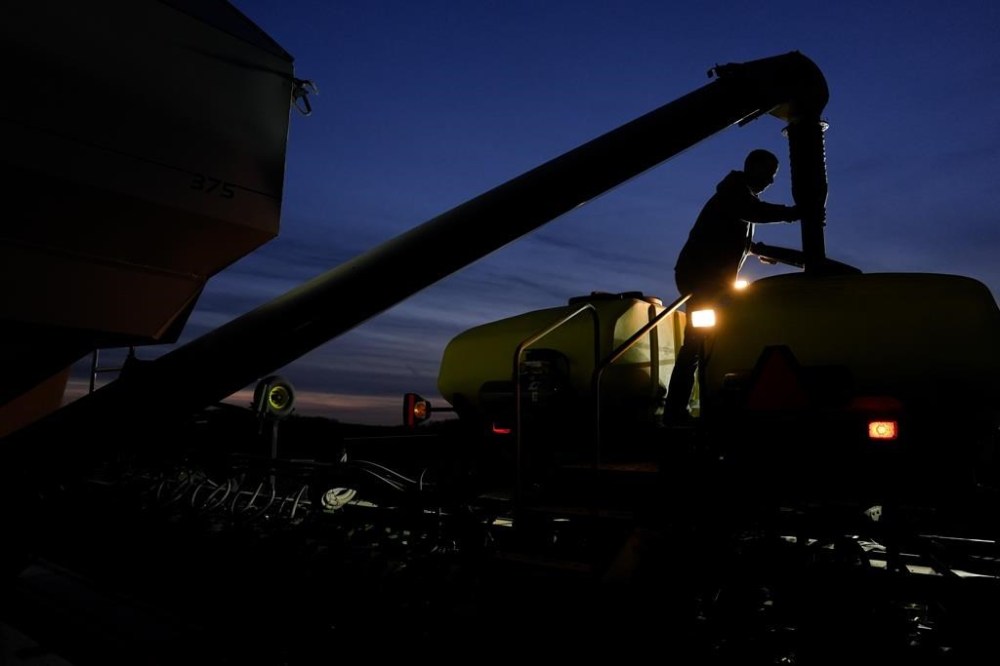
SABINA, Ohio (AP) — It was just after dark as Ross Woodruff hopped into a truck to haul soybean seeds out to his brother, Mark, whose planter had run out. It was the first day they could plant after heavy rains two weeks earlier left much of their 9,000 acres too muddy to get equipment into the fields.
With drier conditions, Mark had been going hard since mid-afternoon, finishing the beans in one 60-acre field before moving to another.
“This year, with the way the weather’s been, it’s slowed progress,” Ross Woodruff said. “I wouldn’t say we’re behind but a few more rains and we’re going to be.”
Waiting on the weather is an old story in agriculture, but as climate change drives an increase in spring rains across the Midwest, the usual anxiety around the ritual of spring planting is expected to rise along with it. In Ohio, for example, farmers have lost about five days of field work in the month of April since 1995, according to Aaron Wilson, the state’s climatologist.
When farmers have to wait for fields to dry out, already long planting days can become endurance tests that stretch into the night. Delays in planting can affect yield if they are significant enough, and the quality of crops planted in wet springs may suffer at harvest, too.
“The expectation going ahead is that this will continue to be a worsening issue,” said Dennis Todey, director of the Department of Agriculture’s Midwest Climate Hub. “We need to help agriculture understand that and develop new management mechanisms to deal with that by changing how we plant, changing when we plant, changing what we plant.”
INCREASING SPRING RAINS
Experts say one effect of climate change is that warming is pushing more water into the atmosphere, driving up rainfall. Much of the Midwest has seen a 5% to 15% increase in spring rainfall over roughly the past three decades, according to the federal government’s Fifth National Climate Assessment. That assessment projected an additional 8% to 20% increase in the region by mid-century.
“The number of days with extremes are increasing. It’s an upward trend,” said Melissa Widhalm, the regional climatologist at the Midwestern Regional Climate Center.
The Ohio Valley saw increases in April rainfall of about a quarter-inch per decade between 1980 and 2023, the most of any area in the nation aside from the Southeast, according to NOAA. Southern Ohio, northern Kentucky and large swaths of Indiana saw some of the biggest increases in April rainfall in the Ohio Valley — as much as 5 to 6 inches more than usual in 2024, according to an Associated Press review of four decades of precipitation data from the University of Idaho.
Farmers “are going to need the ability to manage a broader range of conditions,” Widhalm said.
FEWER DAYS ADDS PRESSURE
Farms of all sizes are feeling the pressure to work as much as possible when field conditions allow.
This April, Katy Rogers, who manages the 117-acre Teter Retreat and Organic Farm in Noblesville, Indiana, was planting lettuce seedlings past sunset, long after her staff had left for the day. Like the Woodruffs, she was playing catchup after heavy rains flooded some of her fields weeks earlier. On her small vegetable farm, multiple crops are planted in the spring to harvest in the summer, and other crops are planted in the summer to then harvest in the fall.
“When we miss a window and it throws us off schedule, that crop might not go out at all,” Rogers said. “We might just throw away those seedlings.”
Already this year, she scrapped planting Brussels sprouts because the fields weren’t workable during the couple of weeks needed to plant them, about a $2,800 revenue loss. Because of her operation’s smaller size, Rogers can plant by hand when wet fields won’t allow her tractor, but it’s “extremely draining” work, she said.
“It’s exhausting to come out and be in rain that feels like it’s slapping you,” Rogers said. She said she expected to plant more in covered structures and less in fields in the future.
Ross Woodruff, in Ohio, says it seems like spring days good for fieldwork are more sporadic — coming in two- or three-day spurts rather than the week-long stretches he remembers earlier during his 20 years as a farmer. During those shorter spurts, the hours are long.
“We’ll try to keep stuff going around the clock if we can, if we’ve got enough manpower,” he said.
ADAPTING TO THE RAIN
More rain means farmers need to manage that water, which can threaten to erode soil. A 2018 study from researchers at Purdue University predicted runoff from spring rains could increase between 40% and 70% in some parts of the state.
The Woodruffs, like many larger farms, rely on tile drainage to remove excess water from fields. These tiles are large perforated plastic pipes about 3 feet (1 meter) below the soil that collect water and carry it away, usually to a canal between fields. It’s a costly system, but one that pays off in crop yield, Ross Woodruff said.
But tile drainage has its drawbacks, removing moisture from soil regardless of how much rain has fallen, and that risks leaving fields dry if summer rains don’t come.
Building soil health is key for farmers as they adapt to more spring rain.
Wendy Carpenter, who owns the 1 1/2-acre Christopher Farm in Modoc, Indiana, uses some sustainable farming techniques to do that.
Like many larger farms, she plants cover crops in fields that would otherwise be bare between planting season, along with no-till practices. That keeps organic matter in the soil, helping to maintain structure. Carpenter says her fields can handle excess water as well as retain some of that moisture during excessively dry periods.
This spring, she and her staff of four were able to manually plant vegetables outdoors even after about 7 inches of rain over a week earlier in the month. She says these practices, along with the small scale of her farm and her lack of heavy equipment, have allowed her to be a little more resilient compared to the more conventional row crop farms that surround her, which hadn’t yet started planting.
“When you get those really, really torrential rain events, everybody is going to be in trouble,” Carpenter said. “Those of us who are actively working to increase our soil’s organic matter, that is going to make a difference in how long that water is retained.”
And crop diversity, which is a big part of the plan at Teter Farm, helps build resiliency. Even though Rogers had to forgo planting one crop already this spring, she has dozens of others.
As the Woodruffs scrambled to plant last month while darkness moved in, Mark and Ross worked quickly to reload the planter, get it turned around and lined up on the next row. The planter rattled to life, its blades lowered into the ground and the tractor’s headlight marked a clear path.
Mark wouldn’t finish planting until 11 o’clock, while Ross stayed up past midnight doing office work. And they weren’t alone.
Down the road, another farmer was planting his field under the full moon.
___

Associated Press data journalist Mary Katherine Wildeman contributed reporting from Hartford, Connecticut.
___
Follow Joshua A. Bickel on X and Instagram.
___
The Associated Press’ climate and environmental coverage receives financial support from multiple private foundations. AP is solely responsible for all content. Find AP’s standards for working with philanthropies, a list of supporters and funded coverage areas at AP.org.