

The Governance Triangle: ‘Democracy does not exist in a vacuum’
Advertisement
Read this article for free:
or
Already have an account? Log in here »
To continue reading, please subscribe:

Digital Subscription
One year of digital access for only $205*
- Enjoy unlimited reading on winnipegfreepress.com
- Read the E-Edition, our digital replica newspaper
- Access News Break, our award-winning app
- Play interactive puzzles
*First annual payment billed as $205.00 + GST for one year. This annual subscription will automatically renew at $233.00 + GST every 52 weeks (10% off the regular annual price of $259.35). Offer available to new and qualified returning subscribers only. Cancel any time.
To continue reading, please subscribe:
Add Free Press access to your Brandon Sun subscription for only an additional
$1 for the first 4 weeks*
- Enjoy unlimited reading on winnipegfreepress.com
- Read the E-Edition, our digital replica newspaper
- Access News Break, our award-winning app
- Play interactive puzzles
*Your next Brandon Sun subscription payment will increase by $1.00 and you will be charged $17.95 plus GST for four weeks. After four weeks, your payment will increase to $24.95 plus GST every four weeks.
Read unlimited articles for free today:
or
Already have an account? Log in here »
Hey there, time traveller!
This article was published 16/05/2024 (853 days ago), so information in it may no longer be current.
Los Angeles (DNA) — The global index released this week by an international group of governance researchers is meant to give fellow academics, politicians and other policymakers a new way to understand the interactions between states and citizens.
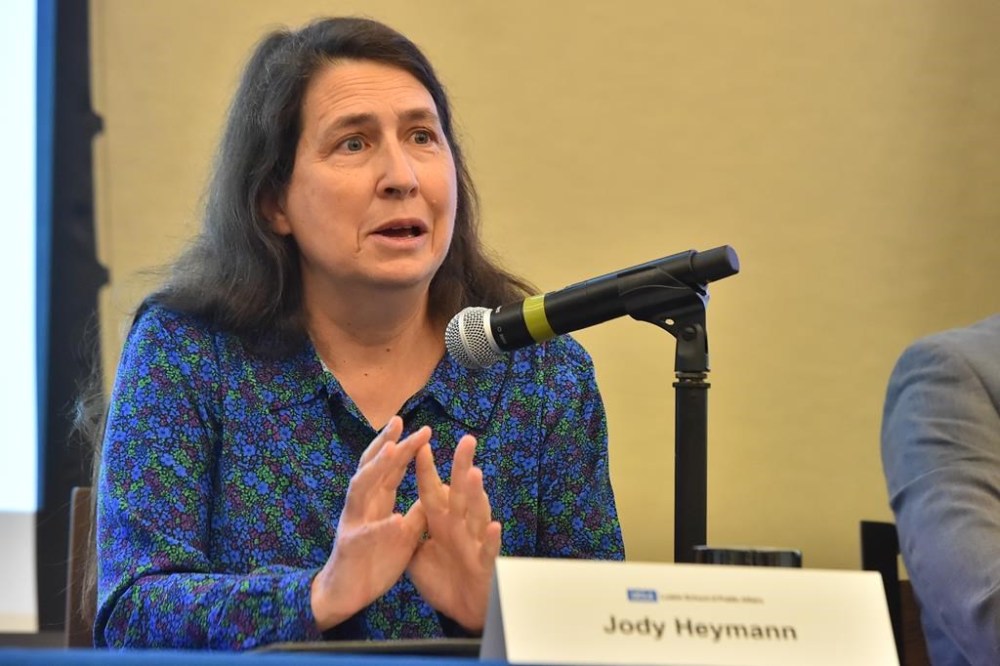
Jody Heymann, public health scholar at the University of California Los Angeles (UCLA), and founding director of the WORLD Policy Analysis Center, said that the 2024 Berggruen Governance Index (BGI) gives a higher-resolution picture of governance around the world.
Heymann described how world maps produced by geographers 500 years ago reflected the state of available information at the time, imprecisely depicting «big blobs of continents.» «Then it gets a little better by 1600, a little better by 1700, and by now we have GPS maps,» Heymann said.
Similarly, the 2024 BGI gives a more nuanced picture of 145 countries around the world by producing an index of democratic accountability alongside indices of state capacity and the delivery of public goods.
«The BGI is a giant step forward, not a small step,» Heymann said. «And I think that giant step is because of the conceptualization: We have to care about democratic accountability, we have to care about state capacity, and we have to care about public goods provision.»
The 96-page report, titled «Democracy Challenged», was issued by the Luskin School of Public Affairs at the UCLA, which collaborated on the project with the Berggruen Institute, a think tank headquartered in Los Angeles, and the Hertie School, a German university. It was presented on Wednesday in Los Angeles.
«Democracy does not exist in a vacuum,» the report said. «Rather, what the BGI refers to as democratic accountability is closely linked to two other core aspects of the state to form the Governance Triangle.»
The Governance Triangle looks into the interconnectedness of three factors: state capacity, public goods provision and democratic accountability.
The researchers described state capacity as the ability of governments to generate resources and coordinate core functions, which amounts to the quality of government. Public goods provision accounts for the state’s ability to deliver essentials: economic stability, social welfare, healthcare and environmental quality. Democratic accountability is concerned with the quality of democracy – for example free and fair elections, the health of democratic instutions, freedom of speech or the media – in a state.
«As opposed to just looking at outcomes, or just looking at inputs, we really look at the idea: Is a society equipping itself with the tools, the instruments to deliver for citizens, meaning, the institutions, the legal framework, or in some cases, really, cultural framework to deliver for itself,» said German-American philanthropist Nicolas Berggruen, founder of the Berggruen Institute.
The report found declines in democratic accountability — sometimes small, sometimes much larger — in most of the world’s 50 most populous countries, comprising the overwhelming majority of humanity. Meanwhile, state capacity overall has been little changed. Yet most states have found ways to improve delivery of public goods, which the report calls a «puzzle.»
«There is a general and long-term trend towards higher levels of public goods provision,» the authors write, «suggesting that, on average, countries are becoming better at offering a higher quality of life to their populations.»
Joseph Saraceno, a data scientist and BGI co-author, cited the example of Thailand, which saw severe erosion of democracy from 2010-2021. «It was one of the highest performers in terms of increases in public goods provision over the last 20 years,» he said. «What is this paradox that we’re uncovering?»
———————————–
This text and the accompanying material (photos and graphics) are an offer from the Democracy News Alliance, a close co-operation between Agence France-Presse (AFP, France), Agenzia Nazionale Stampa Associata (ANSA, Italy), The Canadian Press (CP, Canada), Deutsche Presse-Agentur (dpa, Germany) and PA Media (PA, UK). All recipients can use this material without the need for a separate subscription agreement with one or more of the participating agencies. This includes the recipient’s right to publish the material in own products.
The DNA content is an independent journalistic service that operates separately from the other services of the participating agencies. It is produced by editorial units that are not involved in the production of the agencies’ main news services. Nevertheless, the editorial standards of the agencies and their assurance of completely independent, impartial and unbiased reporting also apply here.