First Nation legislator makes history at Queen’s Park with speech in Oji-Cree
Advertisement
Read this article for free:
or
Already have an account? Log in here »
To continue reading, please subscribe:
Digital Subscription
One year of digital access for only $1.44 a week*
- Enjoy unlimited reading on winnipegfreepress.com
- Read the E-Edition, our digital replica newspaper
- Access News Break, our award-winning app
- Play interactive puzzles
*Billed as $5.77 plus GST every four weeks. After 52 weeks, price increases to the regular rate of $19.95 plus GST every four weeks. Offer available to new and qualified returning subscribers only. Cancel any time.
To continue reading, please subscribe:
Add Free Press access to your Brandon Sun subscription for only an additional
$1 for the first 4 weeks*
- Enjoy unlimited reading on winnipegfreepress.com
- Read the E-Edition, our digital replica newspaper
- Access News Break, our award-winning app
- Play interactive puzzles
*Your next Brandon Sun subscription payment will increase by $1.00 and you will be charged $17.95 plus GST for four weeks. After four weeks, your payment will increase to $24.95 plus GST every four weeks.
Read unlimited articles for free today:
or
Already have an account? Log in here »
Hey there, time traveller!
This article was published 28/05/2024 (872 days ago), so information in it may no longer be current.
TORONTO – After decades of being told his first language should be forgotten, Sol Mamakwa stood on the floor of the Ontario legislature about to make history.
But he couldn’t shake the thought that he should continue in English and not Anishininiimowin, also called Oji-Cree, the language his mother taught him.
“I thought I was breaking the laws and the rules of this house and I tried to remind myself that there’s nothing wrong with this, ‘You’re allowed to speak,'” Mamakwa said.
And so he did.
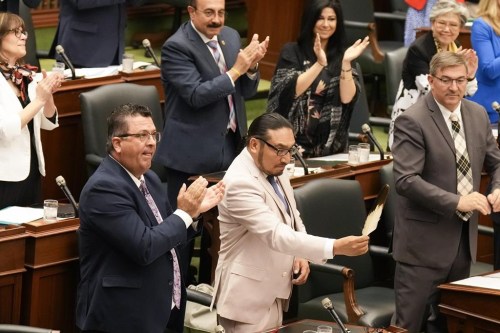
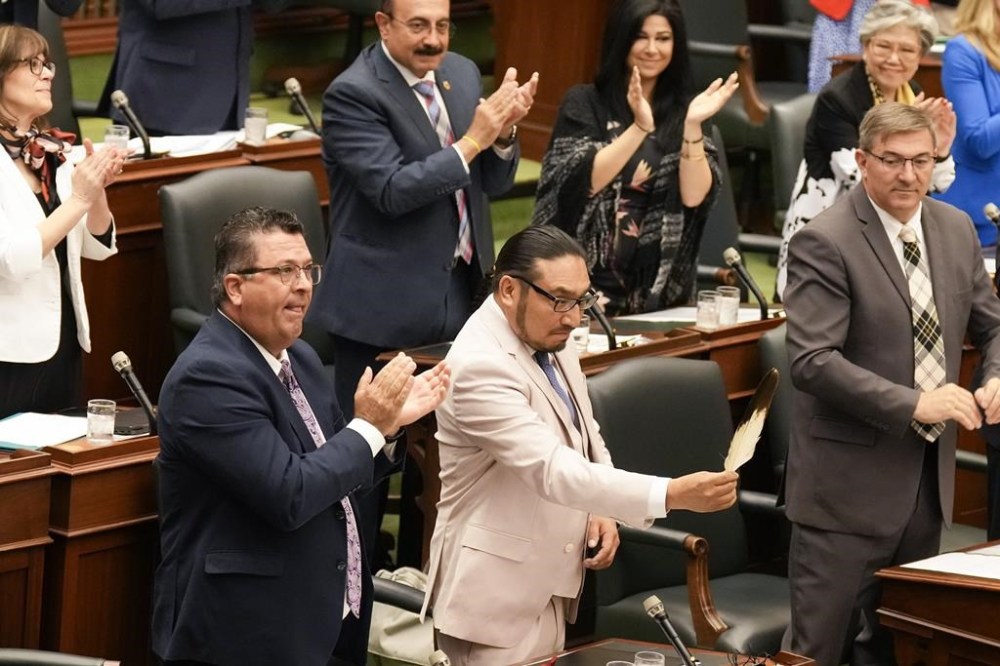
In a moment that made history, the New Democrat – and the only First Nation legislator in the province – addressed Queen’s Park in his own language on Tuesday, marking the first time a language other than English and French has been allowed by officials in Ontario’s legislative chamber.
In the process, the 53-year-old Mamakwa secured a pledge from the premier to build a long-term care home in Sioux Lookout, Ont.
“I want to say thank you to everyone present. I’m very grateful, thankful for the opportunity to be able to speak my Anishininiimowin, in Indigenous Oji-Cree language in this legislature,” Mamakwa said through an interpreter at the start of his speech.
“I am speaking for those that couldn’t use our language and also for those people from Kiiwetinoong, not only those from Kiiwetinoong, but for every Indigenous person in Ontario.”
Ontario’s legislature had not previously allowed interpreting and transcribing a language other than English and French.
About 100 supporters gathered in Toronto to watch the historic moment, including Mamakwa’s mother, siblings, friends and First Nation leaders. It was a gift to his mom, Kezia Mamakwa, who turned 79 on Tuesday.
Politicians sang “Happy Birthday” to her and gave several standing ovations to Sol Mamakwa in an emotional question period.
“Today was monumental for me,” Mamakwa said afterward.
After his speech, Mamakwa took the lead questions during question period, grilling the government in his language about elder care in the north. He demanded to know if, or when, the government would follow through on its commitment to build 76 more beds at a nursing home in Sioux Lookout.
“I’m committing today in the public: we will be building those beds. We’ll be building a home in Sioux Lookout,” Premier Doug Ford said.
The premier said he was proud of Mamakwa, who sits directly across from Ford in the chamber.
“No one’s ever done this, what you’re doing today,” Ford said. “I just want to tell you how proud I am of you, how proud everyone here in the legislature is, how proud everyone is in the First Nations.”
Mamakwa and Ford met in the middle of the room and hugged.
Over the last century, Indigenous languages across Canada have been dying. Governments in the past, along with help from the Catholic and Protestant churches, ripped First Nation children from their homes and forced them to learn English in residential and day schools. Children would be punished for speaking their own language.
Mamakwa was no different.
He spent two years as a teenager in a residential school in northwestern Ontario. He and his friends would be punished if he spoke Anishininiimowin. Sometimes it would be detention, other times it would be worse. Similar punishment would be doled out across the country at the residential schools, the last of which shut down in 1996.
“Sometimes even soap was used to wash their mouth for speaking Anishininiimowin, Oji-Cree language,” Mamakwa said through the chamber’s first interpretation of an Indigenous language.
“They were given manual labour for speaking in their own language in residential schools.”
Kezia Mamakwa looked on from the gallery as her son spoke in the language she taught him.
“She used to take me out into the wilderness, into the land, teaching me the language,” Sol Mamakwa said of his mom.
“She taught me and also other people – also the youth, the children, our grandchildren, our great grandchildren, they need to continue on in their First Nations language so that they can speak their own language.”
Mamakwa called on First Nations to save their languages while there are still older generations who speak it.
“Everyone that’s listening: we need to revitalize our First Nations language, teach your children to speak the First Nations language and to be proud of it.”
Mamakwa sparked the change at Queen’s Park after convincing Government House Leader Paul Calandra to allow him to speak at the legislature in the language his parents taught him.
The legislator from Kingfisher Lake First Nation in northern Ontario has said the milestone is important because Indigenous people are losing their languages, and his speech and questions in the legislature would mark a step toward reconciliation.
Calandra changed the standing orders on languages spoken in the legislative chamber to include any Indigenous language spoken in Canada.
The legislature brought in interpreters to translate Mamakwa’s words in real time. Mamakwa’s words will also be represented in syllabics, an Indigenous writing system, in Hansard, the official record of proceedings at Queen’s Park.
Numerous First Nation leaders took in the historic moment.
“To hear your language being spoken in the most colonial institution in this province is something that many of us never thought we would ever witness,” said Grand Chief Alvin Fiddler of Nishnawbe Aski Nation, which represents 49 First Nations in northwestern Ontario.
“It’s something that is long overdue.”
Neskantaga First Nation Chief Chris Moonias said the language change is very important to his people.

“All of us thought that would never happen, but we survived,” he said. “We survived through cultural genocide, we survived through mental health addictions, we survived residential schools, we survived day schools.”
It was also an emotional day for Mamakwa’s family. Mamakwa honoured his later father, Jerry, who died in 2018.
Mamakwa’s brother, Jonathon Mamakwa, said his dad was with them in spirit.
“He always told us to do something,” he said, “and Sol just did something great.”
This report by The Canadian Press was first published May 28, 2024.