D-Day hero
Ordered to abandon his burning plane, Andrew Mynarski tried saving trapped comrade
Advertisement
Read this article for free:
or
Already have an account? Log in here »
To continue reading, please subscribe:

Digital Subscription
One year of digital access for only $205*
- Enjoy unlimited reading on winnipegfreepress.com
- Read the E-Edition, our digital replica newspaper
- Access News Break, our award-winning app
- Play interactive puzzles
*First annual payment billed as $205.00 + GST for one year. This annual subscription will automatically renew at $233.00 + GST every 52 weeks (10% off the regular annual price of $259.35). Offer available to new and qualified returning subscribers only. Cancel any time.
To continue reading, please subscribe:
Add Free Press access to your Brandon Sun subscription for only an additional
$1 for the first 4 weeks*
- Enjoy unlimited reading on winnipegfreepress.com
- Read the E-Edition, our digital replica newspaper
- Access News Break, our award-winning app
- Play interactive puzzles
*Your next Brandon Sun subscription payment will increase by $1.00 and you will be charged $17.95 plus GST for four weeks. After four weeks, your payment will increase to $24.95 plus GST every four weeks.
Read unlimited articles for free today:
or
Already have an account? Log in here »
Hey there, time traveller!
This article was published 04/06/2024 (833 days ago), so information in it may no longer be current.
On June 8, 1944, Royal Canadian Air Force Pilot Officer Andrew Charles Mynarski penned the last letter he would ever write, to his widowed mother in Winnipeg’s North End.
The missive was written on an official Armed Forces air letter. (It has been edited for length.)
8.6.44
Wayne Glowacki / Free Press files
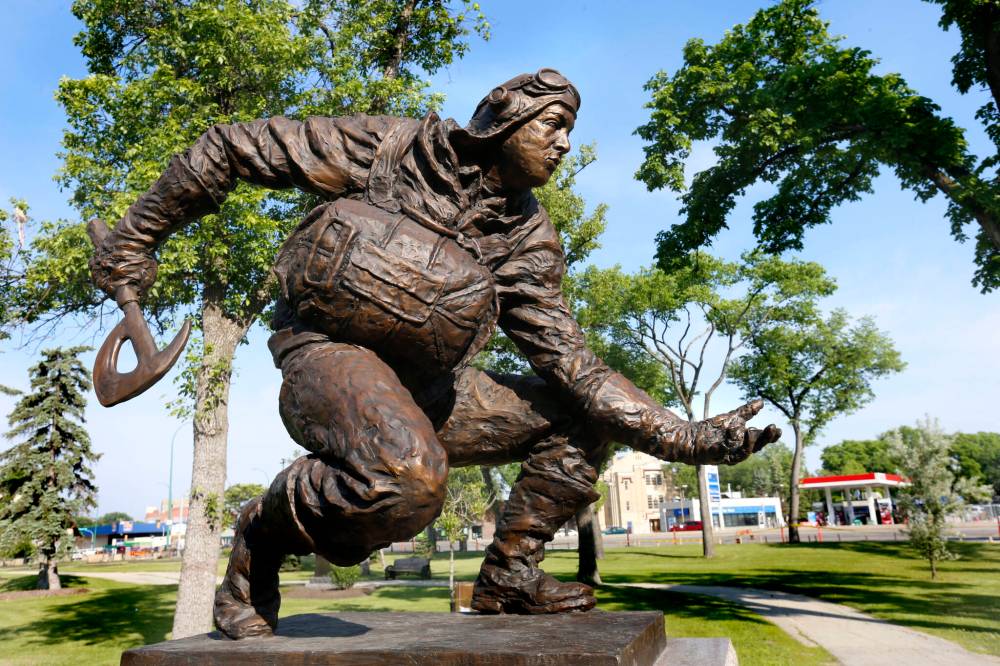
A statue in Vimy Ridge Park honouring Andrew Mynarski was unveiled in 2015.
Dearest Mother,
Just dropping you a few lines to let you know that I am fine and in the best of health, so I hope you are all the same at home. And how is your leg ma. I hope it is not bothering you. And how is Bob getting on at work and Stephie and Caroline and Wanda (Mynarski’s sibling) and dear Vickie (Victoria Safain, his fiancée) and give everyone all my love and to you ma. And I do miss you all. Well ma I suppose you have read about the invasion. We were over for three nights in a row. We started Tuesday morning just before the invasion started bombing the French coast and we did it the next two nights. The trips (sic) quite exciting for me. We would take off about one or two in the morning and return about five in the morning.
We are not flying tonight but might tomorrow night. So, I hope our trips are good as the others were. I hope it’s over real soon and that we can be back ma. I just can’t tell you how I wish its over. I sure would be glad to get back. I suppose everyone back home was quite excited about the invasion. I see that everything is going pretty good. So please don’t worry to (sic) much ma as everything is OK with me.
So, ma dear give everyone all my love. And to all the girls and all my love to Vickie and I do miss her very much. And I do miss you all and how is the weather.
Well ma darling I will be closing for now and love and kisses to you all. So long for now. Your loving son, Andrew.
All of Andrew Mynarski’s letters to his mother and siblings are kept in plastic sleeves inside a binder at the 17 Wing Heritage Office. The letters came with the Victoria Cross — which he was awarded posthumously in 1946 — and other memorabilia from his sister in the early 1990s, says Gord Crossley, 17 Wing heritage officer, who points out the letters were all written on different types of paper.
“At the bases in Canada and the U.K., the YMCA and different organizations set up huts where soldiers could go and relax, and they provided free writing materials; postage was free to the military. So they have that label at the top,” he says.
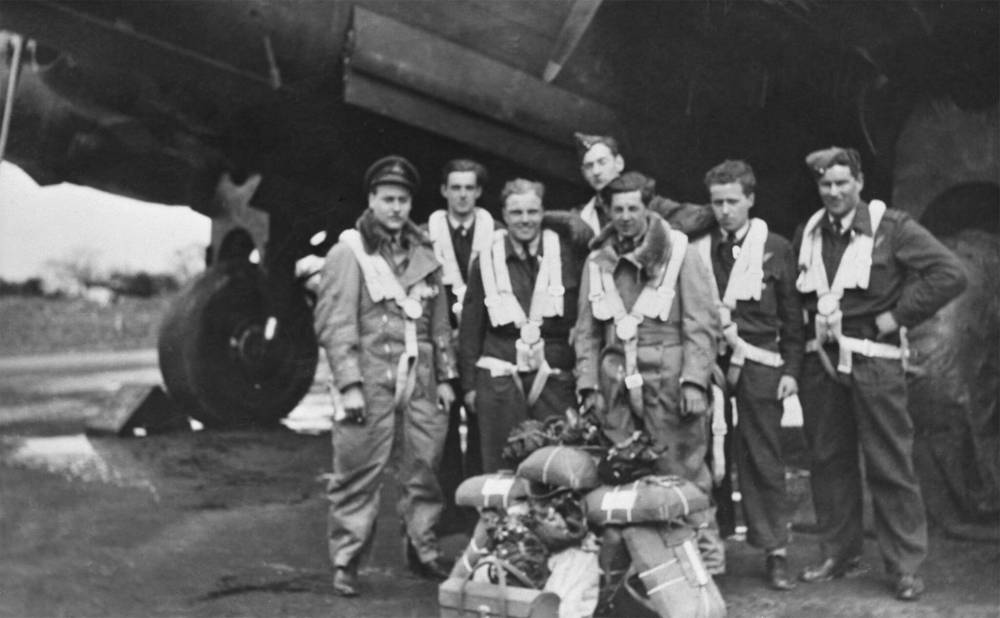
Mynarski’s flight crew (from left) Flight Officer G. Brophy, Pilot Officer W. Kelly, Flight Sergeant R. Vigars, Flight Officer A. de Breyne, Pilot Officer A. Mynarski, Pilot Officer J. Friday, Flight Officer A.R. Body.
The invasion Mynarski (Oct. 14, 1916 – June 13, 1944) referenced in his final letter was, of course, the Allied D-Day Invasion, codenamed Operation Neptune, launched on the coast of Normandy on June 6, 1944. The operation was a turning point in the Second World War, beginning the liberation of France and laying the foundations of the Allied victory on the Western Front.
A few nights later on June 12, 1944, during a raid on Cambrai, France, Lancaster B.Mk.X KB726 VR-A, of which Mynarski was the mid-upper gunner, was set aflame by a German fighter, notes a report on the incident.
This was Mynarski’s 14th operation.
“The captain ordered the crew to abandon the aircraft, but the rear gunner, Pilot Officer Pat Brophy, was trapped in his turret and Mynarski without hesitation made every effort to free him using a fire axe to try and pry open the doors ‘before finally resorting to beating at the turret with his hands,’ but was unsuccessful,” says the report.
“With Mynarski’s flight suit and parachute on fire, Brophy eventually waved him away. Mynarski crawled back through the hydraulic fire, returned to the rear door where he paused and saluted. He then reputedly said ‘Good night, sir,’ his familiar nightly signoff to his friend, and jumped.”
Brophy miraculously survived the crash of the burning plane, while Mynarski parachuted safely to the ground.
“However, he had suffered extensive burns. French farmers rushed him to a doctor but he died soon after,” the online source says,
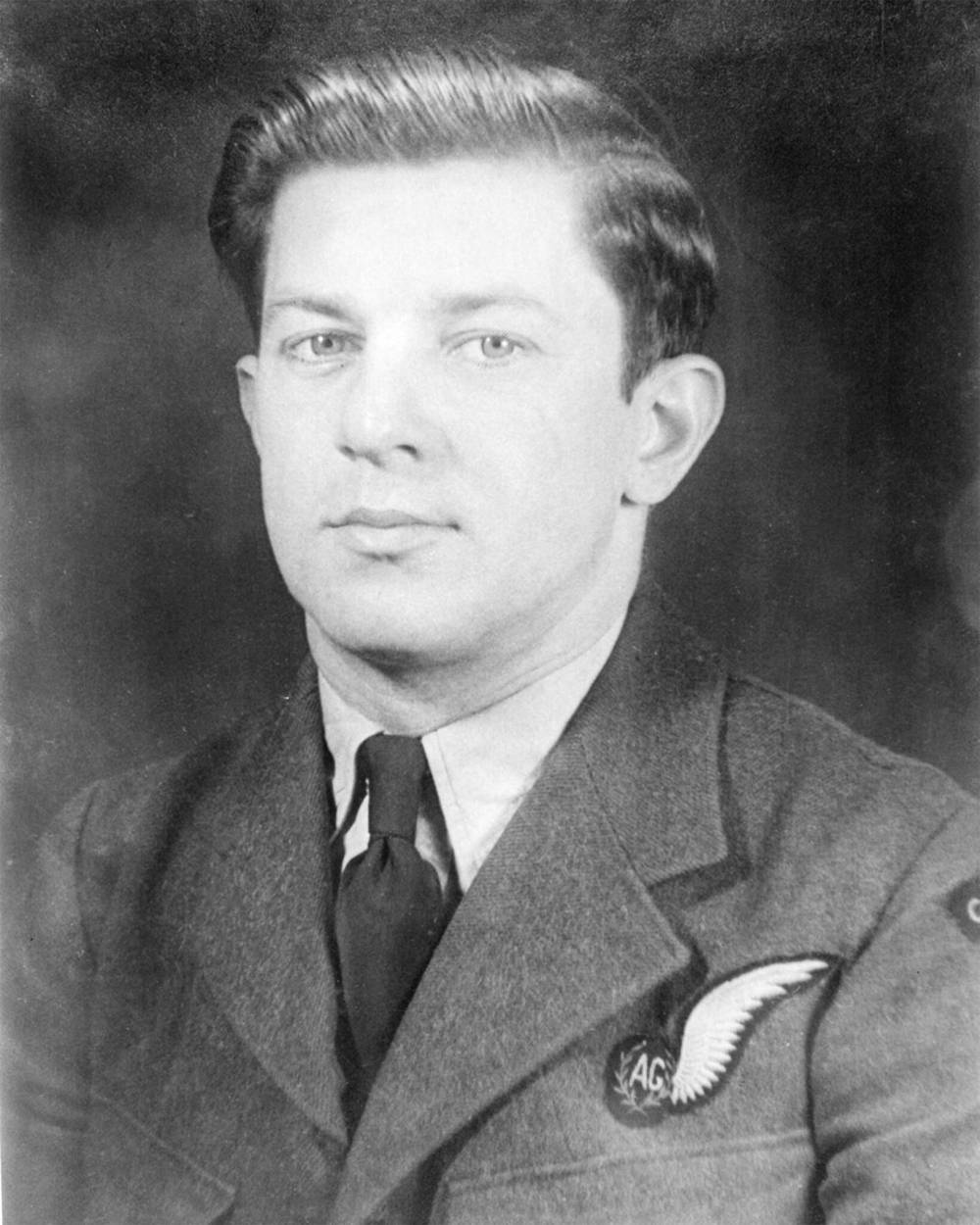
Mynarski was 27 years old when he died; he was buried at Méharicourt Communal Cemetery in France.
Mynarski was the first member of the RCAF in the Second World War to receive the Victoria Cross, Canada’s highest military honour, which he was awarded posthumously in 1946. The citation reads, in part, “He lost his life by a most conspicuous act of heroism which called for valour of the highest order.”
Flying Officer Monte Green of Winnipeg was in another 419 Squadron. Lancaster about 90 metres away and, as the bomb aimer in the front of the aircraft, witnessed the attacked, says a writeup in the “official” casualty book: “The starboard wing was completely on fire in seconds. The Lanc swerved toward us and we took evasive action. We were fairly low in our attack between 5,000 -8,000 feet, so the stricken Lanc hit the ground in seconds it seemed. I met several of the crewmen when they escaped back to Britain so heard what happened first-hand.”
Mynarski’s Victoria Cross was passed to Air Command in 1989 and is on display, along with several personal items, in the entrance foyer at the Mynarski Memorial Room of 1 Canadian Air Division in Winnipeg.
“We also have the Memorial Cross that was sent to his mother with his name on his back,” notes Crossley.
“We also have his Operational Wings, which is a small two winged pin with an ‘O’ for operations. Normally, you had to complete 30 operations to receive the Operational Wings, but if you were killed in action the badge was given to the next of kin.”
No. 419 Squadron in CFB Cold Lake also displays the original axe Mynarski used to try to free the jammed Lancaster turret; the axe was recovered from the Lancaster bomber at the crash site in northern France, Crossley says. This axe was recently moved to Winnipeg, and will be on display in 1 Canadian Air Division Headquarters.
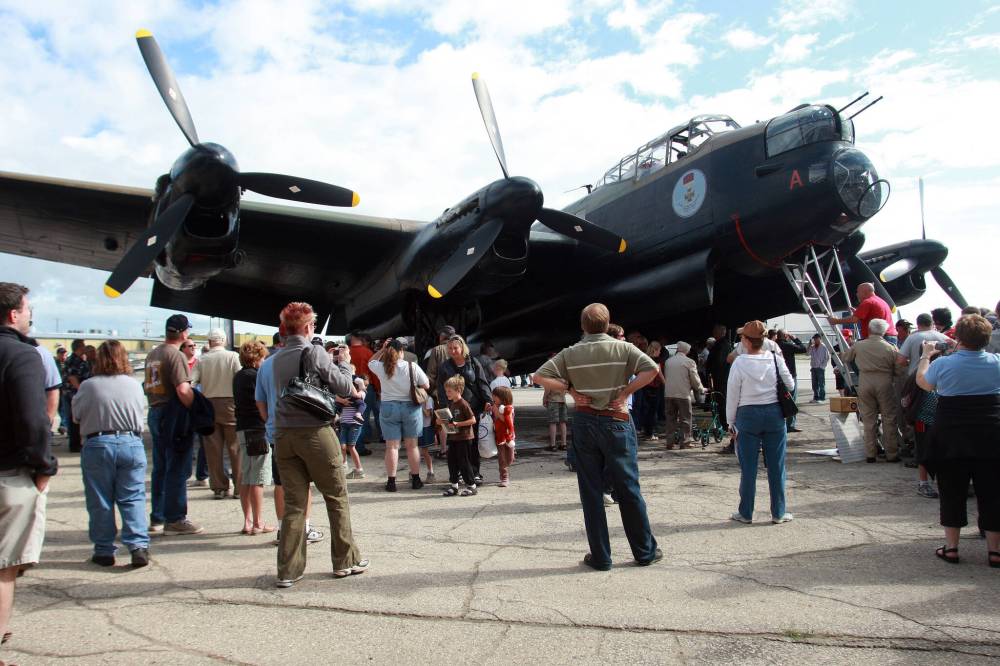
KEN GIGLIOTTI / FREE PRESS files
The Lancaster Bomber VRA, bearing the Victoria Cross of Andrew Mynarski, lands at the Western Canada Aviation Museum in 2009.
Over the decades, Mynarski, the son of Polish immigrants, has been commemorated in a number of ways. In 1974, he was among the first veterans inducted into Canada’s Aviation Hall of Fame in Calgary.
In 1988, the Canadian Warplane Heritage Museum in Mount Hope, Ont., unveiled a restored Lancaster and, with members of his crew in attendance, dedicated it to Mynarski’s memory.
A Winnipeg middle school, Andrew Mynarski V.C. School, and a chain of lakes in northern Manitoba (Mynarski Lakes) is named after him. A plaque was unveiled on June 12, 1994, near the Main Street entrance of Kildonan Park to comemorate the 50th anniversary of his death.
In June 2005, members of Mynarski’s crew were present when Corporal Pat Brophy’s daughter unveiled a three-metre bronze statue of Mynarski near the base where he served at Middleton St. George, England.
In 2006, 14 bronze statues formed Ottawa’s new Valiants Memorial to honour people who played major roles in Canadian conflicts; among them is Mynarski. The Andrew Mynarski VC Memorial Statue, which was created by artist Charlie Johnston, was dedicated in Winnipeg’s Vimy Ridge Memorial Park during a public ceremony on June 12, 2015.

Mynarski’s story was commemorated in a Heritage Minute by Historica Canada. At the 2014 Toronto International Film Festival and the 2015 Sundance Film Festival in Utah, local director and screenwriter Matthew Rankin screened his eight-minute Mynarski Death Plummet, a blend of animation and live action that tells of the Winnipegger’s heroism.
A graphic novel-style animation of Mynarski’s story can be seen at the 1 Canadian Air Division museum website, forvalour.ca, which also features the stories of all seven Canadian aerial VC winners.
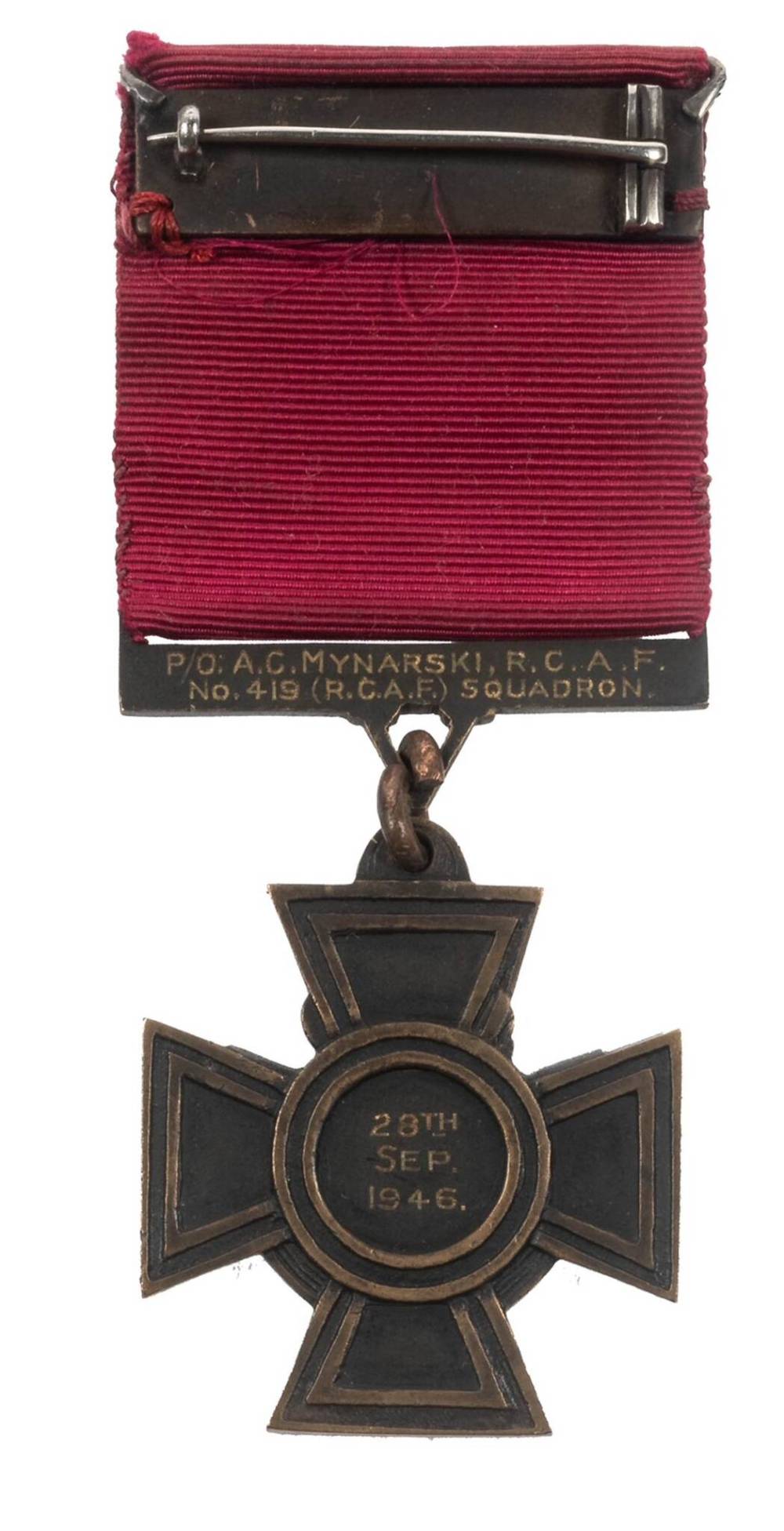
Pilot Officer Andrew Charles Mynarski Victoria Cross on June 13, 2019 at 17 Wing Winnipeg, MB Photo by Cpl Angela Gore, 17 Wing Imaging Winnipeg
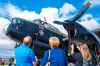
On July 16 and 17 the Lancaster from the Canadian Warplane Heritage Museum will be on view to the public at the Royal Aviation Museum of Western Canada. This aircraft is painted to represent the aircraft in which Mynarski performed his heroic deed.
Mynarski’s letters and photographs can be viewed by emailing Gord Crossley at gordon.crossley@forces.gc.ca.
Martin Zeilig is a freelance writer and the photo journalist at The Voxair, the online publication at 17 Wing CFB Winnipeg. For more information, see www.17wingvoxair.com.
Related Articles
Kinew to visit Juno Beach for 80th anniversary of D-Day


Advertisement Advertise With Us
Advertisement Advertise With Us