Coffee, sculptures and financial advice. Banks try to make new branches less intimidating
Advertisement
Read this article for free:
or
Already have an account? Log in here »
To continue reading, please subscribe:

Digital Subscription
One year of digital access for only $205*
- Enjoy unlimited reading on winnipegfreepress.com
- Read the E-Edition, our digital replica newspaper
- Access News Break, our award-winning app
- Play interactive puzzles
*First annual payment billed as $205.00 + GST for one year. This annual subscription will automatically renew at $233.00 + GST every 52 weeks (10% off the regular annual price of $259.35). Offer available to new and qualified returning subscribers only. Cancel any time.
To continue reading, please subscribe:
Add Free Press access to your Brandon Sun subscription for only an additional
$1 for the first 4 weeks*
- Enjoy unlimited reading on winnipegfreepress.com
- Read the E-Edition, our digital replica newspaper
- Access News Break, our award-winning app
- Play interactive puzzles
*Your next Brandon Sun subscription payment will increase by $1.00 and you will be charged $17.95 plus GST for four weeks. After four weeks, your payment will increase to $24.95 plus GST every four weeks.
Read unlimited articles for free today:
or
Already have an account? Log in here »
Hey there, time traveller!
This article was published 10/06/2024 (852 days ago), so information in it may no longer be current.
NEW YORK (AP) — It’s like Sephora or Starbucks now offered a checking account.
After years of closing or mostly neglecting physical bank branches across the U.S., the nation’s largest banks are spending hundreds of millions of dollars on refurbishing old locations or building new ones, and in the process changing the look, feel and purpose of the local bank branch.
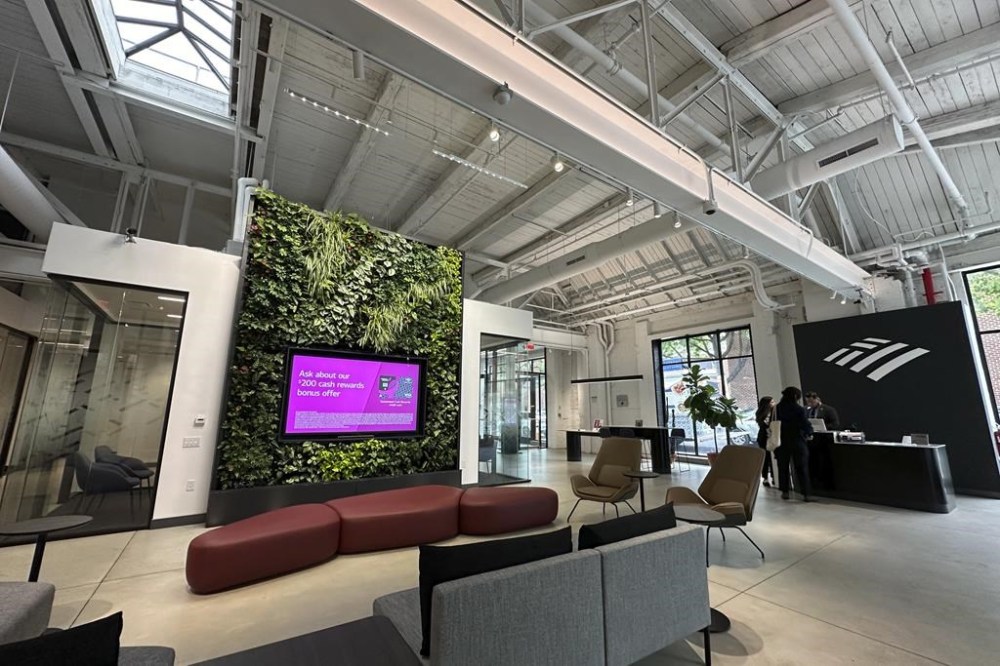
Many of these branches are larger, airier, and meant to feel more comfortable for those walking in with difficult financial questions. Others are being designed as “third spaces” to allow local nonprofits or community representatives to hold workshops or seminars for customers or neighbors. They are a contrast to the marble-clad temples to finance built 50 or 75 years ago and the stale cookie-cutter branches that more recently cluttered suburban malls.
“Coming into a branch can be intimidating. We’re now creating these spaces so everyone can feel welcome,” said Diedra Porché, the head of community and business development of consumer banking at JPMorgan Chase & Co.
Porche heads a team of 150 employees who work at what JPMorgan now calls “community centers,” which are larger branches that have areas for non-profits to do presentations to local residents and provide workshops to those seeking advice. The latest of these community centers opened in The Bronx in April, attended by New York local and state politicians as well as JPMorgan Chairman and CEO, Jamie Dimon.
JPMorgan isn’t alone in designing branches that are focused less on sales and more on providing advice. Capital One opened its latest “café” in Union Square in May, a space that serves coffee and baked goods and allows anyone, Capital One customer or not, to sit inside the café and work and network.
“Banking shouldn’t be that experience of someone sitting in a suit behind a desk talking about your loan application, but it should be someone who is sitting with you, offering to help you through those questions about money and finances,” said Jennifer Windbeck, head of Capital One’s retail bank channels and operations.
Banks such as JPMorgan Chase, Bank of America and Wells Fargo had been steadily closing branches since the 2008 financial crisis. They saw little need for their networks of thousands of physical locations when fewer Americans were entering a branch regularly for routine banking needs and ATMs had largely replaced tellers. In the branches that remained, customers often noticed threadbare carpet and well-worn office furniture and cubicles.
It seemed like the fate of the bank branch was sealed when the technological gains during the pandemic made it possible to buy a home or car without interacting physically with another human being. The U.S. banking industry is estimated to have closed roughly 4,000 branches since 2020, according to the National Community Reinvestment Coalition.
Policymakers and community advocates criticized the industry for closing so many branches after the financial crisis, particularly branches located in low income neighborhoods where financial services were often limited to check cashing stores, pawn shops and payday lending storefronts.
“When bank branches close, there are several adverse effects on the surrounding community. Small business lending and activity in the area declines. More people use alternative financial services that open them to unregulated and predatory financial practices. An important commercial tenant and employer are lost,” wrote researchers at the NCRC in a report in 2020 about the waves of bank branches shutting down.
Local bank branches are so important that even Congress got involved in the issue during the Civil Rights Era, passing the Community Reinvestment Act, a law partially designed to make sure banks had branches in poor neighborhoods the same way they did in rich neighborhoods.
The trend of branch closures may be reversing, or at least slowing. Chase is net adding new branches, while Bank of America has considerably reduced the rate of branch closures. Other large banks like Capital One and Wells Fargo are slowly adding branches as well. Banks are finding new uses for their branches, often in unexpected ways.
Despite the spread of digital banking, bankers and community groups still emphasize that physical branches are a necessity. Industry and independent research have shown Americans still want to enter a branch when it comes to big financial issues like buying a home or car, preparing for retirement, dealing with the financial impacts of marriage or divorce, or having a new child.
Some banks are even building new branches in unique locations that do not initially scream “this should be a bank.”
Bank of America, for example, brought in Rebekah Sigfrids from Sephora and Victoria’s Secret as its first in-house designer for branches instead of using traditional third-party contractors.

One example of Sigfrids’ work is a Bank of America branch opened in Williamsburg, Brooklyn, that was previously used as studio space for a sculptor. The clean, airy branch features sculptures by the artist who was previously in the space, as well as additional art from around the neighborhood.
“We’re now really thinking ‘how do we fit this branch into the community?’ Bank of America had its own look and feel but what about when we go into Williamsburg? What about if you’re going to be in downtown Manhattan, or Seattle or what if you’re in Texas?”
JPMorgan Chase has opened nearly 20 of what it now calls “community centers.” These are larger branches placed in low-and-moderate income neighborhoods designed to provide more comprehensive services to typically lower-income Chase customers.
Chase builds these centers with multipurpose areas to allow nonprofit organizations or Chase employees known as community managers to run workshops or financial education seminars for the community. The Chase employees are specifically instructed not to talk about Chase products as part of these workshops, in order to provide higher levels of trust, said Porché.
“We wanted to marry all of the traditional needs in a branch but expanding on that space to where customers can also get financial workshop and programming. These (new branches) should be an anchor for the community,” she said.