Harsh winters put an end to Halifax palm tree experiment begun in 2018

Advertisement

Advertise with us

HALIFAX - An unlikely experiment undertaken six years ago to see if palm trees could survive the fickle weather of Halifax came to an end this spring when the last two surviving trees failed to bloom.

Read this article for free:


or

Already have an account? Log in here »

To continue reading, please subscribe:

Subscribe and receive a limited-edition Free Press branded hat or tote.

Digital Subscription

One year of digital access for only $205*

  • Enjoy unlimited reading on winnipegfreepress.com
  • Read the E-Edition, our digital replica newspaper
  • Access News Break, our award-winning app
  • Play interactive puzzles

*First annual payment billed as $205.00 + GST for one year. This annual subscription will automatically renew at $233.00 + GST every 52 weeks (10% off the regular annual price of $259.35). Offer available to new and qualified returning subscribers only. Cancel any time.

To continue reading, please subscribe:

Add Free Press access to your Brandon Sun subscription for only an additional

$1 for the first 4 weeks*

  • Enjoy unlimited reading on winnipegfreepress.com
  • Read the E-Edition, our digital replica newspaper
  • Access News Break, our award-winning app
  • Play interactive puzzles
Start now

*Your next Brandon Sun subscription payment will increase by $1.00 and you will be charged $17.95 plus GST for four weeks. After four weeks, your payment will increase to $24.95 plus GST every four weeks.

Hey there, time traveller!
This article was published 10/06/2024 (804 days ago), so information in it may no longer be current.

HALIFAX – An unlikely experiment undertaken six years ago to see if palm trees could survive the fickle weather of Halifax came to an end this spring when the last two surviving trees failed to bloom.

The city initially planted nine trees in four parks on the Dartmouth side of Halifax Harbour in 2018, choosing varieties known to grow in more northerly climates of Asia, such as Japan and China, or in high-altitude areas such as northern India.

The trees included windmill and miniature Chusan palm, which are native to parts of Asia, needle palm from the southern United States and pindo palm, native to South America.
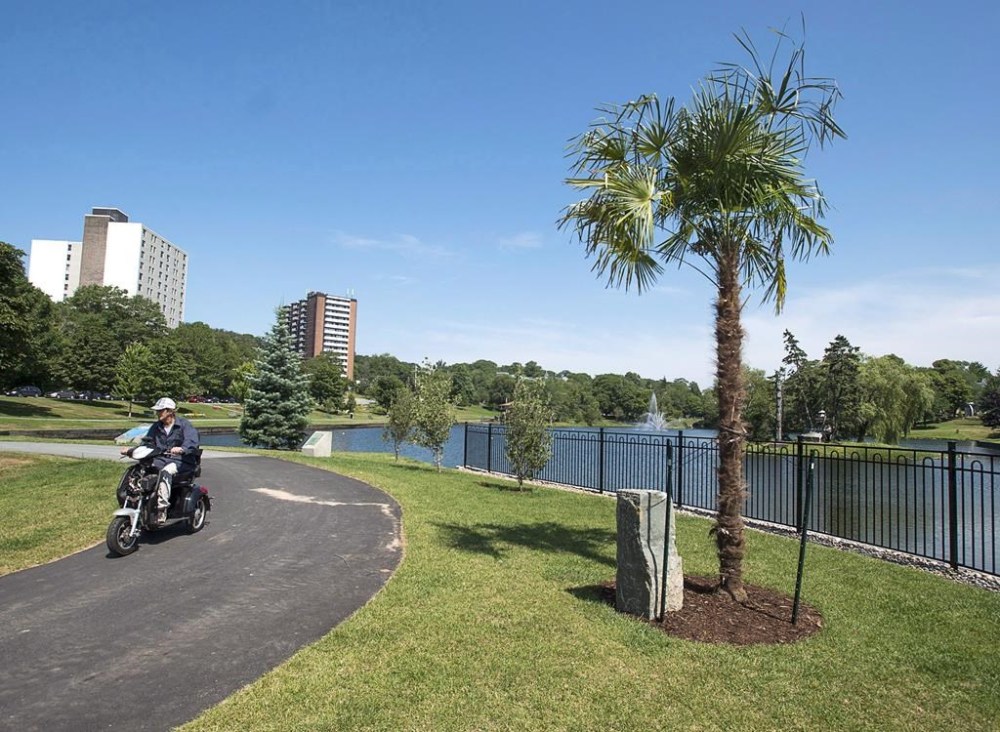
An experiment that began in 2018 to see if palm trees could survive in Halifax came to an end this spring when the last two trees failed to bloom. A palm tree is seen in a park in Dartmouth, N.S. on Wednesday, Aug. 1, 2018. THE CANADIAN PRESS/Andrew Vaughan

“Our winters proved to be a little too challenging for them,” said municipal spokesperson Ryan Nearing. “There was a little success, with some of them at least surviving a few winters.”

Five trees died by the end of winter 2021-22 despite the various methods used to try and protect them, Nearing said.

“That included surrounding the trunk with mesh or with wooden boxes,” he said. “Some of the leaves were taken off of the trees and were re-potted inside in greenhouses during the winter to see if maybe that would help preserve them a little bit more.”

Two trees died early on in the experiment and were subsequently replaced, although those trees didn’t survive either. The last of the trees — two windmill palms — were declared dead in April.

And while there are no plans for a similar experiment in the future, Nearing said the city continues to look for ways to introduce biodiversity into its green spaces.

“There are no plans for palm trees specifically, but our municipal gardeners at our greenhouses are always exploring potential new plants, new species that could be introduced,” he said, adding that the park spots that were chosen to grow the palm trees are now home to heartier tree species capable of surviving the winter.

Halifax has had varying degrees of success with exotic species such as coffee and pineapple plants. During the summer of 2018 an agave managed to briefly bloom in the city’s renowned Public Gardens, where it had been transplanted after being nurtured in a municipal greenhouse.

Meanwhile, palms have been successfully grown in Vancouver, where average temperatures are milder than in Atlantic Canada’s largest city.

Lord Abbey, an associate professor of horticulture at Dalhousie University who is based in Truro, N.S., said that although the Halifax palm tree experiment was “a good idea,” he’s not surprised by the outcome.

“Some (palms) can survive temperatures as low as -10 C, but it’s harder in a climate like Nova Scotia’s where temperatures can fall to much colder levels and where there is much fluctuation in temperature,” Abbey said.

There are zonal classifications for plant hardiness, and Abbey said palm trees can survive in zones seven to 11, while the zone that includes Halifax is classified as six.

Previous experiments have shown that tropical plants and trees can be grown in northern climates but doing so is difficult and requires the assistance of greenhouses.

“It’s worth trying, but it has to be done under research conditions,” Abbey said.

This report by The Canadian Press was first published June 10, 2024.
Report Error Submit a Tip

More Stories

Kinew’s message for PM: don’t back down

Niigaan Sinclair 5 minute read Preview

Kinew’s message for PM: don’t back down

Niigaan Sinclair 5 minute read Friday, Aug. 21, 2026

Let it be known that when Canada’s provinces and alcohol industries needed a defender, Canada’s first First Nations provincial premier was their greatest warrior.

This is, admittedly, a provocative opening line — referencing historical and cultural intersections and relying on a stereotype or two.

It’s impossible, however, not to see how important the nearly Canada-wide provincial-led ban on the sale of U.S. alcohol is to Manitoba Premier Wab Kinew.

It’s due to his stand on national matters like these that he’s become very popular — according to polls, the most popular premier in Canada — and has been empowered to take on the mantle of one of the captains of “Team Canada” on economic, political and domestic issues.

Read
Friday, Aug. 21, 2026

Frustration mounts as drug raids sweep problems out of downtown, into West End

Scott Billeck 7 minute read Preview

Frustration mounts as drug raids sweep problems out of downtown, into West End

Scott Billeck 7 minute read Friday, Aug. 21, 2026

West End business owners say their neighbourhood has been under siege for months, and some believe downtown police drug sweeps have made things worse by pushing more street disorder in their direction — and pushing customers away.

Read
Friday, Aug. 21, 2026

Canada vows dollar-for-dollar tariff retaliation, suspends trade talks with U.S.

Catherine Morrison, The Canadian Press 7 minute read Preview

Canada vows dollar-for-dollar tariff retaliation, suspends trade talks with U.S.

Catherine Morrison, The Canadian Press 7 minute read Updated: Yesterday at 8:27 AM CDT

OTTAWA - A last-ditch effort to reach a new trade deal before a midnight tariff deadline failed Friday, as Prime Minister Mark Carney suspended talks with the United States and summoned his negotiators back to Ottawa.

The decision meant new 50 per cent tariffs on billions of dollars in Canadian exports to the U.S. took effect at 12:01 a.m., and Carney vowed Canada would retaliate with equal measures of its own.

"In recent weeks, we made important progress toward improving Canada's position as having the best deal in the world with the U.S.," Carney said in a statement just before Trump's tariff deadline.

"However, that progress has not been enough to meet our objectives for Canadians."

Read
Updated: Yesterday at 8:27 AM CDT

The good, bad and record setting performance in Bombers loss to Elks

Joshua Frey-Sam 7 minute read Preview

The good, bad and record setting performance in Bombers loss to Elks

Joshua Frey-Sam 7 minute read Yesterday at 6:50 PM CDT

The Winnipeg Blue Bombers’ 22-19 defeat at the hands of the Edmonton Elks at Commonwealth Stadium in Alberta on Friday was fitting for all the wrong reasons.

The Bombers looked reinvigorated as they jumped out to a 16-point lead in the first half. Then some bad habits reared their ugly head, as the Elks roared back with 19 straight points before kicker Vincent Blanchard walked it off with a 40-yard field goal.

A night that began with so much promise left many fans to wonder what the ceiling actually is for this team in 2026.

On offence, Zach Collaros completed 19 of 30 passes for 219 yards, one touchdown and an interception; Brady Oliveira amassed 118 yards on 16 carries and added a pair of catches for 11 yards; and Nic Demski secured five grabs for 80 yards.

Read
Yesterday at 6:50 PM CDT

Wooed by wood, Cedarella founder takes pride in handcrafted designs

David Sanderson 8 minute read Preview

Wooed by wood, Cedarella founder takes pride in handcrafted designs

David Sanderson 8 minute read Yesterday at 6:00 AM CDT

Marina Bulan is the founder of Cedarella, a two-year-old venture that turns out eye-catching wood products such as jewelry, kitchen decor, children’s toys and, most recently, metre-high outdoor planters that double as home street-number indicators.

Ahead of immigrating to Winnipeg a decade ago from their native Russia, Bulan and her partner thought it would be prudent to conduct some research on their soon-to-be new home, a city they knew next to nothing about.

Imagine their surprise as they were viewing the 2007 surrealist film My Winnipeg, which comically blends historical facts about our burg with what Winnipeg-born writer/director Guy Maddin has termed “mystical hypothesizing.”

(For instance, there is no proof that, as reported in the award-winning flick, Winnipeg is the sleepwalking capital of the world, and that residents keep keys to their former abodes on their person in the event they turn up there during a bout of somnambulism.)

Read
Yesterday at 6:00 AM CDT

Five Things: PM Carney explains why Canada left the U.S. negotiating table

David Baxter, The Canadian Press 5 minute read Preview

Five Things: PM Carney explains why Canada left the U.S. negotiating table

David Baxter, The Canadian Press 5 minute read Updated: Yesterday at 1:58 PM CDT

OTTAWA - Canada is preparing to hit the U.S. with dollar-for-dollar tariffs in response to new 50 per cent duties on $28 billion worth of Canadian products that took effect when talks between the two nations collapsed as negotiations neared the finish line. 

Prime Minister Mark Carney was quiet publicly during the final days of negotiations, but now has now explained his rationale for telling the Canadian negotiating team, led by Canada-U.S. Trade Minister Dominic LeBlanc and chief negotiator Janice Charette, to leave the table.

Restrictions on further trade deals

"The U.S. Introduced at the last hours, in the last hours, efforts to restrict our ability to have other trade deals. You heard me say a moment ago, what we've accomplished in the past year, 20 new deals, economic and security partnerships, the prospect of doubling our market access because we believe in free trade. We're the partner of choice in many respects for countries around the world and the Americans wanted to restrict that. They had language that what they wanted to restrict that, unacceptable," Carney said during a press conference on Parliament Hill.

Read
Updated: Yesterday at 1:58 PM CDT