Environment Canada predicts warm summer across country, especially in East
Advertisement
Read this article for free:
or
Already have an account? Log in here »
To continue reading, please subscribe:

Digital Subscription
One year of digital access for only $205*
- Enjoy unlimited reading on winnipegfreepress.com
- Read the E-Edition, our digital replica newspaper
- Access News Break, our award-winning app
- Play interactive puzzles
*First annual payment billed as $205.00 + GST for one year. This annual subscription will automatically renew at $233.00 + GST every 52 weeks (10% off the regular annual price of $259.35). Offer available to new and qualified returning subscribers only. Cancel any time.
To continue reading, please subscribe:
Add Free Press access to your Brandon Sun subscription for only an additional
$1 for the first 4 weeks*
- Enjoy unlimited reading on winnipegfreepress.com
- Read the E-Edition, our digital replica newspaper
- Access News Break, our award-winning app
- Play interactive puzzles
*Your next Brandon Sun subscription payment will increase by $1.00 and you will be charged $17.95 plus GST for four weeks. After four weeks, your payment will increase to $24.95 plus GST every four weeks.
Read unlimited articles for free today:
or
Already have an account? Log in here »
Hey there, time traveller!
This article was published 11/06/2024 (820 days ago), so information in it may no longer be current.
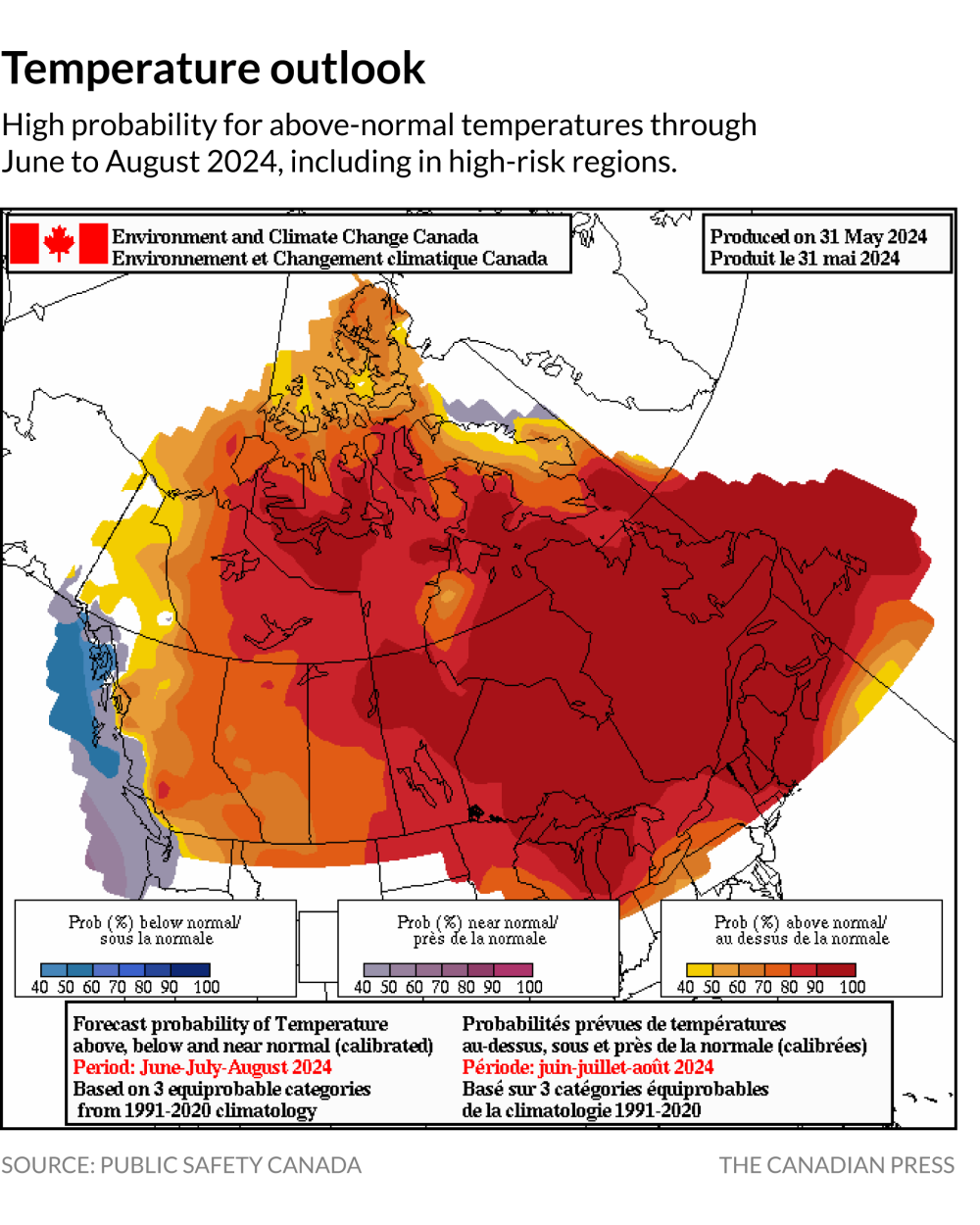
Environment Canada is predicting a warmer-than-usual summer across the entire country, with the greatest chance of high temperatures everywhere east of Manitoba.
“There is a high probability of above-normal temperatures for the summer season,” said meteorologist Jennifer Smith. “Above-normal temperatures are expected for the Prairies, but the probability isn’t as high as out East.”
The government agency released maps Tuesday suggesting the chance of a hot summer is virtually 100 per cent almost everywhere east of the Ontario-Manitoba boundary. That probability falls to as low as 50 per cent in Alberta.
Coastal British Columbia and Yukon are the only parts of Canada for which normal temperatures are forecast.
Still, the usual weather of a Canadian summer is expected — that is, a little bit of everything.
“Daily weather will vary,” said Smith. “Expect heat waves, cool spells and all the fluctuations that summer brings.”
No such simple pattern presents itself for precipitation.

“The climate models are not able to make reliable predictions,” Smith said. “There is no clear signal.”
Predicting rainfall is much harder than precipitation, said Smith, who compared long-range rain forecasts to trying to predict where individual particles of milk go when you drop them in a cup of coffee.
“The science is there but the ability to measure what’s happening in the atmosphere everywhere at all times is not.”
Those higher temperatures will have an effect on wildfires. Heat will dry up soils, and mountain snowpacks are already melting earlier in the year than they used to.
“Our colleagues at (Natural Resources Canada) are predicting increased wildfire risk for Central Canada in the later part of the summer,” said Environment Canada climatologist Nathan Gillett.
The department plans to offer new products this summer.
A website called FireWork, expected to be running by the end of next month, would pinpoint sources of smoke and predict where it would drift over the next three days. It would be accompanied by an advisory scale describing the severity of the threat.
Users could set it to issue an advisory when smoke levels pass whatever threshold they consider safe or comfortable.
The agency is also developing a rapid response climate change attribution system, which would allow scientists to calculate the probable contribution of climate change to any extreme weather event.
For example, last spring’s heat wave in Alberta, which saw temperatures of over 30 C when the average is about 18 C, was made at least twice as likely by the influence of climate change.
Gillett said that information would allow officials to target their response to such events. If you’re rebuilding a bridge, he said, it’s useful to know if climate change played a role or if it’s natural variability.
Gillett said climate is already taking effect. Temperatures have risen since 1948, he said.
“Warming has been observed from coast to coast in summer,” he said. “The human-induced warming explains almost all the observed warming.
“The signal of climate change on warming in Canada is clear.”
This report by The Canadian Press was first published June 11, 2024.