How AI could help farming become more efficient and sustainable
Advertisement
Read this article for free:
or
Already have an account? Log in here »
To continue reading, please subscribe:

Digital Subscription
One year of digital access for only $205*
- Enjoy unlimited reading on winnipegfreepress.com
- Read the E-Edition, our digital replica newspaper
- Access News Break, our award-winning app
- Play interactive puzzles
*First annual payment billed as $205.00 + GST for one year. This annual subscription will automatically renew at $233.00 + GST every 52 weeks (10% off the regular annual price of $259.35). Offer available to new and qualified returning subscribers only. Cancel any time.
To continue reading, please subscribe:
Add Free Press access to your Brandon Sun subscription for only an additional
$1 for the first 4 weeks*
- Enjoy unlimited reading on winnipegfreepress.com
- Read the E-Edition, our digital replica newspaper
- Access News Break, our award-winning app
- Play interactive puzzles
*Your next Brandon Sun subscription payment will increase by $1.00 and you will be charged $17.95 plus GST for four weeks. After four weeks, your payment will increase to $24.95 plus GST every four weeks.
Read unlimited articles for free today:
or
Already have an account? Log in here »
Hey there, time traveller!
This article was published 16/06/2024 (835 days ago), so information in it may no longer be current.
At Nature Fresh Farms in Leamington, Ont., there’s something new amid the rows of tomatoes, cucumbers, peppers and strawberries.
Using thousands of sensors in every greenhouse, artificial intelligence technology is helping the farm optimize aspects like lighting, irrigation and harvest timing.
“We wanted to use technology to help us grow more, have a better-tasting vegetable, and just do more in general,” said Keith Bradley, vice-president of information technology and security at Nature Fresh Farms.
The technology from Intel and Dell is helping the farm be proactive instead of reactive, he said, increasing the yields of its crops and reducing its use of power and water. It’s even helping employees have a better work-life balance, he added.
Amid ongoing research into AI’s potential benefits for agriculture, farms like Nature Fresh are on the frontlines of adoption.
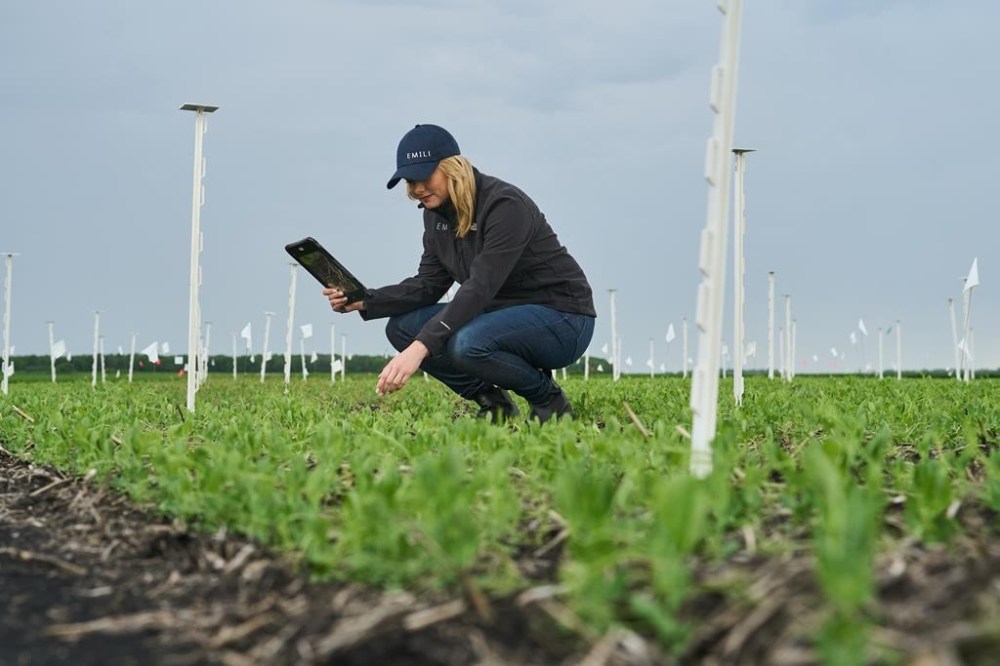
Farmers already use an array of technology, with some having adopted high-tech tools such as drones to survey farms and look for information on weeds, pests and disease, said Jacqueline Keena, managing director at industry-led nonprofit Emili. The organization operates Innovation Farms, a “smart farm” where new technologies are tested and demonstrated near Winnipeg.
The next phase of that technology involves AI models using that data to make inferences, predictions and even decisions, said Keena — and AI enables agriculture to become “hyper-optimized” down to a more specific level than before.
The technology is becoming more sophisticated, moving from simple rules-based systems to large language models, said Rozita Dara, an assistant professor in the University of Guelph’s School of Computer Science and the director of the Artificial Intelligence for Food initiative.
This has applications for precision agriculture, she said, which involves analyzing data from sensors to make decisions about things like how much water or fertilizer to use. AI can be used to make increasingly complex decisions that have long been made by humans, she said.
AI can help address issues like labour shortages and climate challenges, said Darrell Petras, CEO of the Canadian Agri-Food Automation and Intelligence Network.
As an example, his group is invested in a company called Croptimistic, Petras said, which gathers data from the field to detect pests, changes in crop colour, and other potential stressors on the crop.
AI “can determine if there’s a stressor happening earlier than … the human eye can pick up and then the management intervention can happen much more quickly,” he said.
AI also has potential uses in grading grain in the field, which can help the farmer figure out when to harvest the crop and what to expect when they go to sell it, added Petras.
It can also be used to mitigate the effects of a changing climate, he said.
A lot of the research into AI and agriculture is done at post-secondary institutions, said Petras, but it then needs to be tested in the field. This often is done through a “commercialization vehicle,” he explained, whether it’s a startup company or an existing firm.
There is a network of so-called smart farms across Canada, led by Olds College of Agriculture & Technology in Alberta, whose purpose is to test and demonstrate emerging agricultural technologies.
One of the farms in the network is Emili’s Innovation Farms.
“We really show how they work in a commercial setting, and in a way are being a bit of a risk mitigator as we try out these technologies … and then share with others, including other farmers, how they actually work as a means to accelerate the adoption and full integration of those new technologies,” said Keena, of Emili.
Another one of the smart farms is at Olds College, where Felippe Karp is conducting research into how to develop standards for data collection and processing to build AI models.
AI models are only as good as their datasets, explained Karp, who is a research associate at the college and a PhD candidate in bioresource engineering at McGill University. His focus right now is on measuring and predicting variability of soil nutrients.
“With this data set, we trained an artificial intelligence model … and used that to predict the availability of nutrients in the soil.”
It takes time to find out whether new technology or a new approach has affected a crop, said Dara, and this can be a barrier to adoption for farmers.
“Sometimes … it’s within a year, within a season or within a few years,” she said.
Farmers often get just “one shot” at a crop each year, Keena said.
“And so we can’t ask them to take big risks on integrating new technologies at scale as part of their operations in things that are unproven.”
“Innovation Farms … addresses a piece of one of the barriers of people needing to be able to see these technologies rolled out in a full scale and commercial way ahead of being able to adopt them themselves.”
Farmers’ trust levels are also a barrier, said Dara, especially since with AI sometimes the decision-making process isn’t clear.
Data is paramount to AI models, she added, but farmers need to be better incentivized to share their data in order to make the technology better.

Farmers can be resistant to sharing their own data, said Karp: “That’s one of the challenges we face when we talk about developing more complex models.”
But over time, Petras said he’s seeing an uptick in engagement from farmers.
“Farmer engagement is absolutely critical” to developing AI tools for agriculture, he said, which can include field demonstration days, conferences and workshops, he said.
“If they’ve seen it demonstrated, essentially in their backyard through a smart farm, well, then we’re that much further ahead toward adoption.”
This report by The Canadian Press was first published June 16, 2024.
Related Articles
Canada is a force in AI research. So why can't we commercialize it?
Advertisement Advertise With Us
Advertisement Advertise With Us