

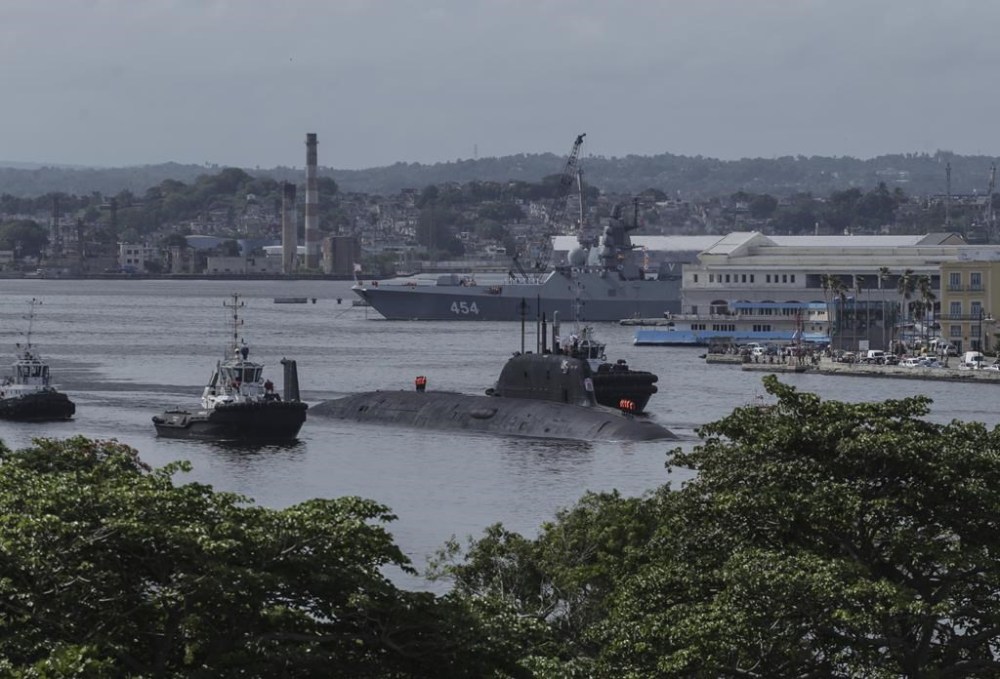
Russian warships leave Havana’s port after a 5-day visit to Cuba
Advertisement
Read this article for free:
or
Already have an account? Log in here »
To continue reading, please subscribe:

Digital Subscription
One year of digital access for only $205*
- Enjoy unlimited reading on winnipegfreepress.com
- Read the E-Edition, our digital replica newspaper
- Access News Break, our award-winning app
- Play interactive puzzles
*First annual payment billed as $205.00 + GST for one year. This annual subscription will automatically renew at $233.00 + GST every 52 weeks (10% off the regular annual price of $259.35). Offer available to new and qualified returning subscribers only. Cancel any time.
To continue reading, please subscribe:
Add Free Press access to your Brandon Sun subscription for only an additional
$1 for the first 4 weeks*
- Enjoy unlimited reading on winnipegfreepress.com
- Read the E-Edition, our digital replica newspaper
- Access News Break, our award-winning app
- Play interactive puzzles
*Your next Brandon Sun subscription payment will increase by $1.00 and you will be charged $17.95 plus GST for four weeks. After four weeks, your payment will increase to $24.95 plus GST every four weeks.
Read unlimited articles for free today:
or
Already have an account? Log in here »
Hey there, time traveller!
This article was published 17/06/2024 (814 days ago), so information in it may no longer be current.
HAVANA (AP) — A fleet of Russian warships, including a nuclear-powered submarine, left Havana’s port on Monday after a five-day visit to Cuba following planned military drills in the Atlantic Ocean. The exercise has been seen by some as a show of strength by Moscow against the backdrop of tensions as U.S. and other Western nations support Kyiv in Russia’s war on Ukraine.
The submarine, a frigate, an oil tanker and a rescue tug slowly departed from the port on Monday morning.
It’s unclear what the fleet’s next destination is or where it will dock next in the Caribbean, although U.S. officials said days ago that the vessels could possibly also stop in Venezuela.

Officials with the Biden administration said last week that they were monitoring the vessels and confirmed that they did not pose a threat to the region or indicate a transfer of missiles. Still, the United States docked a submarine, the USS Helena, at its Guantanamo Bay Naval Base in Cuba.
The American naval base, located in the southeastern part of the island about 1,000 kilometers (625 miles) from the capital of Havana, is considered by the Cuban government to be illegally occupied territory.
Last week, the Russian ships arrived at the port after the Russian Ministry of Defense reported that the fleet successfully conducted military drills in the Atlantic Ocean, simulating a missile attack on targets that could be more than 600 kilometers (375 miles) away.
The fleet, made up of the frigate “Gorshkov,” the nuclear-powered submarine “Kazan,” the tanker “Pashin,” and the tug “Nikolai Chiker,” was received in Havana with a 21-gun salute.

Cuban President Miguel Díaz-Canel visited the frigate on Saturday and interacted with the sailors, according to a post by the president on the social media platform X, formerly known as Twitter.
Meanwhile, Cuban Deputy Foreign Minister Carlos Fernández de Cossío rejected the presence of the American submarine at Guantanamo Base, stating it was unwelcome and uninvited.
A State Department spokesperson said last week that Russia’s port calls in Cuba are “routine naval visits” and do not pose any danger.
On Thursday, a day after arriving, hundreds of people lined up to visit the frigate. The ship was also open to the public on Saturday, which is a common practice when vessels arrive at the port.
Canada’s navy patrol boat Margaret Brooke entered the Havana harbor on Friday.