

Behind enemy lines
Couple worked as Allied saboteurs fostering resistance against Nazis in France
Advertisement
Read this article for free:
or
Already have an account? Log in here »
To continue reading, please subscribe:
Digital Subscription
One year of digital access for only $1.44 a week*
- Enjoy unlimited reading on winnipegfreepress.com
- Read the E-Edition, our digital replica newspaper
- Access News Break, our award-winning app
- Play interactive puzzles
*Billed as $5.77 plus GST every four weeks. After 52 weeks, price increases to the regular rate of $19.95 plus GST every four weeks. Offer available to new and qualified returning subscribers only. Cancel any time.
To continue reading, please subscribe:
Add Free Press access to your Brandon Sun subscription for only an additional
$1 for the first 4 weeks*
- Enjoy unlimited reading on winnipegfreepress.com
- Read the E-Edition, our digital replica newspaper
- Access News Break, our award-winning app
- Play interactive puzzles
*Your next Brandon Sun subscription payment will increase by $1.00 and you will be charged $17.95 plus GST for four weeks. After four weeks, your payment will increase to $24.95 plus GST every four weeks.
Read unlimited articles for free today:
or
Already have an account? Log in here »
Hey there, time traveller!
This article was published 22/06/2024 (708 days ago), so information in it may no longer be current.
This is the extraordinary chronicle of the potency of love when it is really most inconvenient.
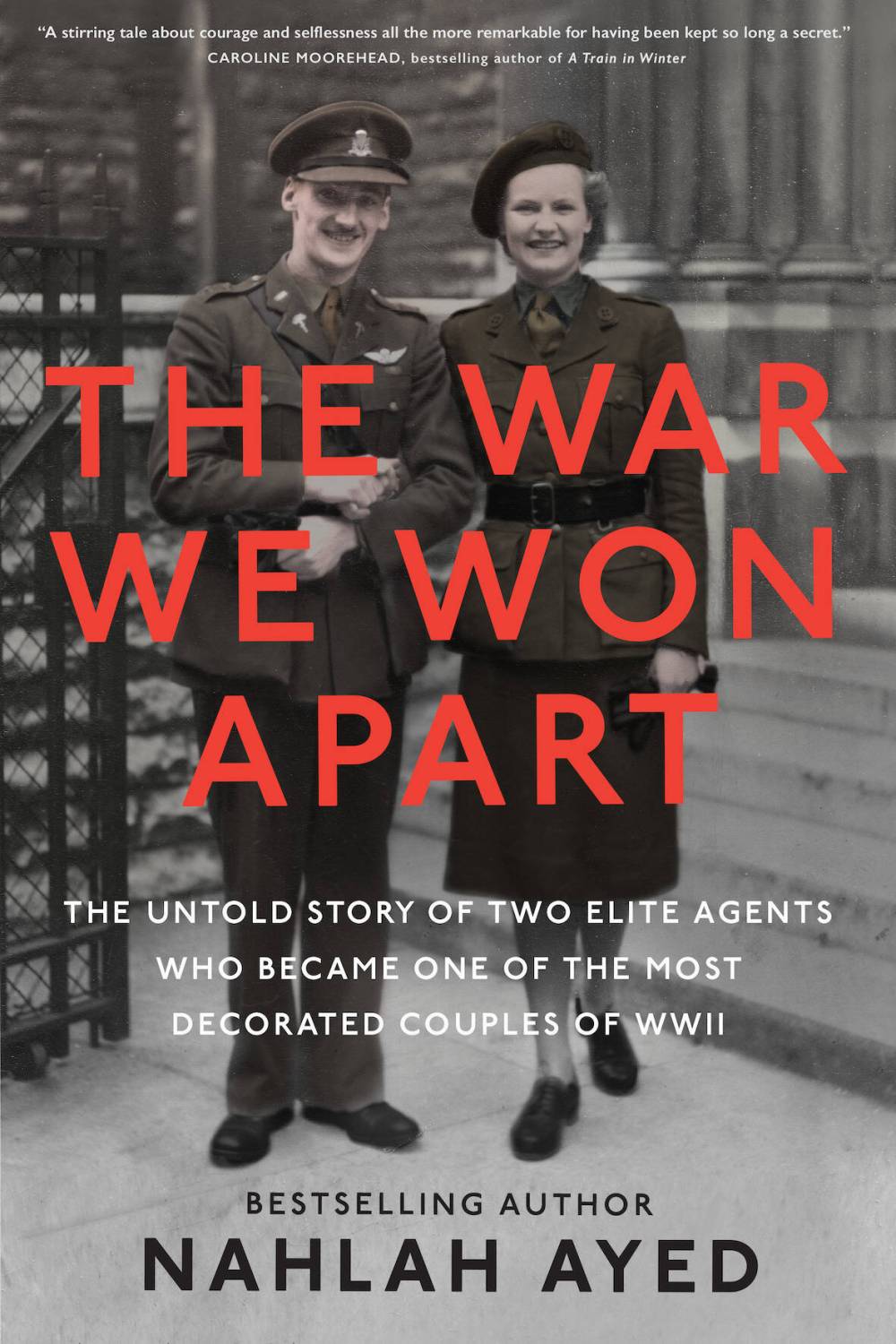
The War We Won Apart is a fervent masquerade of men and women with false identities dropping from the skies over France in the Second World War to conduct an orchestra of killing.
It is especially an autopsy of two people’s war— Britain’s Sonia Butt and French-Canadian soldier Guy d’Artois — who meet for the first time and fall hard for each other in the most unlikely of places: a spy school in the highlands of Scotland.
Jet Belgraver photo
Nahlah Ayed
Butt, d’Artois and others are being prepared to marshal French resistance forces and, if it comes to it, kill the occupying Germans and their quislings with their bare hands. And before they parachute into this mire of uncertainty, they’re given suicide pills — just in case.
Author Nahlah Ayed excels in her intermarriage of action and human emotion in the unveiling of the brave parachutists who joined, encouraged and co-ordinated the friendly local French to terrorize, confuse, corrupt and cripple the Nazi troops in their country and turn their enemy’s morale, communications and transport to rubble.
Much of this stealth and death is to help the upcoming D-Day landings on June 6, 1944 on the seaside beaches of Normandy. The more Germans killed or kept from the beaches, or even delayed, the better it’ll be for the Allied troops in their landing craft.
Meanwhile, separate from Sonia, Guy and his French compatriots are destroying bridges and rail lines and attacking German positions.
Sonia and Guy are members of an elite army of saboteurs, men and women, some from Canada, recruited to, in Winston Churchill’s words, “set Europe ablaze” by helping occupied countries and their resistance groups with money, munitions and on-site expertise. Thus was born the Special Operations Executive (SOE), to “bring Hitler down.” By D-Day, 220 SOE agents are at work in France.
Sonia Butt is a British civilian, hardly more than a teenager, who speaks French. Guy is older than her; he’s from Montreal. Shortly after getting married in London after training, their honeymoon ends with one parachuting into one area of France, followed shortly after by the other dropping into another enemy area in that besieged country.
Guy goes first. It is five weeks after their marriage and he carries a money belt holding a half-million francs for the French resistance. Sonia, now 20 and still afraid of heights, jumps second five days after Guy and nine days before D-Day.
The couple had yearned to jump together, and thought they were going to, but SOE changed its mind, and Guy was in the air even before Sonia knew it. She felt angry and betrayed, but the reason for SOE’s decision was that if the couple worked together in France and was captured, the Germans would have the advantage of torturing one in the face of the other and, under such pressure, one of them would presumably talk.
Back in training, officialdom had been reassuring: “We cannot guarantee your safety, but we think the chance of you being picked up (undercover in France) is very small.” But Ayed is closer to the truth when she says “There was… every chance they would never return.”
Later, among the surviving agents, they find out about fellow saboteurs shot in concentration camps, hung by piano wires and executed by firing squads. Other books about these operations are even more lurid in describing what could happen to enemy agents captured alive by the Germans. They describe torture by the Gestapo so bestial, so excruciating that death would be welcomed relief. Many of those captured and brutally interrogated who lived spent the rest of their lives emotionally crippled.

Courtesy of the d’Artois family
Sonia and Guy d’Artois together in London around the time of their marriage in April 1944.
Sonia and Guy get their feet wet as dangerous operatives in their clandestine groups of killers and saboteurs who want their country back from the Germans. The couple has been specially trained in the use of explosives. They don’t see each other for some time.
The War We Won Apart is an impressive work by an equally extraordinary Canadian writer, journalist and CBC personality who frames this story in a moving canvas of facts. Earlier, she was a notable foreign correspondent for the network. Ayed was born in Winnipeg.
“I came to the story of the Special Operations Executive very late. It was only in 2019 that I began to understand its unique role in the Second World War — and the significance of women, as well as Canadians, within it,” Ayed writes.
Sonia becomes a deadly adversary in France by mingling as a friend with German soldiers in cafés and restaurants as she co-ordinated ambushes to kill them. One time she was followed by two German soldiers and was raped by one of them.
Ayed’s research is exhaustive. Her list of references runs to 53 pages in small type.
She gives an example of the anonymous cruelty of war. “Some 14,000 young Canadians would land on the beaches (on D-Day) and more than 350 of them would be cut down in an instant,” she writes.
A story in the Globe and Mail on Dec. 20, 1944 sparked controversy about how Guy acted in France. He was quoted as saying: “We lined up 58 Germans … and then we shot them. And then we sent word to the (German) commandant and told him that if he killed any more of our wounded we would kill twice 58 Germans. He did not kill any more of our wounded.” Guy later said he wasn’t directly involved in the killings.
The day before Sonia parachuted into France, she attended a last briefing in London and was given an envelope containing a handful of pills. The white ones would give her more energy, and the blue one would kill her in three minutes.
Says Ayed: “Worried that she might forget which was which, Sonia flushed them all down the toilet before leaving for the airfield.”
The War We Won Apart
Guy was 81 when he died in 1999. Sonia followed in 2014. She was 90.

There is so much more in this well-written book than can be described here, including Guy’s time two years before Sonia as a sergeant in Canada’s famed Royal 22nd Regiment, then an officer in the storied First Special Service Force (half American, half Canadian) with the Canadians selected being the toughest, most lethal warriors their army could find. It was about then he got what he always wanted: paratrooper wings. Later, the unit would brilliantly live up to its nickname “The Devil’s Brigade.”
But with D-Day not that far off, Guy was recruited by the SOE, and the rest is history.
With the war still raging, Sonia was visiting her father in London when a bomb struck her hotel. She would have been killed. She was pregnant. She thought of the debilitating wartime rationing and wanted to give her child a good start in life. She thought of her own family. She said: “my little brother, who was about two at the time, had yet to know what a banana was.”
Sonia’s first child was born in Montreal, where she and Guy had settled, about two months before the war ended. Five other children followed.
Barry Craig is a former journalist. Right after the war, as a seven-year-old, he came to Canada with his family from Glasgow, Scotland. The first thing they did once ashore was head for an eatery. He ordered a banana and started to eat it skin-on.