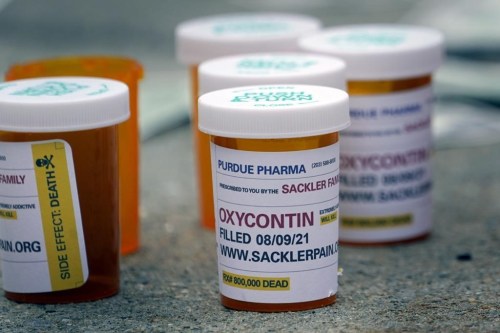
The legal odyssey for OxyContin maker Purdue Pharma and its owners is complex. Here’s what to know
Advertisement
Read this article for free:
or
Already have an account? Log in here »
To continue reading, please subscribe:
Digital Subscription
One year of digital access for only $1.44 a week*
- Enjoy unlimited reading on winnipegfreepress.com
- Read the E-Edition, our digital replica newspaper
- Access News Break, our award-winning app
- Play interactive puzzles
*Billed as $5.77 plus GST every four weeks. After 52 weeks, price increases to the regular rate of $19.95 plus GST every four weeks. Offer available to new and qualified returning subscribers only. Cancel any time.
To continue reading, please subscribe:
Add Free Press access to your Brandon Sun subscription for only an additional
$1 for the first 4 weeks*
- Enjoy unlimited reading on winnipegfreepress.com
- Read the E-Edition, our digital replica newspaper
- Access News Break, our award-winning app
- Play interactive puzzles
*Your next Brandon Sun subscription payment will increase by $1.00 and you will be charged $17.95 plus GST for four weeks. After four weeks, your payment will increase to $24.95 plus GST every four weeks.
Read unlimited articles for free today:
or
Already have an account? Log in here »
Hey there, time traveller!
This article was published 27/06/2024 (850 days ago), so information in it may no longer be current.
Members of the Sackler family who own OxyContin maker Purdue Pharma have been cast as prime villains in the U.S. opioid epidemic.
The Supreme Court on Thursday rejected a deal for the company to settle thousands of lawsuits over the toll of opioids through bankruptcy court. The deal was to be financed largely through the company being converted to a public benefits corporation, with profits being used to fight the opioid crisis, and the owners kicking in up to $6 billion for the same purpose.
But in a 5-4 ruling, the court rejected the plan because it would have extended protection from civil lawsuits to company owners who didn’t seek bankruptcy protection themselves — and not all the parties agreed to that.

Here’s a look at the family, the Stamford, Connecticut-based company the overdose crisis:
The opioid crisis deepened after OxyContin hit the market and has grown more complex
Deaths from opioids started rising in the years after the powerful prescription painkiller debuted in 1996.
The drug was marketed to doctors as having a low risk of addiction.
Deaths linked to prescription opioids, including OxyContin, which came in high dosages and in its original formulation was easily crushed to make it even stronger, rose rapidly until 2011 — when more controls were put on prescriptions and there were more crackdowns on illegal sales — and have fluctuated since then. When those leveled off, deaths from heroin started to skyrocket. And as heroin fatalities dropped in the late 2010s, there were a growing number of deaths linked to fentanyl and other potent, illicit, lab-produced opioids.
The number of U.S. overdose deaths from all drugs dropped last year for just the second time in three decades, according to provisional data.
Still, overdose deaths remain near a record high. The 2023 total is projected to be above 107,000, with about three-quarters of those involving opioids.
About twice as many people in the U.S. are now dying each year from opioid overdoses as from car crashes.
Purdue’s owners pushed for more sales
Three physician brothers — Arthur, Mortimer and Raymond Sackler — bought the drug company known as Purdue Frederick in 1952. Arthur, the oldest, was a pioneer of marketing drugs, including Valium, to doctors. His descendants sold their share of the company after his death in 1987, years before OxyContin hit the market.
The other brothers and their heirs continued to hold seats on the company’s board until the last of them resigned in 2019, ahead of efforts to settle the thousands of lawsuits the company was facing claiming the company was deceiving doctors and the public about the risks of OxyContin. They are still the owners, though they have not received profits in years.
Documents made public as part of lawsuits showed that family members pushed for more sales of OxyContin, which ultimately made them billions.
At the time of the drug’s 1996 launch, Richard Sackler, a son of Raymond who was then a Purdue executive and later became president and board chair, told the company’s sales force at a meeting that there would be “a blizzard of prescriptions that will bury the competition.”
Five years later, as it was apparent that the drug was being misused in some cases, he said in an email that Purdue would have to “hammer on the abusers in every way possible,” calling them “the culprits and the problem.”
The crisis pulled the family into an unwanted spotlight
The Sacklers have been ranked as one of the country’s wealthiest families and have largely kept a low profile. One exception: They contributed millions to cultural and educational institutions and got their names on places including galleries in New York’s Metropolitan Museum of Art, the Louvre in Paris and a school at Tufts University. Many of those places have removed the Sackler name over the last five years.
At a hearing in 2021, Richard Sackler said that he, the family and the company bore no responsibility for the opioid crisis. In the same hearing, a cousin, Mortimer D.A. Sackler, expressed some sympathy, saying, “We’re sorry if a medicine that we put out that was intended to relieve pain caused pain.”
The next year Richard and two other family members appeared remotely for an unusual court hearing in which a woman who lost a son to overdose called them “scum of the earth.”
Amid the lawsuits, the family and company made deals
Beset by the lawsuits, Purdue and its owners took a series of major steps.
By early 2019, the Sackler family members left the board. And by the end of the same year, the company filed for bankruptcy as part of a move to negotiate a settlement of all those suits.
The deal they eventually reached called for family members to contribute up to $6 billion over time — representing around half the family’s collective fortune — to fight the crisis, with at least $750 million of that going to individual victims in payments ranging from about $3,500 to $48,000.
The Sacklers would also give up ownership of Purdue, and the company would become known as Knoa Pharma, a business structured for its profits to battle the epidemic.
In exchange, family members would be protected from civil lawsuits.
In 2020 the company pleaded guilty to failing to maintain an effective program to prevent drugs from being diverted to the black market, providing misleading information to the DEA and paying doctors in a speakers program to encourage them to write more prescriptions. The plea was part of a deal with the federal government to settle criminal and civil cases that included $8.3 billion in penalties and forfeitures. But it was to pay only a small fraction — $225 million — so long as it executed the settlement through bankruptcy court.
Purdue is part of a broader set of lawsuits and settlements
OxyContin is the best known prescription opioid, but Purdue is hardly alone in producing the drugs and facing lawsuits.
Including Purdue’s proposed settlement, there has been more than $50 billion worth of opioid settlements with state, local and Native American tribal governments. The money is intended to be used to combat the crisis.
The companies involved have included drugmakers such as Johnson & Johnson and Teva; distributors including McKesson, Amerisource Bergen and Cardinal Health; and pharmacy chains including Walgreen Co., CVS Health and Walmart.
More recently there have been claims against pharmacy benefit managers such as Express Scripts and Optum Rx. Those companies have denied wrongdoing, and the cases have not yet gone to trial.