Emotions in motion Each movement in Indian classical dance Bharatanatyam conveys meaning
Read this article for free:
or
Already have an account? Log in here »
To continue reading, please subscribe:

Digital Subscription
One year of digital access for only $205*
- Enjoy unlimited reading on winnipegfreepress.com
- Read the E-Edition, our digital replica newspaper
- Access News Break, our award-winning app
- Play interactive puzzles
*First annual payment billed as $205.00 + GST for one year. This annual subscription will automatically renew at $233.00 + GST every 52 weeks (10% off the regular annual price of $259.35). Offer available to new and qualified returning subscribers only. Cancel any time.
To continue reading, please subscribe:
Add Free Press access to your Brandon Sun subscription for only an additional
$1 for the first 4 weeks*
- Enjoy unlimited reading on winnipegfreepress.com
- Read the E-Edition, our digital replica newspaper
- Access News Break, our award-winning app
- Play interactive puzzles
*Your next Brandon Sun subscription payment will increase by $1.00 and you will be charged $17.95 plus GST for four weeks. After four weeks, your payment will increase to $24.95 plus GST every four weeks.
Read unlimited articles for free today:
or
Already have an account? Log in here »
Hey there, time traveller!
This article was published 09/07/2024 (770 days ago), so information in it may no longer be current.
It’s Saturday morning at BRT Academy and Shylaja Ramprasath’s students are limbering up for Bharatanatyam lessons at the classical Indian dance and music studio.
Setting aside their modern accoutrements, earbuds and cellphones tucked away, they prepare to immerse themselves in worlds far removed from ones they usually inhabit.
Clad in jewel-coloured silks and brass bell anklets that ring with every step, their practiced hands apply makeup — a crucial part of the performance — paying special attention to the eyes.
In Bharatanatyam the entire body and face are in service to dance.
BROOK JONES / FREE PRESS Mayura Manivasan demonstrates a general dance pose while wearing a practice saree costume. Bharatanatyam dancers emote through movement, conveying shringara (love), hasya (laughter), karuna (compassion), veera (courage), bhayanaka (fear), bhibatya (disgust), raudra (anger), shantha (peace) and adbuta (amazement).
These preparations are an integral part of the lesson and will aid the dancers to better convey the mythological stories that structure the performance.
Considered one of the oldest forms of classical dance in the world, Bharatanatyam originated in Tamil Nadu, South India, nearly 2,000 years ago. Originally known as Sadiraattam, it was performed in temples as a form of devotion, connecting the human to the divine.
In the early 1930s it was rechristened to better describe the nature of the dance.
The word Bharatanatyam is a backronym of three elements: bha for bhavam, which means feelings or emotions; ra for ragam, referring to Carnatic melodies and music; and ta for talam, meaning rhythm or beats. All three combine with natyam, the Sanskrit word for dance.
BROOK JONES / FREE PRESS BRT Dance Academy dance instructor Shylaja Ramprasath is set to perform at the World Indian Dance Festival in Athens, Greece, on July 16.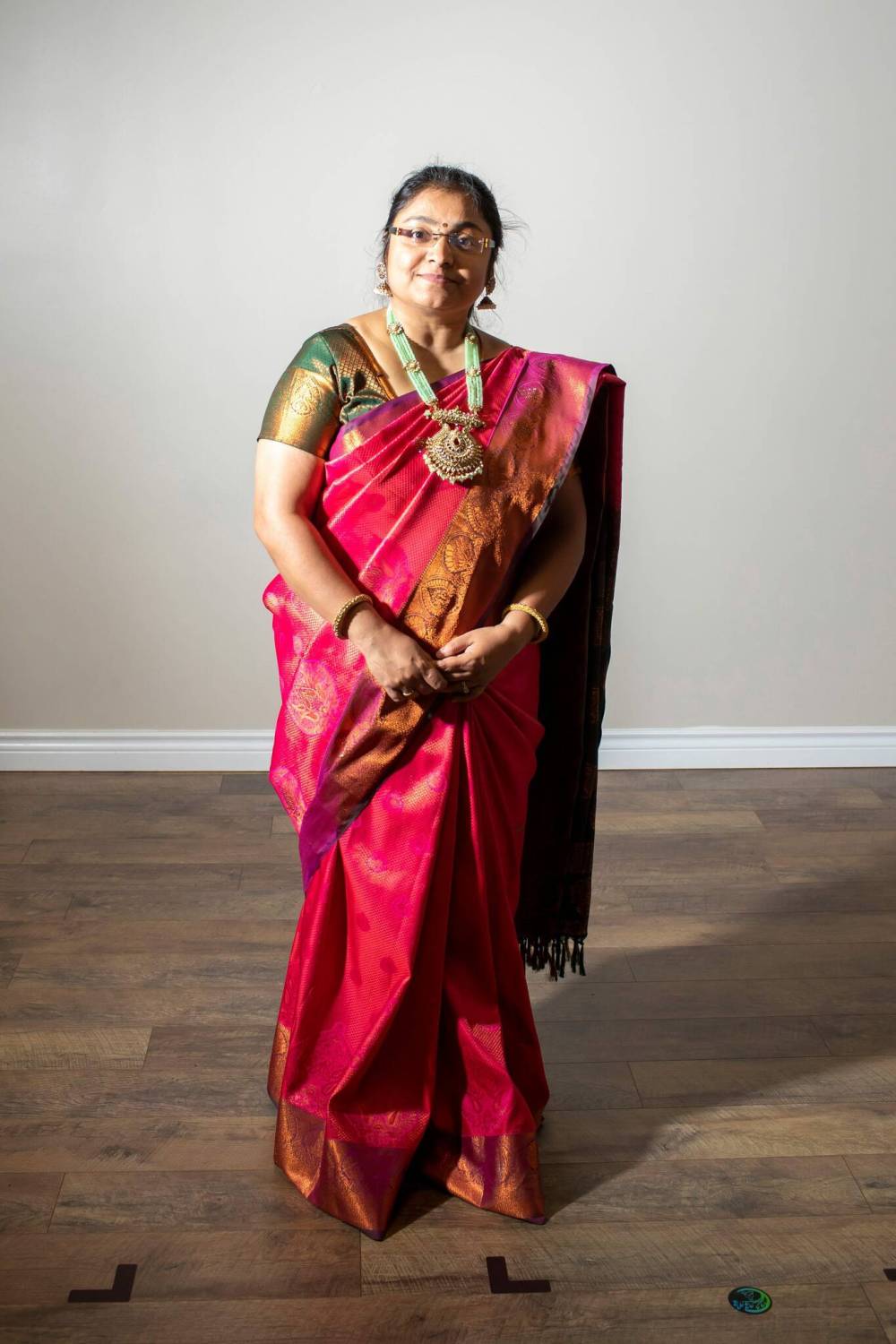
“Only when you have all the three elements will you have the basics of Bharatanatyam,” explains senior dance instructor and school founder Ramprasath. “There are several styles of the dance. I teach a structured dance syllabus based on the Kalakshetra style, which was founded by dancer Rukmini Devi Arundel in 1936. It has some elements of ballet combined with Pandannallur-style Bharatanatyam.”
As the percussive beats of the mridangam, an ancient two-headed cylindrical drum, plays out the rhythmic backbone of the dance, reality fades to the distance and Ramprasath’s students, dancing the stories from ancient religious texts, are transported to a time when Hindu deities walked among mortals.
Manipulating their figures into millennia-old postures, their bodies transform into a lexicon of movement, each intricate hand, head or eye gesture, so emblematic of the dance, communicating a specific sentiment.
Bharatanatyam is the expression of navarasam (emotion) through dance, Ramprasath explains.
Dancers emote through movement, conveying shringara (love), hasya (laughter), karuna (compassion), veera (courage), bhayanaka (fear), bhibatya (disgust), raudra (anger), shantha (peace) and adbuta (amazement).
As she weaves her way among the dancers, Ramprasath makes tweaks and corrections to their araimandi, samam and muzhumandi positions, integral to the dance as a plié, relevé and sauté are to ballet.
BROOK JONES / FREE PRESS Sachini Mapa does a nandi deva dance pose.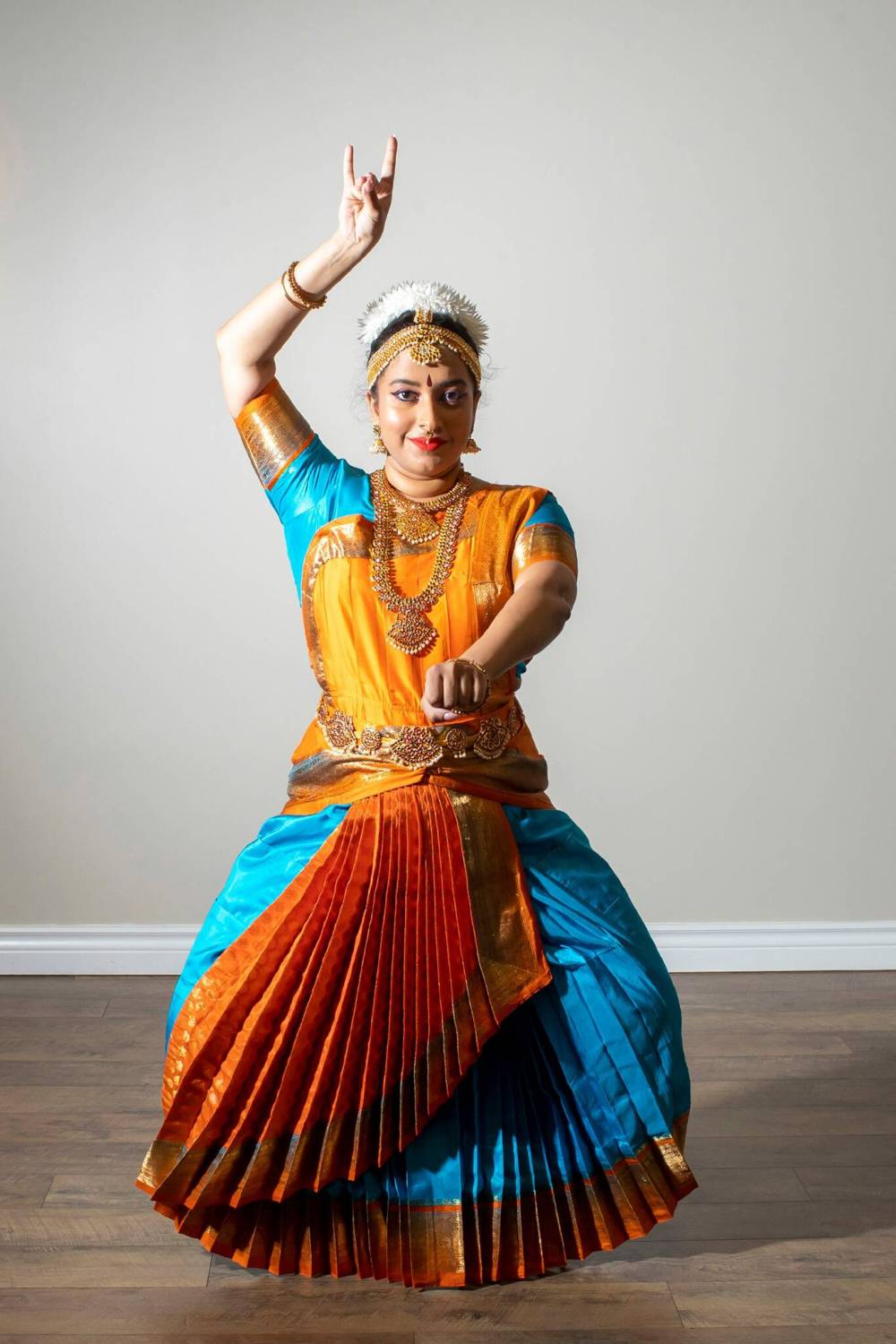
She is busy with preparations for the World Indian Dance Festival being held in Athens next week.
She and four other dancers will perform a new six-minute dance, Devi Stuthi, based on the nature of the Hindu goddess Devi to an international audience made up of Indian classical dance professionals on July 16.
“It’s a new kind of choreography that is going to be really effective and powerful onstage,” Ramprasath says.
But it’s not just stories of yore that are told in this form; new dances are often choreographed to highlight a perspective not yet interpreted, or convey modern narratives.
However, a classical Bharatanatyam dancer is the only person who should choreograph new moves into the existing framework, Ramprasath says.
“There are a lot of fusion dancers we see these days who are trained in other dance forms which are not classical. And when they dance the classical movements, which they bring into the fusion, the dance loses its authenticity,” she says.
There is no fear of her students here losing their links to the dance’s age-old beginnings; Ramprasath is a stickler for tradition.
“The authenticity of the traditional way of dancing Bharatanatyam is fading. We wanted to make sure that all the students, anyone who is interested to learn this, should be given the actual form of instruction as we used to learn from India. Anyone can say ‘I learned Bharatanatyam’ but how authentic, and how clearly you follow that form, is a big question. That was one of the major reasons why I started the school,” she explains.
BROOK JONES / FREE PRESS BRT Dance Academy instructor Shylaja Ramprasath (far left) watches her students. Students at the academy range in age from four to 55. 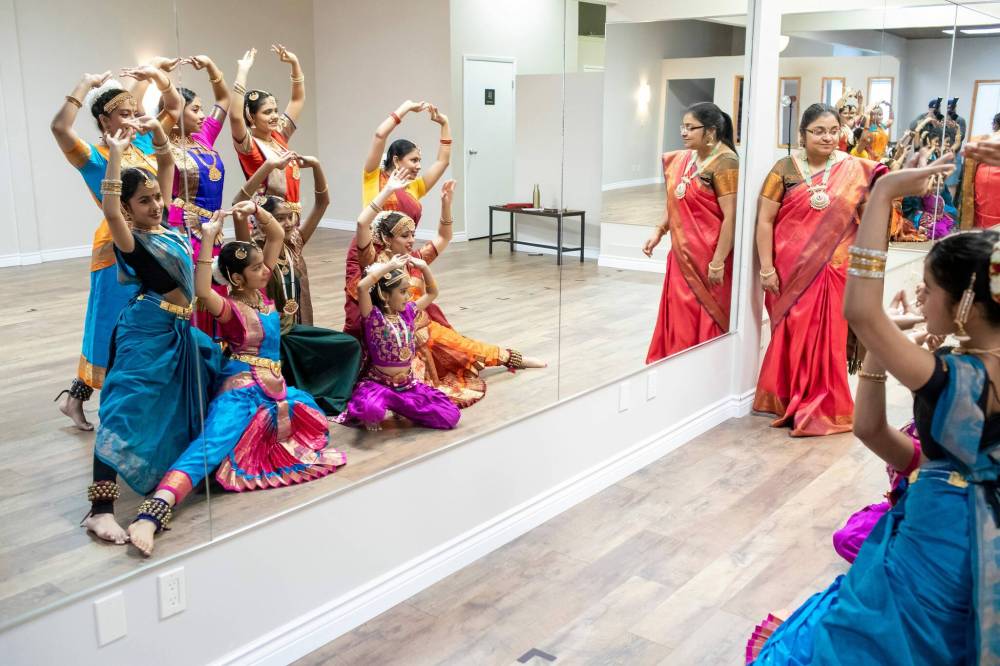
Aided by three other instructors, Ramprasath runs 16 classes a week on Wednesday evenings and Saturday afternoons at the studio on on Markham Road in Fort Richmond.
Her students, who range in age from four to 55, attend classes to perfect the seven dance levels they need to pass before they are deemed ready for the Arengatram or graduation dance, a two-hour continuous performance composed of nine different pieces.
Novice dancers can take up to eight years to complete the levels before graduating as fully fledged classical Bharatanatyam dancers.
While Hinduism is an intrinsic feature of the art form, one does not have to be a believer to learn. Ramprasath’s students come from all walks of life.
Some dancers take classes to remain connected to their Indian or Sri Lankan roots, while others are keen to expand their classical dance repertoire. Then there are some who consider it exercise, fitting in a dance class between weekly gym or pool sessions.
BROOK JONES / FREE PRESS Ragavi Noel does a shiva dance pose.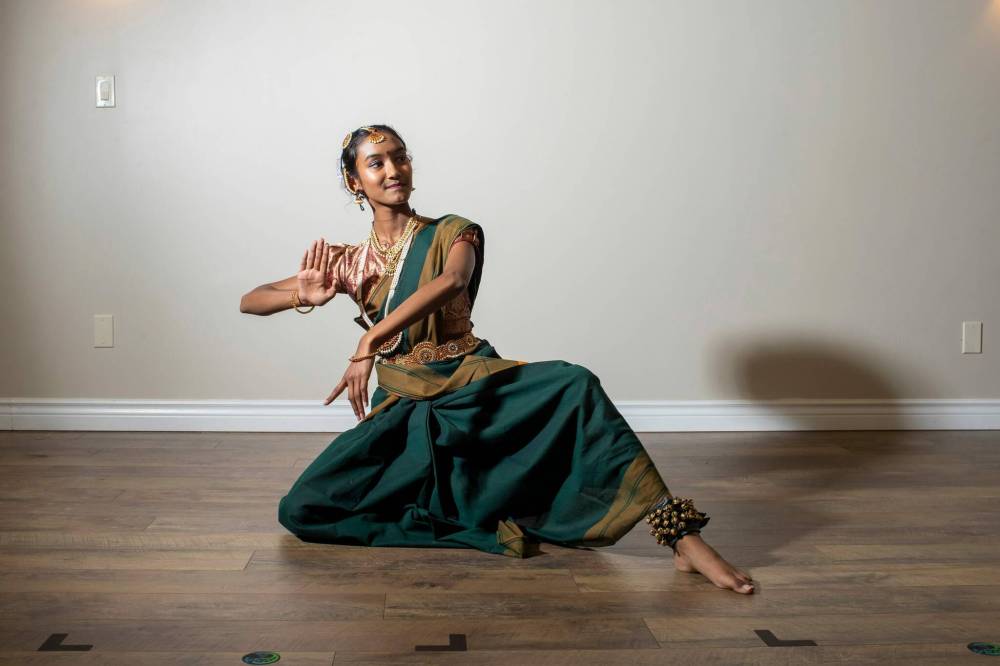
Students who are South Indian immigrants or first-generation Canadians often come from families keen to familiarize their children with South Indian arts.
“The parents think that we are keeping to the culture and they want to make sure their children understand and get exposed to the terms that are used in India or Sri Lanka,” Ramprasath says.
One such student is seven-year-old Aaheli Sarkar, who attends Saturday morning classes. As well as dedicating an hour of her weekends to dance, she also practises daily at home under the watchful eye of her mother, Urbi Biswas Sarkar, herself a trained Bharatanatyam classical dancer.
BROOK JONES / FREE PRESS Seven-year-old Aaheli Sarkar attends Saturday morning classes at BRT Dance Academy. The Fort Richmond studio specializes in the ancient south Indian dance Bharatanatyam.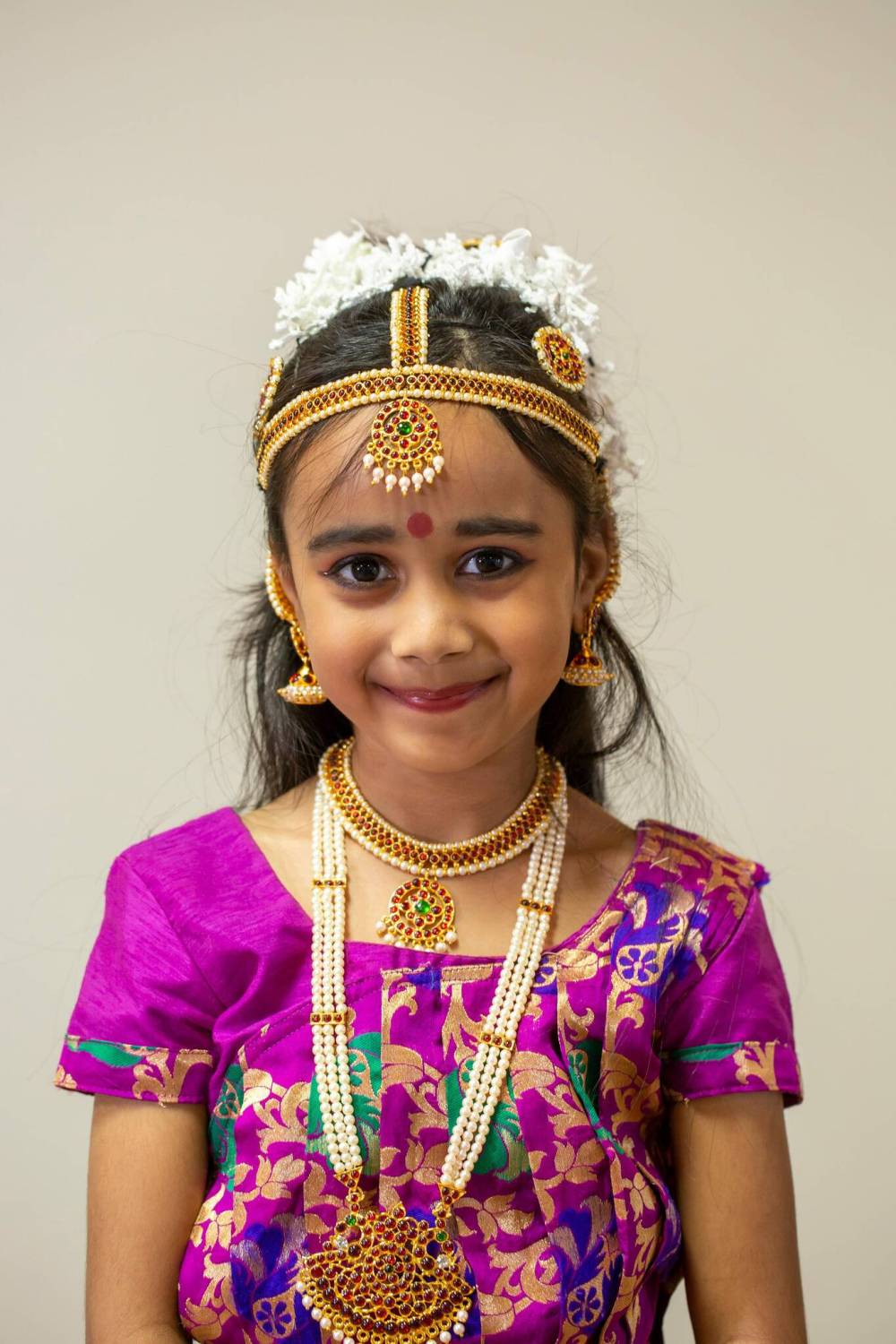
Biswas Sarkar, 43 — who moved to Canada 10 years ago with her childhood-sweetheart husband, Arindam Sarkar, 43 — says learning Bharatanatyam is one way for Aaheli to remain connected to their culture.
“It definitely ties to our culture, to our roots. That is why we thought of getting her involved in dance, and luckily she loved it,” she says.
“When we started her with the dance, it wasn’t difficult at all. She just loved it. It runs in her blood, it runs in the family and it’s part of her upbringing — ‘Mommy does it’ — so she was quick to pick it up,” Arindam Sarkar adds.
BROOK JONES / FREE PRESS Bharatanatyam dancer Manusri Vanu Ramprasath does a shiva dance pose.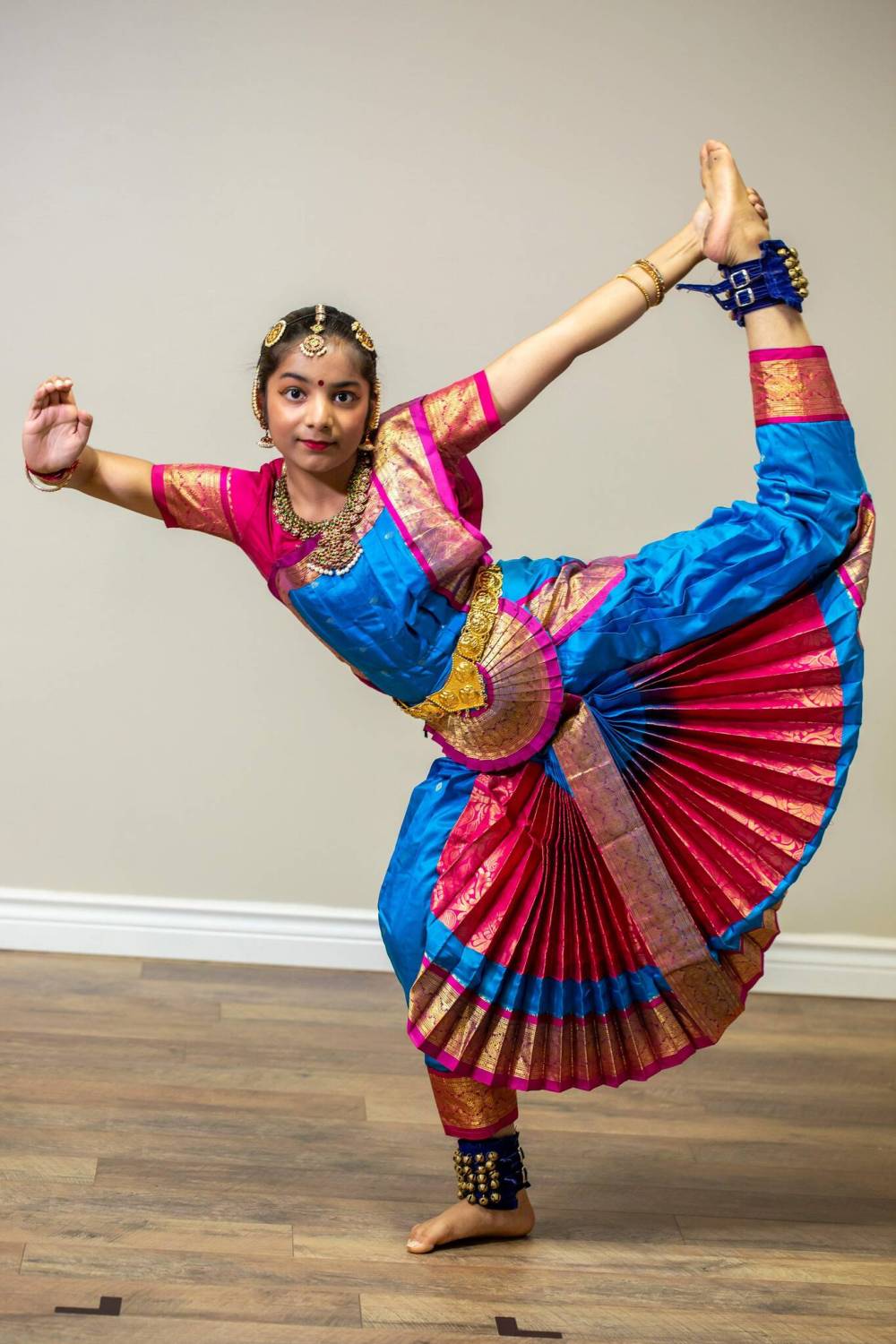
Biswas Sarkar, who started dancing when she was 2 1/2 years old, stopped performing in 2000 when work commitments took over, but Aaheli’s participation in what was once her passion has reignited her spark.
“Practising with my daughter has made me want to get back to dancing. It makes me happy. We plan to continue as long as we can and plan to keep the culture growing within this and the next generation,” Biswas Sarkar says.
Whatever your motivation to dance, Bharatanatyam will affect you on a deeper and more spiritual level, Ramprasath says.
“The dance connects to your soul. There is the emotion from the music, and then Bhavam, the expressions, which are all are intertwined. Eventually, as you continue to dance, you will come to understand how it connects you to your body and your soul.”
av.kitching@freepress.mb.ca

AV Kitching is an arts and life writer at the Free Press. She has been a journalist for more than two decades and has worked across three continents writing about people, travel, food, and fashion. Read more about AV.
Every piece of reporting AV produces is reviewed by an editing team before it is posted online or published in print — part of the Free Press‘s tradition, since 1872, of producing reliable independent journalism. Read more about Free Press’s history and mandate, and learn how our newsroom operates.
Our newsroom depends on a growing audience of readers to power our journalism. If you are not a paid reader, please consider becoming a subscriber.
Our newsroom depends on its audience of readers to power our journalism. Thank you for your support.
History
Updated on Wednesday, July 10, 2024 8:57 AM CDT: Corrects spelling of Harsha Blumer's name in photo cutlines
Updated on Wednesday, July 10, 2024 1:52 PM CDT: Corrects photo cutline